

On October 29, 2025, at the invitation of Ms. Li Xiaoli from the Law Department of Beijing Union University, Mr. Wang Jiaming, a partner of Beijing King&Capital Law Firm, gave a special lecture entitled “Interpretation of China's Criminal Procedure Jurisdictional System from the Perspective of ‘Pelagic Fishing’” to the LLM students. Mr. Wang Jiaming, a partner of Beijing Kyoto Law Firm, gave a lecture entitled “Interpretation of China's Criminal Procedure Jurisdiction System from the Perspective of ‘Offshore Fishing’” to LLM students. Combined with his own rich experience in criminal defense practice, Wang Jiaming deeply analyzed the outstanding problems in the current criminal jurisdiction, and systematically sorted out the jurisdiction system in China's criminal legislation, which brought a feast of legal knowledge with both theoretical depth and practical value to the teachers and students present. The lecture was hosted by Ms. Li Xiaoli and attended by the 25th grade Master of Law (LL.M.) students.
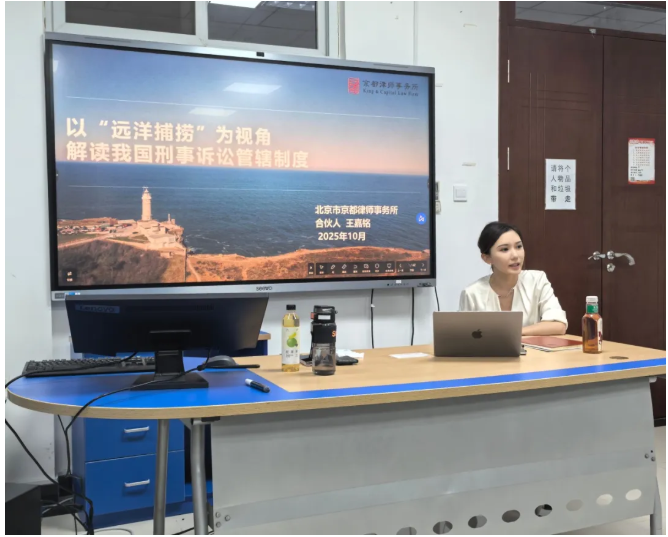
At the beginning of the lecture, Ms. Wang firstly explained the meaning of “offshore fishing” in the legal aspect. She pointed out that “offshore fishing” in the legal field is not a reasonable way of operation in the fishery industry, but a way of forcing some local public security and judicial organs to establish jurisdiction over foreign enterprise-related cases that should not or should not be under their jurisdiction, and even creating artificial jurisdictional links to force suspects to “voluntarily” hand over their assets by means of unlawful searches, seizures, and detention. The act of forcing a suspect to deliver property “voluntarily” in order to obtain illegal benefits. In order to let teachers and students more intuitive understanding, she cited a number of typical cases: the south of a Hong Kong listed company due to the existence of secondary agents to buy back the game coin behavior, was found to constitute the crime of opening a casino, the company's assets of hundreds of millions of dollars were confiscated; the amount involved in a case of only more than 600,000 yuan, even deployed 1,600 police force off-site law enforcement; there is also a "Beijing entrepreneur died during the specified residence in Inner Mongolia, 8 months after the withdrawal of the case. In addition, “Beijing entrepreneur died during the designated residence in Inner Mongolia, 8 months later, the case was withdrawn” and other events that caused widespread social concern, these cases have highlighted the “ocean fishing” on the rights and interests of enterprises and the parties involved in the serious infringement of the legitimate rights.
Subsequently, Wang Jiaming analyzed the deep-seated reasons for the chaos of “distant water fishing”. She said that financial and interest drive is an important factor, part of the region due to financial pressure, in the economic downturn through the tendency to law enforcement “income generation”, the formation of “handling cases to generate income - return the share - expanding jurisdiction” of the closed loop; at the same time, the defects of the jurisdiction system led to jurisdiction At the same time, the defects of the jurisdiction system lead to the generalization of jurisdiction and the abuse of designated jurisdiction, coupled with insufficient legislation and supervision, assessment and conceptual bias and other issues, which jointly gave birth to this chaos. It is noteworthy that “ocean fishing” has attracted great attention from the central government, with the Third Plenary Session of the 20th CPC Central Committee and General Secretary Xi Jinping putting forward requirements for the protection of the legitimate rights and interests of enterprises and the standardization of law enforcement in the forum of private enterprises, and the State Council, the Supreme People's Procuratorate and other departments introducing relevant policies to prohibit unlawful and off-site law enforcement.
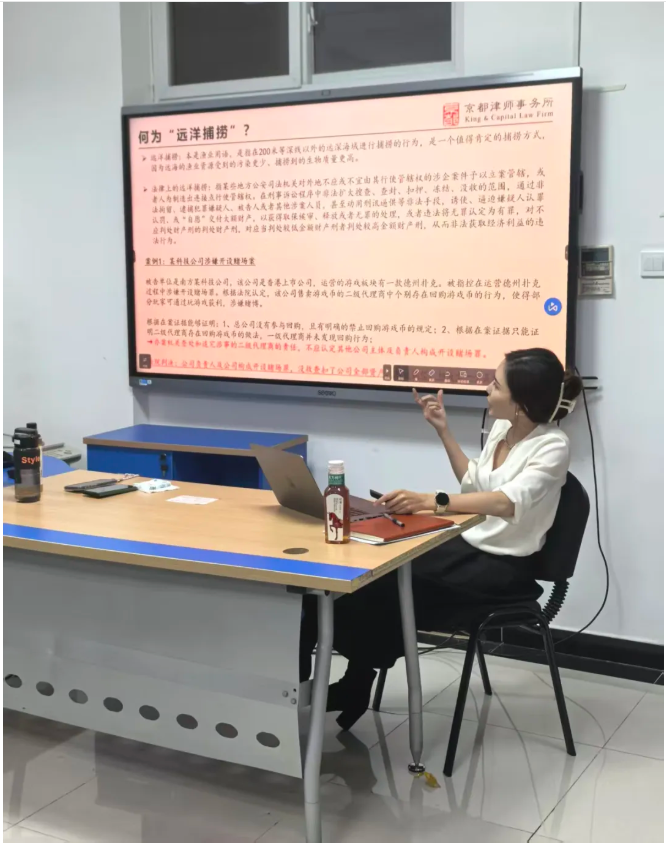
In sorting out the jurisdiction system in China's criminal legislation, Mr. Wang Jiaming explained in detail the difference and connection between criminal jurisdiction and criminal procedure jurisdiction, introduced the specific classification of filing jurisdiction and trial jurisdiction, and reviewed the legislative history of China's jurisdiction system. From the relevant trial provisions in 1962 to the many amendments to the Criminal Procedure Law in 1979, 1996 and 2012, China's jurisdiction system has been continuously improved to meet the needs of social development. At the same time, she also explained the legal basis of China's jurisdiction system - the principle of statutory judge, emphasizing its significance in safeguarding judicial justice. In response to the chaotic phenomenon of “offshore fishing”, Ms. Wang put forward suggestions to improve the jurisdiction system of criminal proceedings, including clarifying the jurisdictional connection points to prevent “control at the edge”, improving the jurisdiction objection system to protect the rights of the parties to relief, strengthening the supervision of law enforcement to curb the tendency to law enforcement, optimizing the allocation of judicial resources to improve the administration of justice, and optimizing the allocation of judicial resources to improve the administration of justice. The lecture also suggested optimizing the allocation of judicial resources to improve the efficiency and quality of justice.
At the end of the lecture, four students from the Department of Law discussed the relationship between the emergence of “distant water fishing” and the social and economic conditions, how enterprises and lawyers deal with “distant water fishing”, and how to take advantage of the pit lawyers and other issues.
This lecture not only strengthened the students' understanding of the jurisdiction system in criminal justice practice, but also broadened their academic horizons, and played a positive role in promoting a deep understanding of the jurisprudential basis and practice of the jurisdiction system. Lawyer Wang Jiaming expressed his hope that through this study, the students will deepen their understanding of the criminal procedure jurisdiction system, establish the correct concept of the rule of law, and contribute to the maintenance of the dignity and authority of the law in the future.