

Liu Lijie, a senior partner at King&Capital Law Firm in Beijing, and Qian Hao, a full-time attorney at the firm, successfully secured a significantly reduced sentence in a major and complex securities crime case, demonstrating effective defense. The case was one of 20 typical cases of capital market violations published by the China Securities Regulatory Commission (CSRC), involving allegations of fraudulent issuance of securities worth nearly 10 billion yuan and improper disclosure of financial data amounting to over 10 billion yuan. Leveraging their professional expertise, the legal team broke through layer by layer to secure a significantly reduced prison sentence for the client. The professional opinions they presented also garnered attention from relevant authorities, achieving the dual value of both individual case defense and the advancement of the rule of law.

I. A Crisis of Billions in Fraud: Early Intervention Sets the Defense Strategy
After the China Securities Regulatory Commission (CSRC) identified the case as a typical example of financial fraud by a bond issuer—finding that the issuer had engaged in systematic financial fraud and disclosed false information—entrepreneur Mr. W sought out Attorney Liu Lijie, a senior partner at King&Capital Law Firm. After an initial assessment, it was determined that the enterprise under W’s actual control had engaged in fraudulent issuance amounting to nearly 10 billion yuan, with over 5 billion yuan remaining unpaid upon maturity. The company had also violated regulations by disclosing material information involving financial data exceeding 10 billion yuan. Facing charges of fraudulent bond issuance and illegal disclosure of material information, the criminal risks were extremely high, and W himself was highly likely to be subject to criminal coercive measures.
In light of the specific circumstances of the case, upon accepting the retainer, Attorney Liu Lijie promptly assembled a specialized legal team alongside full-time attorney Qian Hao. The team comprehensively reviewed the facts of the case and conducted in-depth research on core legal issues to solidify the foundation of the defense. Simultaneously, they accurately assessed the trajectory of criminal risks, formulated response strategies in advance of any coercive measures being imposed, and proactively established statutory grounds for leniency or mitigation of punishment, thereby laying a solid foundation for subsequent trial defense and sentencing negotiations.
II. Confronting Controversies and Overcoming Challenges: Professional Argumentation Shapes the Core of the Defense
Once the case formally entered criminal proceedings, the defense team, while conducting sentencing negotiations based on the favorable circumstances established earlier, focused on the two core legal points of contention in the case. They meticulously analyzed and thoroughly argued these issues, not only presenting compelling defense arguments but also transforming their professional research findings into written articles. By addressing practical challenges in judicial practice with professional depth, they made their defense arguments more persuasive.
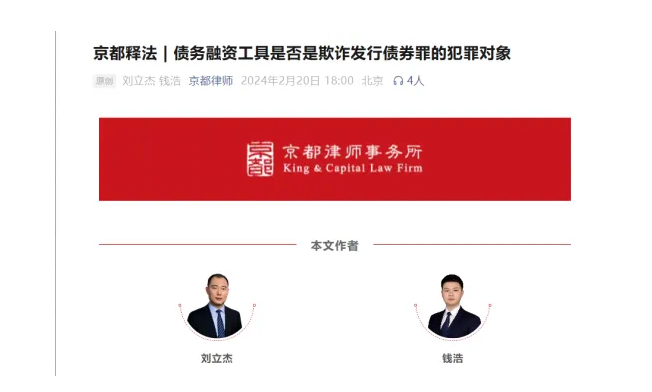
First, whether non-financial corporate debt financing instruments circulating in the interbank bond market constitute the subject matter of the crime of fraudulent issuance of bonds. From the perspective of changes in criminal charges, the crime of fraudulent issuance of securities was previously known as the crime of fraudulent issuance of stocks and bonds. The most significant change between the old and new charges lies in the regulated subject matter of the crime—shifting from stocks and bonds to the broader concept of “securities,” which better aligns with market development patterns. At the time of W’s actions in this case, the offense was still classified as the crime of fraudulent issuance of bonds. The bonds issued by W’s enterprise included both corporate bonds traded on the exchange market and non-financial enterprise debt financing instruments traded on the interbank bond market. The crime of fraudulent issuance of bonds is a typical administrative offense; the existence of administrative illegality and the corresponding administrative legal liability are fundamental prerequisites for criminal illegality. In the field of securities law, non-financial enterprise debt financing instruments traded in the interbank bond market differ significantly from corporate bonds traded on the exchange market. In the realm of criminal law, particularly regarding the offense of fraudulent issuance of bonds, whether both fall within the scope of this offense’s regulatory targets remains a contentious issue requiring further clarification.
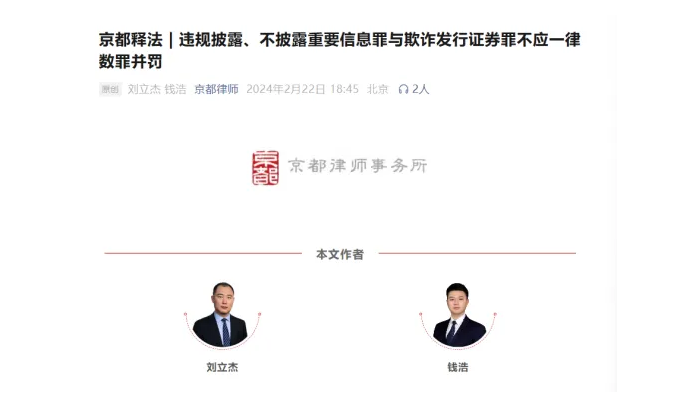
Second, should the offense of unlawful disclosure or failure to disclose material information and the offense of fraudulent issuance of bonds always be punished cumulatively? Considering the overarching legal interests infringed upon, the essential nature of the conduct, and the historical evolution of the offenses in the crimes of unlawful disclosure or non-disclosure of material information and fraudulent issuance of bonds, there exists a specific-general relationship between the two. When there is a factual connection between acts of unlawful disclosure or non-disclosure and acts of fraudulent issuance, and taking into account the theory of expected possibility, there is room for concurrence between the two offenses.
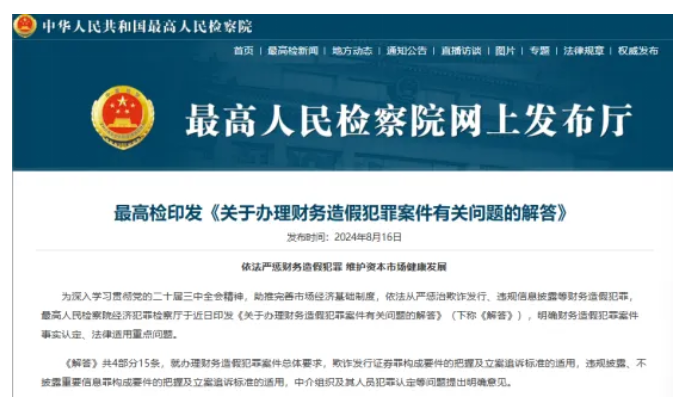
The professional opinions on legal application presented by the legal team not only fostered effective communication between the local prosecuting authorities and the defense team but also drew the attention of the Provincial Procuratorate and even the Supreme People’s Procuratorate. In its issued “Q&A on Issues Concerning the Handling of Financial Fraud Cases,” the Supreme People’s Procuratorate directly addressed the aforementioned points of contention, confirming the accuracy and foresight of the defense team.
III. Tenacious Response to the Prosecution’s Appeal: Three Years of Perseverance Yielded Effective Defense
Given the massive amount involved and the case’s status as a landmark example in the capital markets, the prosecuting authorities and relevant departments attached great importance to it. Even before the first-instance verdict was handed down, multiple court hearings were convened, and the trial process was tortuous and complex. After the first-instance verdict was handed down, although the defense had achieved its expected outcome, the procuratorate filed a prosecution appeal on the grounds that the defendant’s sentence was unduly lenient, presenting new challenges for the defense. Facing the appeal, attorneys Liu Lijie and Qian Hao responded with composure and unwavering resolve. On one hand, they maintained close communication with the client, meeting with Mr. W dozens of times to promptly update him on case developments, address legal concerns, and stabilize his state of mind; on the other hand, they conducted comprehensive case law research, analyzing judicial precedents in similar cases to establish a solid legal foundation for rebutting the prosecution’s appeal; simultaneously, they analyzed and precisely addressed each of the prosecution’s grounds for appeal point by point, formulating a detailed defense brief and engaging in multiple rounds of professional communication with the judicial authorities. After a protracted trial spanning over three years through both the first and second instances, the court ultimately issued a final judgment, finding Mr. W guilty of the crimes of fraudulent issuance of bonds and illegal disclosure of material information. He was sentenced to five years and six months in prison under the principle of concurrent sentencing for multiple offenses. Compared to the initial criminal risks of the case, this resulted in a significantly reduced sentence. The defense team successfully secured a lawful and reasonable judicial outcome for the client, achieving a major and substantive effective defense.

IV. Individual Case Defense Promotes the Rule of Law; Professional Commitment Upholds Judicial Fairness
From early intervention to formulate defense strategies, to directly addressing disputes through professional arguments, and finally to steadfastly opposing the prosecution’s appeal, attorneys Liu Lijie and Qian Hao consistently embodied King&Capital Law Firm’s professional philosophy of “pursuing excellence and living up to the trust placed in us” throughout this case. With solid legal expertise, a rigorous approach to case handling, and unwavering defense efforts, they built a robust line of defense for the client.
The significance of this case extends far beyond securing a lenient sentence for a single client. The professional legal opinions presented by the defense team during the proceedings prompted the Supreme People’s Procuratorate to issue relevant clarifications addressing the legal application of financial fraud crimes. This has provided clear guidance for judicial rulings in similar securities crime cases, achieving the rule-of-law effect of “handling one case, clarifying a category, and advancing the broader legal landscape.”
Links to Related Professional Articles
1. “King&Capital Law Firm Legal Interpretation | Crimes of Improper Disclosure or Failure to Disclose Material Information and Fraudulent Issuance of Securities Should Not Always Be Treated as Cumulative Offenses”
2. “King&Capital Law Firm Legal Interpretation | Are Debt Financing Instruments the Subject Matter of the Crime of Fraudulent Issuance of Bonds?”