

Recently, a criminal case involving a private entrepreneur, represented by Liu Lijie, a senior partner at King&Capital Law Firm in Beijing, and Qian Hao, a full-time attorney, resulted in a significant reversal of the original verdict on appeal. Facing a harsh sentence of 17 years and 6 months in the first instance for four concurrent charges, the legal team, through precise case analysis, professional defense strategies, and relentless legal efforts, successfully had the charge of embezzlement of corporate assets dismissed on appeal, bribery by a non-state employee, and embezzlement of funds, resulting in a significantly reduced sentence. The final verdict was an eight-year prison term, with the amounts of restitution, compensation, and fines also substantially reduced. Through substantive and effective defense, they safeguarded the legitimate rights and interests of the private entrepreneur, demonstrating the power and compassion of professional criminal defense.

I. Seeking Opportunities Amid a Harsh Sentence: Tailoring a Defense Strategy
A single case demonstrates professionalism; a single case builds a reputation. After attorneys Liu Lijie and Qian Hao successfully handled a major securities crime case for local private entrepreneur Mr. W and achieved significant defense results (King&Capital Law Firm | Effective Defense in a 10-Billion-Yuan Securities Crime Case; Attorneys Liu Lijie and Qian Hao Represented a CSRC Model Case to Promote Judicial Improvement), the family of another local private entrepreneur, Mr. F, sought out Attorney Liu Lijie by reputation to request assistance with his appeal. At that time, Mr. F had already been sentenced in the first instance, found guilty of four charges: embezzlement of corporate assets, bribery by a non-state employee, misappropriation of funds, and issuing fraudulent invoices. The case involved tens of millions of yuan. Not only was he sentenced to a severe prison term of seventeen years and six months, but he was also ordered to pay over 20 million yuan in restitution, compensation, and fines, plunging both his personal freedom and his family’s finances into a double crisis.
Before accepting the family’s retainer, attorneys Liu Lijie and Qian Hao immediately conducted a comprehensive and meticulous professional analysis of the first-instance judgment. They precisely identified the flaws in the first-instance ruling regarding factual findings, legal application, and the assessment of criminal charges, confirming that there was room for defense in the appeal. Taking into account the actual financial circumstances of Mr. F’s family, the legal team developed a personalized service plan. Attorney Qian Hao served as the lead counsel, taking full responsibility for specific tasks such as reviewing case files, conducting client meetings, and providing courtroom defense, while Attorney Liu Lijie primarily focused on formulating defense strategies, conducting preliminary meetings, communicating with investigative authorities, and providing case management guidance.
Upon confirmation of the retainer, the legal team immediately initiated case proceedings. On one hand, they comprehensively reviewed the case files, conducting a thorough, in-depth examination of the evidence, the determination of amounts involved, and the elements of the charges; on the other hand, they met with the client, Mr. F, at the earliest opportunity. While verifying the facts of the case and analyzing legal issues, they professionally corrected the client’s misunderstandings regarding the law. Furthermore, with firm professional judgment, they encouraged the client, restoring his confidence and determination in the second-instance defense, and building consensus for the subsequent defense work.
II. Precisely Addressing Difficulties, Multi-Dimensional Defense Targeting the Core
The key to a successful second-instance criminal defense lies in precisely identifying the core issues of the first-instance judgment and directly addressing the critical points regarding the determination of criminal charges and sentencing discretion. Based on a comprehensive review of the case files and multiple meetings with the client, Attorney Qian Hao, integrating criminal law theory with judicial practice, systematically dissected the determination of the four criminal charges in this case. He presented targeted and professional defense arguments for each charge, forming a multidimensional defense strategy that directly addressed the core issues of the first-instance judgment:
1. Embezzlement: Correcting the Criminal Mindset’s Misjudgment of Corporate Operations
The first-instance judgment erroneously applied a criminal mindset to evaluate internal corporate matters. The conduct in question aligned with the original intent of the company’s board resolution; in fact, the shareholders were aware of it and raised no objections. Objectively, this conduct benefited the company’s development and did not constitute embezzlement with the intent of illegal appropriation. The first-instance court’s determination of this charge constitutes a fundamental error regarding the distinction between criminal and non-criminal conduct.
2. Bribery by Non-State Personnel: Clarifying the Boundary Between Lending and Bribery, and Correcting Errors in the Amounts
The parties identified by the first-instance court as the bribe-giver and bribe-taker actually had a genuine lending relationship. Mr. F did not use his official position to seek benefits for others, and the amount of improper benefit attributed to the bribe-giver in the first-instance ruling is lower than the bribe amount, which constitutes a clear factual contradiction. Mr. F’s actions were essentially aimed at revitalizing the company’s business and capital through inter-enterprise cooperation, and he personally made actual capital contributions. This is fundamentally distinct from bribery involving the exchange of power for money. Even if the outward appearance of bribery is acknowledged, the first-instance court’s determination of the amount involved is clearly erroneous.
3. Crime of Misappropriation of Funds: Distinguishing Business Operations from Criminal Offenses
The company operated by F had a commercial practice of lending funds to individuals without collective decision-making. Furthermore, against the backdrop of shareholders exercising excessive control over the company’s management, F’s relevant actions were intended to revitalize the company’s funds and facilitate flexible business operations. These actions actually generated revenue for the company; subjectively, there was no intent to embezzle funds, and objectively, the company’s interests were not harmed. Therefore, the elements of the crime of embezzlement of funds are not met.
4. Crime of Issuing Fraudulent Invoices: Considering the Interrelated Nature of the Charges to Avoid Duplicate Evaluation
Even setting aside the issues with the first-instance court’s determination of the crime of issuing fraudulent invoices itself, there exists a criminal interrelation between the alleged fraudulent invoicing and the embezzlement of corporate assets. According to the rules governing the determination of multiple offenses, the court should evaluate the case based on the more serious offense rather than convicting separately and imposing cumulative penalties. The first-instance judgment thus suffers from the problem of duplicate evaluation.
5. Procedure and Sentencing: Identifying Meritorious Conduct to Remedy Procedural Deficiencies in the First Instance
Procedural violations occurred during the first-instance proceedings. Furthermore, during the second-instance phase, Attorney Qian Hao confirmed through meetings with the defendant that F had reported others’ criminal activities, constituting meritorious conduct.
After formulating a systematic and professional defense strategy, Attorney Qian Hao engaged in efficient and professional communication with the prosecuting authorities, fully articulating the defense’s arguments. The second-instance trial was held in open court. Attorney Qian Hao presented a coherent and logically rigorous defense argument, cross-examining and debating the determination of each charge one by one. With solid factual evidence and precise application of the law, he fully demonstrated to the court the core disputes of the case and the flaws in the first-instance judgment.
III. Post-Trial Efforts to Seek a Turning Point: Effective Defense Ultimately Leads to a Reversal
Following the second-instance hearing, the case’s progress stalled. Attorney Qian Hao maintained close communication with the prosecuting authorities throughout, promptly submitting legal documents—including requests for investigation and evidence collection, new evidence materials, and supplementary defense arguments—addressing key issues in the proceedings. He repeatedly articulated the defense’s key points, making sustained and professional legal efforts to advance the case toward a favorable outcome.
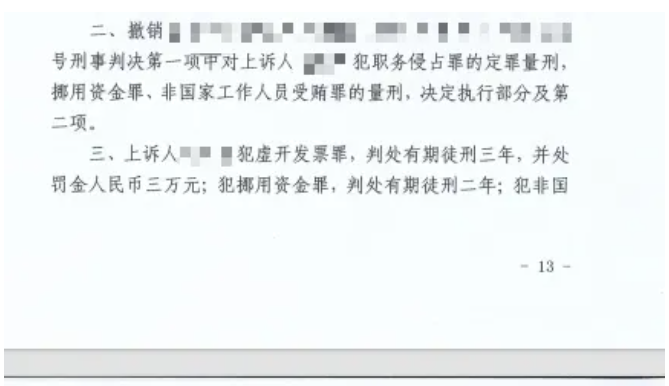
Perseverance paid off. Nearly a year after the second-instance trial began, a pivotal ruling was issued. The appellate court adopted the defense counsel’s arguments and overturned the original verdict: First, it legally determined that F did not commit the crime of embezzlement of corporate assets, thereby eliminating one charge at its root; second, it downgraded the charge of bribery by a non-state employee and significantly reduced the sentence for the crime of misappropriation of funds; Third, alongside the sentencing revision, the court substantially reduced the over 20 million yuan in restitution and compensation, as well as the fine, originally ordered by the first-instance court; ultimately, F was sentenced to eight years’ imprisonment under the principle of concurrent sentencing for multiple offenses. Compared to the first-instance court’s harsh sentence of seventeen years and six months, this resulted in a sentence cut in half, achieving a substantial and groundbreaking defense outcome.
The successful reversal of Mr. F’s sentence not only saved a family in dire straits and safeguarded the legitimate rights and interests of a private entrepreneur, but also demonstrated King&Capital Law Firm’s professional expertise in the field of criminal defense, as well as the firm’s fine tradition of mentorship and talent development.
As a young criminal defense attorney who has grown within King&Capital Law Firm, Attorney Qian Hao took the lead in this case. Through precise case analysis, professional defense strategies, and tireless efforts, he delivered a high-quality defense performance. This achievement stems not only from his own professional expertise and dedication to the case but also from the professional guidance of King&Capital Law Firm’s senior attorneys and the firm’s comprehensive “mentoring and guidance” training system. In 2025, thanks to his solid professional competence and outstanding performance, Attorney Qian Hao was named a “Jingying” Lawyer at King&Capital Law Firm and was awarded the title of “Best Defense Counsel” at the First Beijing Young Lawyers Moot Court Competition.
Moving forward, King&Capital Law Firm will continue to uphold its professional philosophy of “pursuing excellence and living up to the trust placed in us,” carry forward the fine tradition of “mentoring and guiding,” and cultivate more outstanding criminal defense attorneys. Through professional, rigorous, and responsible criminal defense services, the firm will build a strong legal defense for clients, demonstrate judicial fairness and the humanity of the law, and contribute its professional expertise to the development of the criminal justice system.