

Recently, in the case of Mr. L, who was suspected of contract fraud and illegal absorption of public deposits—handled by the legal team led by Attorney Zhou Wenda of King&Capital Law Firm—the procuratorial authorities, after a comprehensive review, decided not to prosecute in accordance with the law. The case went through various stages, including investigation, review for arrest, and review for prosecution. Through a thorough analysis of the facts, the precise collection of key evidence, and the presentation of compelling legal arguments, Attorney Zhou Wenda’s team ultimately succeeded in effectively safeguarding the client’s legitimate rights and interests.
I. Background of Retention: A Professional “Endorsement” from a Cellmate
The establishment of the attorney-client relationship in this case stemmed from a unique “word-of-mouth” recommendation. After Mr. L was approved for arrest, his original defense counsel had failed to make substantial progress. Coincidentally, another detainee in the same cell, Mr. T, was also represented by Attorney Zhou Wenda. Under Attorney Zhou’s professional defense, Mr. T was quickly granted bail pending trial and regained his freedom. After his release, T actively and strongly recommended Attorney Zhou Wenda to L’s family, stating that he had “experienced the professionalism and dedication of King&Capital Law Firm’s attorneys during the defense process.” Following in-depth communication with L’s family and a preliminary assessment of the case, Attorney Zhou Wenda’s team decided to accept the retainer and formally intervene in the defense of this case.
II. Defense Strategy:
Insights from the Change in Charges and Review of the Necessity of Detention
Upon accepting the retainer, Attorney Zhou Wenda immediately met with Mr. L to fully understand the content of his statements during the investigation phase and the prosecuting authorities’ logic behind the charges. Upon a preliminary review of the case files, the legal team keenly observed that while the public security authorities had placed Mr. L under criminal detention on charges of contract fraud, the procuratorate had approved his arrest on charges of illegal absorption of public deposits. This inconsistency in the determination of charges not only reflected a divergence among the investigating authorities regarding the factual characterization of the case but also indicated significant complexity at both the factual and legal levels, thereby clarifying the key focus for subsequent defense efforts.
The defense team immediately launched a comprehensive investigation, frequently visiting L at the detention center to systematically review each key fact of the case, including: the operational model and organizational structure of the company involved; L’s specific job responsibilities within the company; the flow of funds in question; and the nature of his interactions with the victims. After a systematic analysis of the evidence on file, the team formulated a clear defense position: Mr. L’s actions did not constitute the crime of contract fraud nor the crime of illegally absorbing public deposits, and a decision not to prosecute should be made in accordance with the law.
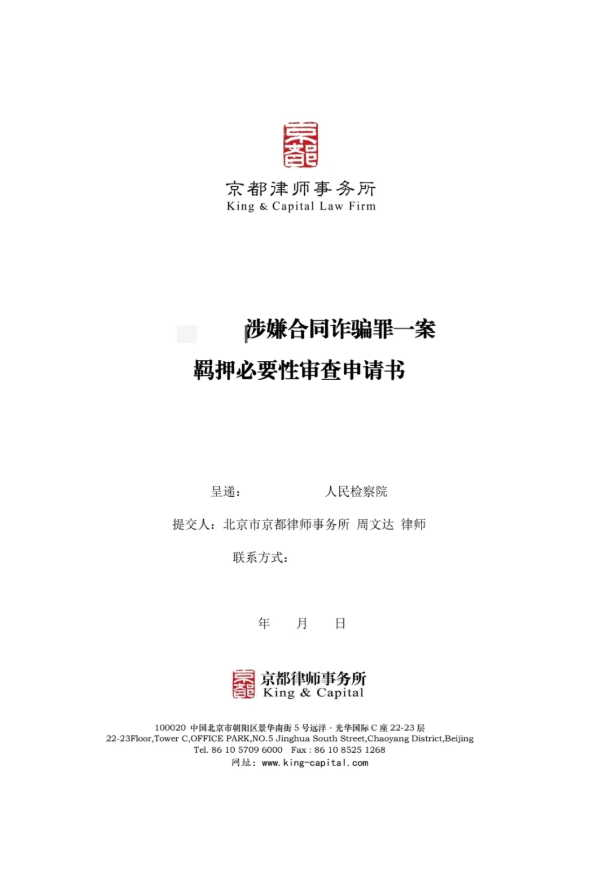
Based on the above arguments, the team promptly drafted an “Application for Review of the Necessity of Detention” and submitted it to the procuratorate. After review, the procuratorate decided within a few days to change Mr. L’s coercive measure to release on bail pending trial. After being detained for several months, Mr. L was able to await trial outside of custody, creating favorable conditions for subsequent defense efforts.
III. Multi-dimensional Defense:
Dismantling the Prosecution’s Chain of Evidence to Secure a Decision Not to Prosecute
To further clarify the facts of the case, the defense team conducted multiple on-site investigations at L’s former workplace to understand the company’s organizational structure, business model, and job responsibilities, and obtained relevant documentary evidence, organizational charts, and business process materials. Simultaneously, the team reviewed the entire case file page by page, identifying significant issues in the case, including:
🔷 Insufficient basis for determining the amount involved
🔷 Inconsistencies in the statements of key witnesses
🔷 Failure to bring certain key individuals into custody
🔷 Key facts of the case remain unclarified
On the legal argumentation front, the team focused closely on the elements of criminal liability under the Criminal Law and put forward the following core arguments:
First, L lacked both the subjective intent and objective conduct required for contract fraud. He did not engage in fabricating facts or concealing the truth to defraud the victim of property; the victim’s mistaken belief was not caused by L’s actions. Furthermore, L had no intent to illegally appropriate the funds in question; he merely received a small commission from his position, which is fundamentally distinct from the intent to illegally appropriate property required for property crimes;
Second, this case did not infringe upon the composite legal interests protected by the crime of contract fraud. The victim can protect their rights through civil and commercial channels and is not in a situation where they have no recourse;
Third, although the public security authorities charged L with the crime of illegally absorbing public deposits, there is no evidence proving that he engaged in the act of absorbing funds from an unspecified public. The charge lacks a factual basis and cannot be established under the law.
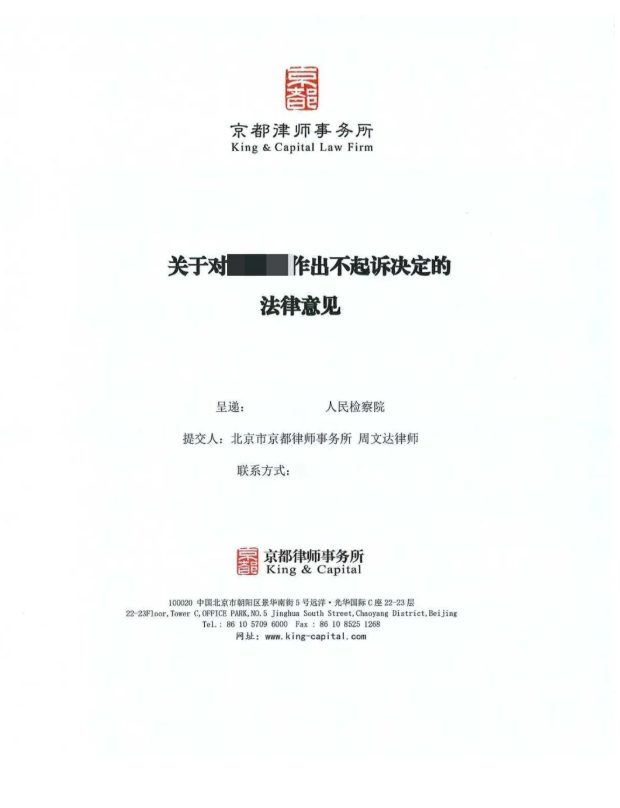
Based on the above, the defense team drafted and submitted a “Legal Opinion on Non-Prosecution,” attaching relevant investigative materials, witness statements, and company policy documents. The team communicated with the prosecuting attorney on multiple occasions to clarify that the case involved “unclear facts and insufficient evidence” and should be handled with a decision of non-prosecution in accordance with the law.
During the investigation and prosecution review phases, the defense attorneys also actively pursued a settlement agreement. After obtaining consent from the investigating authorities, the defense team proactively contacted the victim, Mr. Y, and met with him on multiple occasions to explain Mr. L’s role in the case and the extent of his actual involvement. After multiple rounds of communication with Y, Y finally understood L’s actual role in the case and agreed to issue a written “Statement of Reconciliation” to L upon receiving a small amount of compensation. Obtaining this “Statement of Reconciliation” from the victim Y provided a crucial boost to the effective defense of this case.
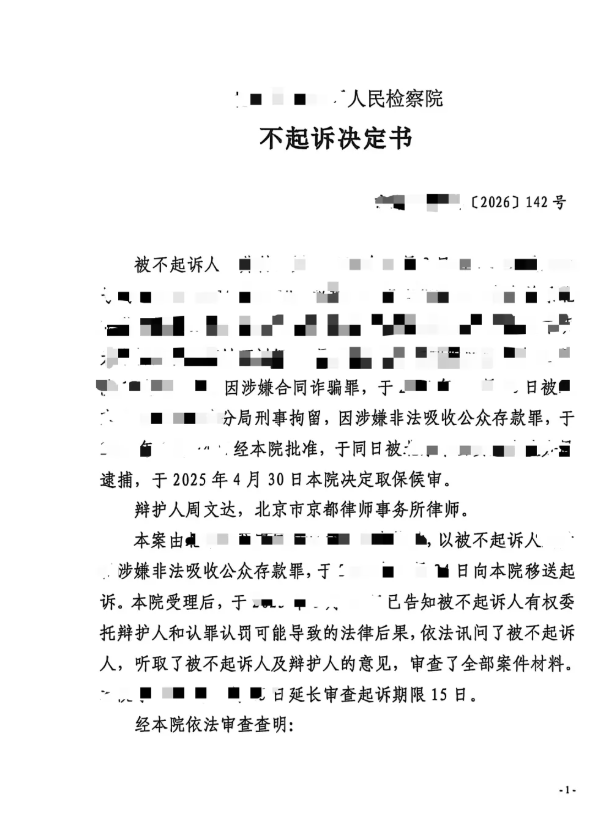
After submitting the “Legal Opinion on Non-Prosecution,” the defense team continued to supplement the case with a large number of similar cases where non-prosecution was granted. They repeatedly presented their defense arguments to the prosecuting attorney regarding the factual findings, legal application, and admissibility of evidence in the case, and successively submitted key evidence such as the victim’s statement of forgiveness, investigative materials from the involved company, and relevant witness testimonies. Finally, in March 2026, the case took a turn for the better, and the procuratorial authorities lawfully decided not to prosecute Mr. L.
Upon learning of the outcome, Mr. L and his family presented Attorney Zhou Wenda with a banner of appreciation, marking the successful conclusion of the defense work in this case.

Conclusion
The defense attorney has always maintained that, within the complex criminal litigation process, professional, prudent, and responsible defense work serves as the foundation for helping clients clarify the facts and secure their lawful rights and interests. For those involved in a case and their families, criminal proceedings are complex and highly specialized; it is crucial not to panic or lose composure. Selecting a professional and dedicated defense attorney to intervene in the case promptly, and using lawful means to clarify the facts, gather evidence, and mount an effective defense, is the fundamental way to safeguard one’s lawful rights and interests.
The proper resolution of this case not only demonstrates the professional value of criminal defense in reconstructing the facts and applying the law, but also reflects the judicial attitude of the procuratorial authorities in reviewing cases in accordance with the law and making prudent decisions. At the same time, the defense team focused on resolving practical issues. In addition to presenting compelling arguments based on the evidence on record and legal provisions, the team’s rational communication with the victim through multiple rounds of discussions from various perspectives also provided significant assistance in the proper resolution of the case. Ultimately, the conflict in this case was successfully resolved, not only restoring the damaged social relationships but also achieving a harmonious balance between legal outcomes and social outcomes.