

Recently, in a case involving the smuggling of general goods handled by the legal team led by Attorney Zhou Wenda of King&Capital Law Firm, the head of the involved entity, Mr. B, faced a criminal sentence of at least three years of imprisonment. Through the team’s effective defense, the case was ultimately classified as a corporate crime, and the amount of evaded taxes was reduced to 950,000 yuan (resulting in a reduced sentencing tier for amounts under 1 million yuan). Ultimately, Mr. B received a suspended sentence.
In this case, the goods in question were primarily valuable musical instruments, numbering over 200 pieces, including high-end wind instruments such as saxophones, trumpets, and flutes. The smuggling methods spanned three modes: smuggling via “water passengers” (individuals carrying goods across the border), underreporting prices, and misdeclaring the nature of trade. During the initial investigation, the estimated evaded tax amount exceeded 1 million yuan. As the actual controller of the company, Mr. B faced a mandatory prison sentence of three years or more under the law.
I. Case Background:
Mr. B Faced a Prison Sentence for Alleged Smuggling of General Goods
Attorney Zhou Wenda’s legal team received an urgent retainer from Mr. B’s family. At the time, Mr. B was under investigation by a customs anti-smuggling branch for the crime of smuggling ordinary goods. The cultural and arts company under his name primarily engaged in the import and sale of high-end wind instruments, as well as art training, and served as a designated partner for several renowned orchestras, enjoying a stable reputation and a foundation of compliant operations within the industry. According to the preliminary findings of the investigative authorities, the facts regarding Mr. B’s alleged smuggling of ordinary goods include:
Smuggling via “water porters”: It was determined that Mr. B conspired with a foreign supplier to smuggle over 300 musical instruments—including saxophones and trumpets—that should have been declared under general trade. These instruments were brought into the country by “water porters” through passenger inspection channels in multiple locations using a “little by little” approach to evade customs supervision;
Smuggling via Undervaluation: During the same period, B smuggled over 50 similar musical instruments from overseas by undervaluing them. Through forged contracts and invoices, B suppressed the declared prices to evade taxes;
Smuggling via Misrepresentation of Trade Nature: Additionally, B conspired with an overseas supplier to misrepresent general trade goods as “small-scale commodity trade with Taiwan,” using multiple ID cards to collect and bring the goods into the country.
When the defense team became involved in this case, the customs preliminary assessment of evaded taxes exceeded 1 million yuan. According to legal provisions, the case was highly likely to be treated as an individual crime. If the amount were determined to be “huge,” Mr. B would face a prison sentence of three years or more, with no possibility of probation. Even if treated as a corporate crime, 1 million yuan marked the threshold for “serious circumstances,” and as the head of the company, he would face a direct increase in sentencing severity.
Before his arrest, Mr. B repeatedly emphasized to his family: “The company has always operated legally. This incident occurred solely because of my own lack of understanding of customs policies, compounded by being misled by the procurement plan proposed by the supplier. If I am sentenced to actual imprisonment, the company will be unable to continue operations, and several employees will face unemployment.” Faced with this complex smuggling case—spanning multiple regions, involving various methods, hovering at the threshold of the “serious” threshold, and featuring disputes over the legal entity—the defense attorney clearly understood the focus of the case and knew that the defense must be built on two key arguments:
First, refute the charge of individual criminal liability, establish corporate criminal liability, and apply the lower sentencing standards for corporate offenses.
Second, precisely calculate the tax arrears to reduce the amount involved to below 1 million yuan, thereby achieving a lower sentencing tier and creating the legal conditions for probation.
II. Thorough Review of Case Files: Finding Breakthroughs in Fragmented Evidence
Once the case reached the review and prosecution stage, the defense attorney immediately completed the review of the case files. The core evidence in smuggling cases consists of customs assessment certificates, electronic data, transaction records, and customs declaration documents—and these four categories of evidence often present opportunities for defense. For example:
(1) Characterization of the Perpetrator: Shifting from “Individual Crime” to “Corporate Crime”
In the early stages of the investigation, the authorities tended to classify B’s actions as an individual offense, reasoning that the smuggling activities—including B’s direct contact with overseas suppliers, payment for goods, and receipt of shipments—were closely linked to personal financial flows.
After reviewing the case files, the defense attorney immediately began a systematic argumentation based on corporate criminal liability, submitting a written defense brief to the procuratorate. The defense centered on four key points:
First, Attribution of Intent: The smuggling activities were conducted to meet the operational needs of a certain cultural and arts company operated by Mr. B. The musical instruments were intended for the company’s sales and training operations, not for Mr. B’s personal profit. Procurement, pricing, and receipt of goods were all carried out in accordance with the company’s operational procedures, reflecting the collective intent of the entity;
Second, Attribution of Benefits: All illicit proceeds were deposited into the company’s accounts and used for daily operations, employee salaries, and venue rentals; they were not embezzled or squandered by Mr. B personally;
Third, Qualified Entity: The cultural and arts company was legally registered and has been in continuous operation, possessing the necessary qualifications for importing and selling musical instruments; it was not established for the purpose of committing a crime;
Fourth, Decision-Making Process: The acts in question were carried out by Mr. B in his capacity as the company’s legal representative and actual controller, constituting the performance of duties by an entity’s responsible person, which aligns with the criteria for determining corporate criminal liability.
More crucially, the defense counsel retrieved and submitted typical corporate compliance cases from the Supreme People’s Procuratorate, as well as local non-prosecution and suspended sentence cases involving similar circumstances, clearly outlining the approach to determining such cases: where a private enterprise commits smuggling due to insufficient compliance awareness or being misled by overseas suppliers, corporate criminal liability should be prioritized, in accordance with the criminal justice policy of minimizing arrests, exercising caution in prosecution, and exercising restraint in detention.

After review, the procuratorial authorities formally adopted the argument for corporate criminal liability, designating a certain cultural and arts company as the defendant entity and identifying Mr. B as the “directly responsible manager.”
The significance of this step lies in the following: According to Article 153 of the Criminal Law and relevant judicial interpretations, when an entity commits the crime of smuggling ordinary goods, if the evaded tax amount is between 200,000 and 1,000,000 yuan, the responsible person faces imprisonment of up to three years or criminal detention, and there is a possibility of probation; if the evaded tax amount exceeds 1,000,000 yuan, the offense is deemed “serious,” resulting in imprisonment of three to ten years, with probation being virtually impossible.
Therefore, the combination of corporate criminal liability and the 1 million yuan threshold constitutes the statutory red line determining whether Mr. B can obtain a suspended sentence.
(2) Tax Amount Reduction: Only by bringing the inflated tax amount back to a reasonable level can there be hope for a suspended sentence
The most difficult “tough nut to crack” in this case is the determination of the evaded tax amount. The initial customs assessment approached 1.1 million yuan. If the court accepted this figure, even if corporate criminal liability were established, Defendant B would still face a prison sentence of three years or more.
Attorney Zhou Wenda’s team conducted a substantive review of the “Customs Assessment Certificate” in strict accordance with legal provisions. They discovered instances of double-counting in the assessed tax amount: there was a slight overlap in the statistics between the goods carried by water porters and the under-declared price portion, resulting in duplicate tax assessments for the same batch of goods. Furthermore, after consulting with customs experts, they discovered that legitimate transactions had been included in the case. A certain cultural and arts company had records of legitimate general trade imports, which customs had failed to exclude and had instead included in the total smuggling amount.
The defense attorneys submitted a detailed legal opinion to the procuratorate, explicitly stating that the original assessment certificate was procedurally flawed and factually incorrect, and therefore could not serve as the basis for a conviction. Ultimately, customs recalculated the figures, reducing the amount by nearly 150,000 yuan, setting the final evaded tax amount at just over 948,000 yuan (approximately 950,000 yuan), which falls within the reduced sentencing bracket for amounts under 1 million yuan.
This change in the figure means that Mr. B’s statutory sentence can be reduced from over three years to under three years, and he has a chance to receive a suspended sentence.
III. Communication with the Prosecution: Exchanging Professional Advice for Sentencing Recommendations
The review and prosecution stage is typically when the sentencing outcome for smuggling cases is finalized. Rather than passively waiting, the defense attorney proactively established a comprehensive leniency framework comprising a plea of guilty and acceptance of punishment, full repayment of taxes, compliance rectification, and support from comparable cases. The attorney also traveled to the case handling location multiple times to communicate face-to-face with the prosecuting attorney. The communication primarily covered:

First, the involved company fully refunded the taxes, thereby restoring the legal interest. The defense attorney guided Mr. B and a certain cultural and arts company to fully refund all evaded taxes totaling over 940,000 yuan. This refund was completed during the review and prosecution stage, and payment receipts were submitted to the procuratorial authorities, fully demonstrating a sincere attitude of repentance.
Second, the defense counsel initiated corporate compliance reforms in accordance with the Supreme People’s Procuratorate’s guidelines on corporate compliance. The counsel guided the cultural and arts company to establish an import business compliance committee and create a dedicated compliance position; improve internal controls across the entire procurement, customs clearance, and financial processes; conduct specialized training on customs laws; and pledge never to repeat the offense. The company also submitted a business operations report demonstrating that it continues to fulfill its public service functions in providing music training to multiple schools, and that the case has not affected its normal operations.
Additionally, the defense counsel submitted opinions on similar cases and non-prosecution decisions. Two relevant cases were provided for the investigating authorities’ reference:
1. A typical case from the Supreme People’s Procuratorate’s second batch of corporate compliance cases (the Shenzhen X Company case involving the smuggling of general goods): With evaded taxes totaling 3.97 million yuan, the company received a non-prosecution decision following its corrective measures;
2. A publicly reviewed non-prosecution case by the municipal procuratorate (the smuggling case of a certain company in Ningbo): The amount of evaded taxes was 4.86 million yuan; after the responsible party pleaded guilty and accepted punishment, and was classified as an accessory, the case was not prosecuted.
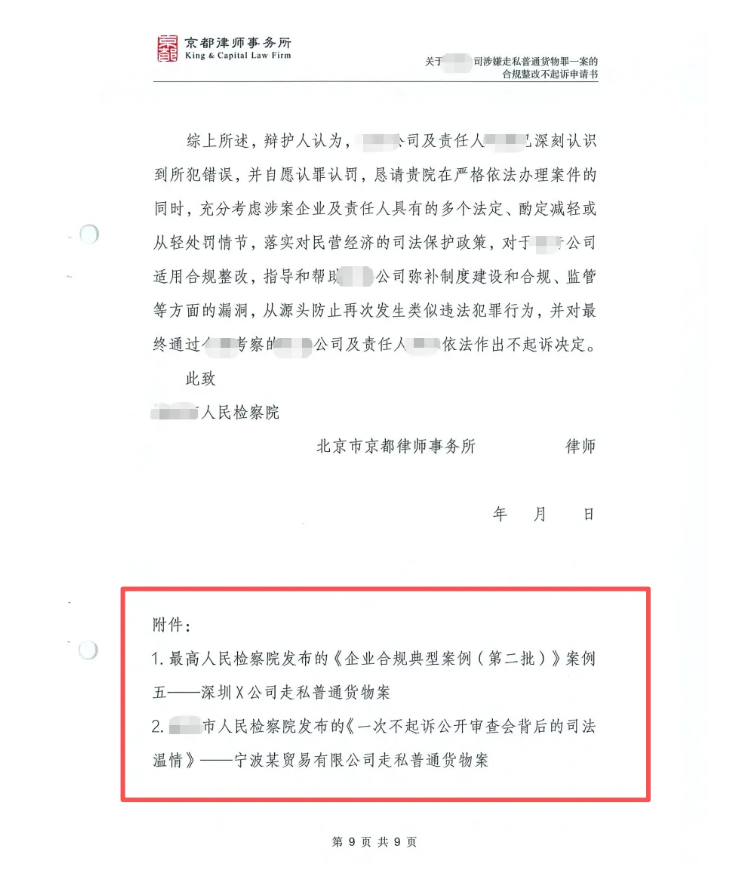
The defense attorney explicitly argued: The amount of evaded taxes in this case is less than 1 million yuan, far lower than the amounts in the aforementioned cases. Given that this is a corporate crime, the full amount has been repaid, it is a first-time and isolated offense, and the defendant has confessed and accepted punishment, the case fully meets the conditions for probation.
After a comprehensive review, the procuratorate ultimately issued the following sentencing recommendations: a fine of 950,000 RMB for the defendant entity, a certain cultural and arts company; and a prison term of one year and ten months for defendant B, suspended for two years. This outcome fully realized the defense objectives set for B following his involvement in the case.
IV. The Verdict: Probation Officially Granted
During the trial, the defense attorney continued to emphasize the defense arguments: This case involves corporate criminal liability, with Defendant B bearing responsibility as the directly responsible manager, rather than as an individual offender; the amount of tax evaded was reduced to less than 950,000 RMB, resulting in a statutory sentence of less than three years, which provides a basis for probation; Defendant B possesses statutory and discretionary mitigating factors, including full confession, admission of guilt and acceptance of punishment, and full repayment of taxes; The company had completed its compliance rectification efforts, and granting Mr. B a suspended sentence would not have a significant adverse impact on the community, aligning with the policy of balancing leniency and strictness.
After deliberation, the court accepted all sentencing recommendations and issued the first-instance judgment: The defendant company was found guilty of smuggling ordinary goods and sentenced to a fine. Defendant Mr. B was sentenced to a suspended sentence.
The moment they received the judgment, Mr. B and his family felt a great weight lifted from their shoulders and did not appeal.
Case Review
Upon concluding this case, the defense attorney gained a clearer understanding of the defense logic for the crime of smuggling ordinary goods. A key aspect of defense work in smuggling cases lies in the formulation of defense strategies; it is essential to accurately determine whether to pursue a not-guilty defense or a defense seeking a lighter sentence.
Once a defense seeking a lighter sentence is adopted, determining the legal characterization of the entity—specifically, establishing that the corporate entity is the perpetrator—is a critical component of defense in smuggling cases. In judicial practice, there is a significant disparity in sentencing between corporate and individual offenses: for individual offenses, tax evasion of 100,000 yuan constitutes a crime, 500,000 yuan is considered “substantial,” and 2.5 million yuan is “particularly substantial”; for corporate offenses, tax evasion of 200,000 yuan constitutes a crime, 1 million yuan is “serious,” and 5 million yuan is “particularly serious.” Whenever a company operates legally, profits accrue to the entity, and decisions reflect collective will, the defense must resolutely seek a determination of corporate criminal liability.
Reducing the tax amount is also a technical challenge. The core of such cases lies in the numerical figures, and the customs assessment certificate is not “conclusive evidence.” Defense attorneys should be bold enough to challenge the tax assessment conclusions on substantive grounds. Even if the attorney lacks expertise in this specialized field, they should consult authoritative professionals in the area for support. Securing an opportunity to reduce the tax amount is crucial for achieving a lower sentencing tier.
In terms of meticulous defense strategy, there are no “last-minute” victories in smuggling cases. Every step is critical—from guiding bail applications during the investigation phase, to cross-examining tax assessments during the review and prosecution stage, to finalizing arguments during the trial. The fact that Client B avoided actual imprisonment in this case is precisely because of the proactive efforts and precise defense strategies implemented at every critical juncture.
Finally, the defense team extends its gratitude to Client B for his trust, and to the responsible judicial officials for their correct assessment of the case, which made it possible to achieve a harmonious balance between legal outcomes and social impact.
Translated with DeepL.com (free version)