

Introduction
In the realm of securities-related criminal offenses, the rate of non-prosecution for insider trading has consistently remained below 1%, making it an extremely rare and difficult-to-achieve defense outcome. Such cases are inherently characterized by strict regulatory oversight, mandatory administrative investigations, and the presumption of subjective intent based on objective conduct. In judicial practice, there is a strong tendency toward conviction, and the vast majority of cases ultimately result in prison sentences.
The transaction amount involved in this case reached tens of millions of yuan, far exceeding the sentencing threshold for “particularly serious circumstances” under the insider trading offense. A conviction would almost certainly result in a prison sentence of five years or more. From the outset of the defense, we made a precise assessment: not only must we strive for an acquittal, but even if that proves unfeasible, we must employ professional defense strategies to secure a reduced sentencing tier, thereby securing leniency or even probation for the client.
The client had initially fallen for a relationship scam and unilaterally demanded a refund and contract termination, thereby missing the golden opportunity to secure a suspended sentence by turning himself in. The case had reached a dead end. Attorneys Liu Lijie and Qian Hao broke away from traditional acquittal defense approaches and pioneered a novel interpretation of the “poison pill plan” defense strategy in the major investment sector—a “fight fire with fire” defense strategy: We proactively presented another set of suspected insider information (such as dividend distributions and rights issues) obtained by the client during a dinner gathering. Although this information was supported by fragmented and indirect evidence, the evidence was insufficient, and the investigative authorities had not conducted a substantive review, making the risk of conviction extremely low; We used this “controllable, mild poison” to offset, dilute, and dismantle the prosecution’s ironclad allegations of the serious crime of insider trading involving a private placement, thereby constructing an entirely new narrative framework. Simultaneously, the team preemptively laid the groundwork for a dual-pronged strategy involving evidence of meritorious conduct as a safety net, balancing an aggressive not-guilty defense with a prudent sentencing contingency. By analyzing positive and negative market signals, dissecting trading patterns, and examining the investment logic in industry research reports, we created reasonable doubt in the evidentiary battle, ultimately securing a decision not to prosecute.
This article fully reconstructs the details of the legal battle, team collaboration, core defense techniques, and the underlying logic of the “poison pill” cross-examination strategy, authentically presenting the entire process by which securities criminal defense attorneys assessed the situation and broke through adversity against the odds.
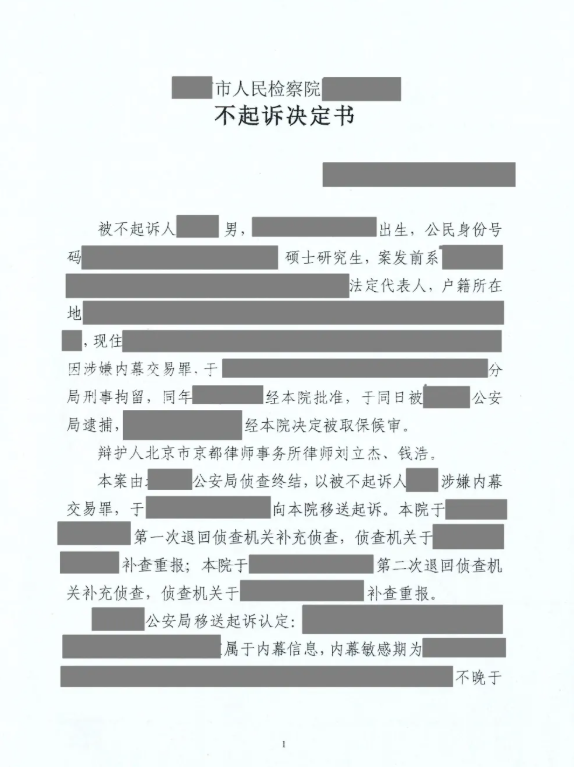
Swipe left or right to view images
I. Initial Consultation: The Client Felt Wronged, Confessions Were Questionable, and Criminal Risks Were Imminent
When the client arrived for a consultation accompanied by a relative, he was already deeply entangled in the vortex of criminal risks related to insider trading in a listed company’s private placement. The transaction amount involved reached tens of millions of yuan; if found guilty of insider trading, he would face a sentence of five years or more in prison under the law, with extremely severe criminal consequences. Faced with a series of factual and evidentiary discrepancies raised by the attorney, the client adopted a peculiar stance: he insisted on his innocence but was unable to provide a satisfactory explanation for his objective contact with senior executives or his trading activities during sensitive periods; while deeply fearful of criminal prosecution, he was unwilling to directly plead guilty and accept punishment.
After multiple rounds of in-depth communication and careful deliberation, the client consistently refused to express any intention to plead guilty, repeatedly emphasizing his innocence. Following a thorough risk assessment, an explanation of the pros and cons of self-surrender, and a clarification of the scope for defense, the client signed a retainer agreement with Attorney Liu Lijie, paid the legal fees, and entrusted him with legal consultation, assistance in planning a strategy for self-surrender to secure a suspended sentence, handling investigative questioning, and full-scale criminal defense throughout the proceedings. Both parties agreed that the client would voluntarily surrender after resolving family and work matters, seeking to qualify for the statutory leniency provisions for self-surrender to secure a reduced sentence and the possibility of a suspended sentence. At the same time, the attorney would not abandon the strategy of arguing for acquittal, thoroughly exploring the possibility of a not-guilty verdict and developing feasible defense strategies.
However, unforeseen complications arose one after another: the client was preoccupied with family concerns and had a large volume of business matters requiring urgent resolution. Compounded by the impact of the COVID-19 pandemic, the client experienced prolonged internal conflict and indecision, delaying the surrender. During this period, the client naively trusted the promises of a so-called “middleman,” subjectively believing that the case had been resolved through personal connections and could be dismissed or swept under the rug. The client subsequently contacted Attorney Liu Lijie to inform him that the case had been “settled,” requesting the termination of the retainer and a refund of the legal fees. Attorney Liu Lijie repeatedly warned him not to place blind faith in personal connections and that the risks had not been eliminated, but the client remained firmly convinced of the so-called “connections at work.” Upholding professional integrity, Attorney Liu Lijie refunded the majority of the legal fees to the client in accordance with regulations, and the attorney-client relationship was amicably terminated. The case was subsequently put on hold, setting the stage for significant risks down the line.
II. A Single Misstep: Deceived by Belief in Connections, Losing Millions; Arrested Suddenly a Year Later, Missing the Golden Window of Opportunity and Passively Plunging into a Desperate Situation
Nearly a year after the refund and termination of the retainer agreement, the client’s relatives made an urgent call with devastating news: the client had been arrested at home by public security authorities on suspicion of insider trading. The family was completely caught off guard. Previously, they had naively trusted a so-called “well-connected intermediary” who falsely claimed to have access to high-ranking officials in the police and the China Securities Regulatory Commission (CSRC), promising to privately dismiss the case and sweep it under the rug. Desperate for a solution, the client paid millions of yuan in bribes, remaining passive throughout the process—neither turning himself in nor following the lawyer’s earlier guidance to secure evidence or organize the transaction records.
The scam was eventually exposed, and millions of hard-earned yuan were lost. The individual was subsequently placed under criminal detention and then formally arrested. In their panic, the family urgently sought help once again, but by this point, the case had completely deteriorated: they had lost the key mitigating factor of voluntary surrender, the window for securing evidence had closed, and the prosecution had already established a complete chain of evidence surrounding the private placement information; compounded by the transaction amounts involving tens of millions of yuan, a sentence of five years or more had become virtually a foregone conclusion, and conventional paths to a not-guilty defense were virtually blocked.
Given existing judicial precedents and the reality of the client’s arrest and imminent entry into the prosecution review phase, the probability of success was extremely low if the defense focused solely on a “not-guilty” argument regarding the “insider trading in private placements.” To achieve a non-prosecution outcome—a probability of less than 1%—it is essential to adopt a disruptive, unconventional defense strategy while preparing a comprehensive contingency plan. This involves trading controllable risks for a breakthrough in the overall case: striving for an acquittal while simultaneously planning for alternative strategies such as reduced sentencing or seeking probation.
III. In-Depth Consultations: Identifying Two Sets of Contradictory Information, Collaborative Team Analysis, Simultaneously Laying the Groundwork for a “Meritorious Conduct” Safety Net, and Developing the Prototype of a “Fight Fire with Fire” Defense Strategy


The legal team met with the client over 40 times
The legal team led by Liu Lijie and Qian Hao immediately initiated multiple rounds of in-depth meetings. Following detention, through patient psychological counseling and professional legal communication, the client let down their guard, fully recounted the transaction details and the full scope of information obtained, and simultaneously provided multiple leads regarding meritorious conduct and potential accusations, bringing to light several key facts in the case.
The first set of information, which the prosecution firmly alleged as a serious offense: insider information regarding a listed company’s private placement. During the sensitive period of the private placement, the client had normal interactions with executives of the listed company at business dinners, while simultaneously engaging in stock accumulation and continuous purchases during that period. Based on this, the prosecution inferred that the client had used insider information regarding the private placement for trading, constituting the crime of insider trading. Combined with the tens of millions of yuan involved in the case, the prosecution’s logic was compelling, the pressure for sentencing was immense, and mounting a defense against this charge alone was extremely difficult.
Second set: Controllable “toxic information” we proactively introduced: uncertain, suspected insider information regarding dividends and rights issues. The defendant stated that during the dinner discussions, the listed company’s executive had casually mentioned year-end dividends and a possible rights issue. Some of this content was indirectly corroborated by electronic data and, in theory, could constitute insider information; However, the key point is that this information is vague and uncertain. The investigative authorities did not specifically verify or thoroughly investigate it, leaving the chain of evidence incomplete. Judging by the standard of proof, even if we proactively disclose it, the probability of a separate conviction is extremely low, and the risk is entirely manageable.
At the same time, the party’s overall explanation of the stock transactions is reasonable: the purchase of the listed company’s shares was, on the one hand, based on in-depth industry research and extensive industry reports, reflecting a positive outlook on the company’s long-term prospects—constituting normal value investing; on the other hand, the fragmented information regarding dividends and rights issues obtained during the dinner gathering also had a certain influence on the trading decisions; The timing of their trades, the proportion of holdings, and the allocation of funds fully align with their consistent personal trading habits, and there are no typical characteristics of insider trading, such as sudden position-building or abnormal trading; the content of the discussions at the dinner gatherings was a mix of industry trends, positive and negative fundamental information regarding the company’s operations, and the boundaries of the information were blurred.
Team’s Coordinated Strategy: Dual-Layer Securing of Meritorious Conduct Clues, Establishing a Dual Safety Net for Acquittal and Sentencing
Given the extremely high risks inherent in a not-guilty defense, the massive amount involved in the case, and the heavy pressure regarding sentencing, the legal team of Liu Lijie and Qian Hao, upholding a prudent and responsible professional attitude, established a dual-safety-net strategy in advance. They simultaneously worked to secure evidence of meritorious conduct and file criminal complaints, thereby paving the way for a not-guilty defense while reserving room for a reduced sentence:
First, disputed but potentially admissible evidence of meritorious conduct: As the victim, the client was defrauded of several million yuan by an intermediary. Under the lawyers’ guidance, the client made a formal report through the detention center’s correctional officers, assisting public security authorities in recovering a portion of the stolen funds. Although there is some legal controversy regarding the application of the law, the team’s analysis indicates a possibility that this evidence could be accepted by judicial authorities.
Second, uncontroversial leads for meritorious conduct: The client reported clues regarding the illegal activities of relevant individuals. These clues were clear and specific; once verified, they could be directly recognized as meritorious conduct.
Third, specialized submission of complaint materials by the attorney: Based on all the above leads, the attorney compiles them into standardized criminal complaint and whistleblowing materials, formally submits them to the relevant investigative authorities, and completes the written process.
Even if the aggressive “fight fire with fire” strategy to seek acquittal is blocked, the client can still rely on the meritorious conduct to achieve a lighter or reduced sentence, thereby securing a lower sentencing tier and maximizing the protection of the client’s rights.
In conventional defense strategies, lawyers often strive to completely disassociate the client from any suspected insider information, attempting to overturn the prosecution’s charges entirely. However, in securities cases, objective contact cannot be avoided; merely denying knowledge of private placement information is easily dismissed by judges and prosecutors as sophistry.
Given the extremely low probability of non-prosecution in this case, the tens of millions of yuan involved, and the highly disadvantageous position, our team, after repeated simulations, pioneered a “poison pill plan” for securities criminal defense—a “fight fire with fire” cross-examination strategy:
Rather than avoiding it, we proactively presented this set of suspected insider information regarding dividends and rights issues—which was insufficiently substantiated and had an extremely low probability of conviction—and acknowledged that the client had obtained such fragmented information; Using this controllable “mild poison” to offset and dismantle the prosecution’s “serious crime” charge of insider trading involving private placements; leveraging the possibility of coexisting information sources to disrupt the prosecution’s singular narrative of guilt. Even if the “mild poison” carries theoretical risks, the high probability of conviction being precluded due to evidentiary flaws ultimately achieves an overall acquittal—with both the “serious crime” and the “minor offense” charges dismissed.
Simultaneously, the team meticulously dissected the impact of both positive and negative information on trading decisions: the client’s decision to buy was influenced by a mix of publicly available industry information, routine business communications, and fragmented, suspected insider information. This made it impossible to definitively attribute the decision solely to private placement insider information, thereby severing the causal chain of insider trading at its root.
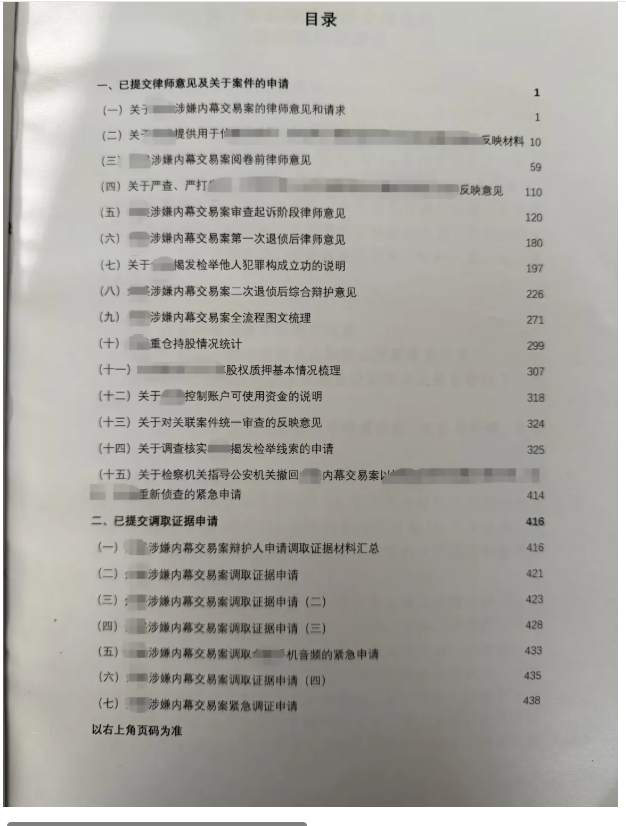
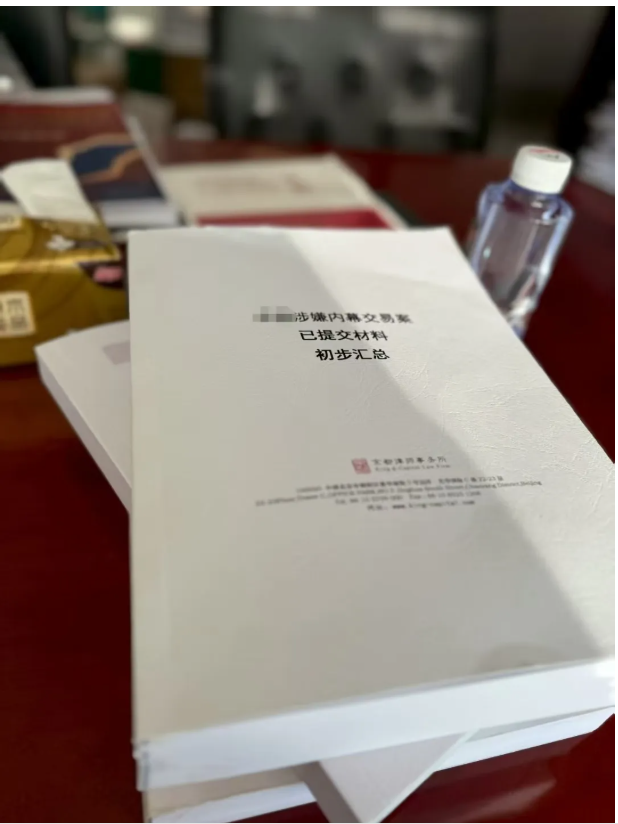
Swipe left or right to view images
Materials submitted by the legal team to the prosecuting authorities
IV. Breaking the Deadlock: The team collaborated to tackle the challenge head-on, using the prosecution’s own arguments against them to construct a new narrative framework, systematically dismantling the prosecution’s closed-loop evidence chain, and creating a reasonable doubt beyond a reasonable doubt
Upon entering the review and prosecution phase, attorneys Liu Lijie and Qian Hao thoroughly reviewed the case files, meticulously combing through the evidence page by page to precisely dismantle the prosecution’s logic: The prosecution relied solely on two objective facts—“contact with an insider during the sensitive period of the private placement” and “trading during the sensitive period”—to directly infer subjective knowledge of private placement insider information and the commission of insider trading. This approach essentially amounted to a presumption of guilt, and the chain of evidence lacked exclusivity.
The team abandoned the traditional defense model of blanket denial and implemented a comprehensive “fight fire with fire” defense strategy, building a new factual narrative in three core layers:
First Layer: Proactively introducing “manageable minor issues” to counter the prosecution’s serious charges regarding the private placement
In the defense, the team no longer evaded the objective facts of the client’s contact with executives and trading during sensitive periods. Instead, they proactively disclosed and documented the client’s acquisition of fragmented, suspected insider information—such as dividend distributions and rights offerings—while simultaneously submitting relevant electronic evidence, including WeChat messages and text messages.
The team explicitly argued that the client’s trading decisions in this case could have stemmed from two parallel sources of information: First, the private placement insider information alleged by the prosecution (potentially a serious offense); Second, fragmented, suspected insider information regarding dividends and stock allocations obtained during dinner gatherings (potentially a misdemeanor), combined with standard industry research reports and publicly available fundamental analysis. By presenting this second possibility, the defense directly diluted and weakened the exclusivity of the first set of facts regarding private placement insider trading, thereby dismantling the prosecution’s singular presumptive logic.
Second Layer: Arguing that the “lesser charge” itself lacks sufficient evidence, is unlikely to result in a conviction, and poses a manageable risk
The defense team’s precise argument: Information regarding dividends and rights offerings is inherently vague and uncertain; it constitutes merely indicative remarks made casually by executives and does not constitute definitive insider information. Investigative authorities did not conduct specialized evidence collection or verification regarding these facts; electronic data serves only as indirect corroboration and cannot form a complete chain of evidence. Even if the defendant admits to obtaining such information, the existing evidence falls short of the standard required for a criminal conviction. The probability of establishing insider trading based solely on this is extremely low, constituting a controllable risk. We leverage this “admitted but not criminally liable” loophole to undermine the foundation of the serious charges related to the private placement.
Third Layer: Reverse Argumentation to Demonstrate That the Serious Offense of Private Placement Insider Trading Cannot Be Uniquely Pinned Down; Dual Negation to Achieve Overall Acquittal
Further Argument: The prosecution has no direct evidence proving that the defendant obtained or utilized private placement insider information; there are no direct evidence of disclosure, such as chat records or call recordings. Relying solely on inferences from objective conduct cannot rule out the reasonable suspicion that the defendant purchased the stock based on dividend or rights issue information or normal investment logic.
This forms a closed-loop logic: the facts constituting the serious offense of private placement insider trading are diluted by another set of information sources and cannot be uniquely established, rendering the serious offense invalid; with insufficient evidence regarding dividend and rights issue information, the lesser offense cannot be established either. This two-way negation directly points to acquittal.
This entire strategy draws directly from the defensive logic of “poison pill” plans in capital markets: by proactively presenting and self-disclosing seemingly disadvantageous and potentially risky “poison pills” (confessions regarding suspected insider information on dividends and rights issues + electronic data), we counter the prosecution’s aggressive offensive alleging serious private placement insider trading, thereby breaking the prosecution’s evidentiary loop. This was the core professional strategy that enabled the case to overcome the 1% probability of non-prosecution and reverse the sentencing dilemma of over five years’ imprisonment stemming from tens of millions of yuan in involved funds.
Throughout the process, the team relied on solid professional expertise to sustain the entire “poison pill” defense logic, and with a strong sense of professional responsibility, withstood the immense pressure of the case, the anxiety of the family, and the uncertainties of the proceedings. They assessed the situation, made strategic moves against the odds, and precisely controlled the pace of every step of cross-examination and defense.
V. A Twisted Path: Navigating the Complex Procedural Battles of the Prosecution Review Phase; Released on Bail After 345 Days of Detention; 12 Months of Persistent Efforts Ultimately Secured a Decision Not to Prosecute
During the prosecution review phase, this case underwent an extremely lengthy and grueling procedural battle. After we fully implemented the “fight poison with poison” defense strategy and submitted a complete set of cross-examination arguments and evidence materials, the case went through three extensions of the review period and two returns for supplementary investigation, with the prosecution and defense locked in a protracted tug-of-war over evidence.
The prosecution was clearly influenced by the logic of the “poison pill” defense strategy and developed significant doubts regarding the original charge of insider trading involving a private placement. However, due to the massive amount of money involved and the sensitive nature of the case, they still believed that key points of doubt required further verification and did not immediately issue a decision of non-prosecution. After the defendant had been detained for 345 days, on the very last day of the review and prosecution period, the procuratorate granted him bail pending trial, and the defendant was finally released from the detention center to reunite with his family.
Bail pending trial did not mean the case was settled, but rather that it had entered a new round of protracted legal maneuvering. Throughout the 12-month bail period, the legal team of Liu Lijie and Qian Hao never ceased their efforts. They maintained in-depth communication with the prosecuting prosecutor, consistently presented core defense arguments, submitted new facts, evidence, and legal opinions, continuously undermined the foundation of the prosecution’s charges, and reinforced the central defense logic that the evidence was questionable and could not exclude reasonable doubt.
Ultimately, on the very last day of the 12-month bail period, the procuratorate, after comprehensively reviewing all the facts, evidence, and the defense arguments presented throughout the proceedings, determined that the existing evidence was insufficient to prove that the defendant had committed the crime.