

To gain a precise understanding of the core provisions of the newly revised “Maritime Code of the People’s Republic of China,” which will officially take effect on May 1, 2026, and to assist colleagues at the firm, as well as professionals in the shipping and international legal sectors, in thoroughly grasping the new regulations and resolving practical challenges, on the afternoon of June 11, 2026, the Shanghai office of King&Capital Law Firm invited Professor Feng Hui from the University of International Business and Economics to deliver a special lecture analyzing the key points of the revised Maritime Code. Attorneys from the firm’s maritime and admiralty, cross-border, and financial investment and financing practice groups, along with industry peers, gathered at the event to explore changes in the new law and exchange professional experiences. Attendees from King&Capital Law Firm included attorneys Katsu Miya, Li Bin Zhang, Yongqian Jiang, Jing Wang, Teng Li, Hepu Guo, Xianghui Lu, Jiang Du, Jianyang Jin, Chunyan Guo, Bo Ba, Qingsheng Zhang, and Chenlei Wang.
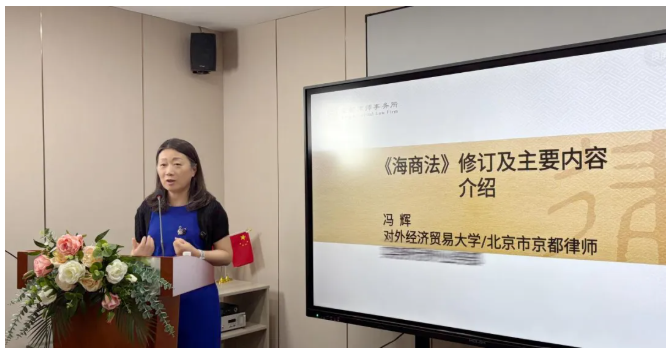
This seminar was organized by the Cross-Border Practice Department of King&Capital Law Firm. Professor Feng Hui has dedicated many years to the fields of maritime and commercial law and international maritime law, combining a solid theoretical foundation with extensive practical research experience. The lecture centered on five key dimensions: the legislative background of the new Maritime Commercial Law, its overall framework, core amended provisions, practical application challenges, and the integration of international rules. Professor Feng Hui provided a comprehensive and in-depth analysis by combining statutory interpretations, typical case studies, and judicial reasoning in cross-border commercial disputes. The entire lecture was packed with practical insights and presented with clear logic.
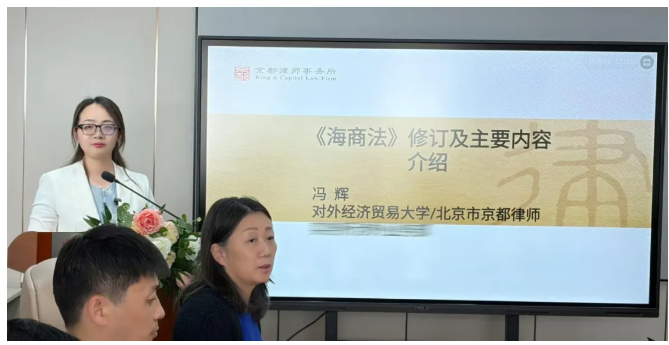
At the beginning of the lecture, Ms. Jiang Yongqian, a senior partner at the Shanghai office of King&Capital Law Firm, took the stage to deliver the opening remarks. She first extended a warm welcome to Professor Feng Hui for sharing his insights and extended sincere greetings to all colleagues and industry partners in attendance. Attorney Jiang Yongqian noted that maritime law serves as the foundational legal framework for shipping, international trade, and ship investment and financing. The 1993 version of the Maritime Code has been in effect for over three decades and is now undergoing its first major revision. The new law comprises 16 chapters and 310 articles, with nearly two-thirds of the provisions revised to introduce systematic innovations in areas such as rule unification, digital transformation, ecological protection, and the rule of law in cross-border matters. She further noted that as an international shipping hub, Shanghai boasts a vast market for maritime and commercial law as well as cross-border legal services. The implementation of the new law will not only profoundly alter the rules governing legal application within the industry but also impose entirely new demands on the professional capabilities of frontline legal practitioners.
She noted that King&Capital Law Firm has long specialized in maritime and admiralty law, cross-border investment and financing, and cross-border dispute resolution. Leveraging its regional advantages, the firm’s Shanghai office serves a large number of clients, including shipping companies, traders, ship charterers, and financial institutions. Furthermore, she emphasized that the purpose of organizing this special seminar was to draw upon Professor Feng Hui’s profound theoretical knowledge and research achievements to help the firm’s team and industry partners systematically analyze the key highlights of the amendment, identify practical risks, and align their approach to handling cases. Finally, Attorney Jiang Yongqian briefly introduced Professor Feng Hui’s academic background and research focus, and announced the official commencement of the seminar.
Professor Feng Hui began by providing an overview of the amendment. This marks the first major revision to the original Maritime Commercial Law since its implementation in 1993. The new law has been expanded to 16 chapters and 310 articles, with adjustments made to a total of 180 provisions. It introduces three major new sections—ship liens, electronic transport records, and liability for oil pollution damage—and optimizes the structure of the existing chapters. She noted that this amendment closely aligns with four core objectives: unifying domestic and international maritime rules; adapting to the trend of digitalization in shipping; improving the system for protecting the marine ecological environment; and optimizing the system for the application of foreign laws. These measures not only respond to the current state of China’s shipping and trade development but also achieve deep alignment with internationally recognized maritime rules.
During the session on interpreting key provisions, Professor Feng Hui analyzed the highlights of the amendments and their practical implications module by module, drawing on the full process of maritime legal practice. In light of the current wave of digitalization in shipping, she focused on interpreting provisions related to electronic transport records (electronic bills of lading), clarifying that Article 82 of the new law establishes that electronic bills of lading have the same legal effect as paper documents, while Article 85 defines the three key technical and legal requirements—uniqueness, integrity, and exclusive control—and provided a detailed explanation of the process for converting between paper and electronic formats. At the same time, drawing on case studies of blockchain-based electronic bills of lading, she analyzed the practical value of electronic documents in scenarios such as letter-of-credit settlement, transfer of cargo ownership, and evidence retention, as well as key risk management considerations.
This lecture focused on high-frequency business operations such as vessel operation, chartering, construction, and financial leasing, directly addressing various practical pain points in the industry. Regarding charter party contracts, the new law integrates voyage charter parties into a dedicated chapter on charter parties and establishes the principle of contractual freedom. Drawing on classic English law precedents, Professor Feng Hui provided an in-depth analysis of the key clauses for the three major contract types—voyage charter, time charter, and bareboat charter—as well as the calculation of loading and unloading times, the determination of demurrage, suspension of charter, and rent payment—long-standing points of contention—and interpreted the judicial application standards for common international shipping rules such as “pay first, dispute later,” clauses prohibiting rent withholding, and the safe harbor guarantee.
Focusing on the two major business sectors of shipbuilding and financial leasing, Professor Feng Hui highlighted the groundbreaking provisions introduced by the new law. She analyzed that Article 8 of the new law clearly defines the rules governing the priority of registration of ownership for vessels under financial leases and the right to accelerate lease payments, while detailing the operational procedures—from notice of default to litigation—for lessors asserting their rights; Article 10, for the first time, legislatively clarifies the rules governing ownership of vessels under construction, establishing the principle that “where there is an agreement, the agreement prevails; where there is no agreement, ownership belongs to the shipbuilder.” In light of potential shipyard bankruptcy risks, she also provided multiple practical risk prevention and control measures, including early ownership locking, asset identification, and registration of vessels under construction. Furthermore, regarding cross-border shipbuilding operations, she interpreted Article 296 of the new law concerning the application of foreign law, clarifying that the law of the place of construction applies to unregistered ships under construction. This provides a legal basis for domestic shipyards to address overseas disputes and seek remedies within China.
This lecture systematically reviewed the maritime liability framework, focusing on three core areas: adjustments to carrier liability, limitations on maritime compensation liability, and liability for oil pollution damage caused by ships. The new law optimizes the carrier’s “receipt and delivery” obligations, redefines the scope of actual carriers, narrows the circumstances under which fire-related exemptions apply, and adjusts the standards for calculating the value of cargo; It introduces a new, standalone chapter on liability for oil pollution damage, aligning with the international CLC 1992 Convention and the Fuel Oil Convention, and establishes strict liability for owners of oil-spilling vessels, mandatory insurance, direct litigation, and a compensation fund system. Additionally, the lecture explicitly stated that general limitations on maritime liability do not apply to oil pollution damage. Regarding limits on maritime liability, the new law unifies the liability limits for seagoing and inland waterway vessels and significantly raises the standards, further balancing the interests of all parties.
In addition, Professor Feng Hui interpreted the new law’s newly added countermeasures clause. She noted that this clause elevates countermeasures in the fields of maritime transport and shipbuilding from administrative regulations to the level of law, providing a solid legal foundation for China’s shipping and shipbuilding industries to address discriminatory policies from abroad. Drawing on typical practical cases—such as failure to collect cargo at the port of destination, changes to the port of discharge due to war or force majeure, and the impact of international sanctions on contract performance—she analyzed, one by one, the judicial rules under the new law regarding the allocation of liability among parties, cost allocation, and contract termination, providing lawyers with a clear framework for handling related maritime disputes.
Following the keynote presentation, the event moved into an interactive discussion session. Gong Ke, a senior partner at the Shanghai office of King&Capital Law Firm, shared a recent landmark maritime case handled by his team. The case involved the preservation of vessel cargo at Shanghai’s Yangshan Port and encountered jurisdictional disputes across multiple courts, with each court holding differing views on where jurisdiction lay. After extensive communication and coordination, a local Shanghai court ultimately took the lead in freezing the cargo, successfully safeguarding the client’s rights and interests. Drawing on this case, Attorney Gong Ke shared practical experience in handling maritime preservation measures and resolving jurisdictional disputes, sparking a lively discussion among the attendees.
The interactive session of the lecture was lively. Attending attorneys actively posed questions on complex issues—drawing from their own experience handling cases involving maritime cargo transportation, ship leasing, cross-border shipbuilding, and maritime torts—such as the evidentiary validity of electronic bills of lading, the drafting of charter party clauses, the choice of law in foreign-related maritime cases, the process for oil pollution damage claims, and contract performance under cross-border sanctions. Professor Feng Hui provided detailed answers to each question, sharing his perspectives by drawing on legal principles, statutory provisions, and judicial precedents from both China and abroad. The two-way exchange sparked numerous insights, leaving the attendees deeply inspired.
Attendees unanimously noted that since the implementation of the new Maritime and Commercial Code, the regulatory framework for maritime and commercial law as well as cross-border legal services has undergone significant changes. This seminar closely aligned with the new regulations and was grounded in practical applications, offering both cutting-edge theoretical interpretations and actionable operational guidance. It effectively helped participants clarify the legislative amendments, gain a thorough understanding of core provisions, and resolve professional uncertainties.
Maritime and commercial law, as well as cross-border legal services, are key practice areas in which King&Capital Law Firm has deeply specialized. This special lecture served not only as an important initiative to strengthen the firm’s professional capabilities and solidify its practice foundations but also as a valuable exploration in building an industry exchange platform and sharing professional insights. Moving forward, the Shanghai office of King&Capital Law Firm will continue to focus on new laws and regulations, industry hot topics, and cutting-edge legal issues. We will regularly organize professional seminars, specialized training sessions, and exchange activities to continuously enhance our team’s professional service capabilities. Leveraging our integrated service system, we will provide professional, efficient, and comprehensive legal services—including maritime and admiralty law, cross-border civil and commercial law, and investment and financing—to clients such as domestic and international shipping companies, trading firms, and financial institutions, thereby helping the shipping and trade industries navigate steadily toward a prosperous future.