

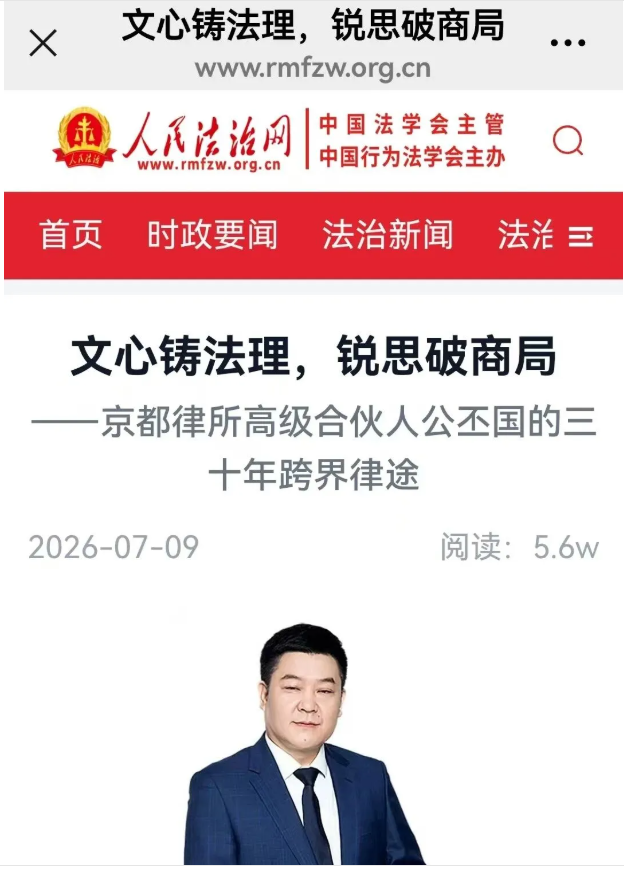
Recently, People’s Rule of Law, a leading domestic legal media outlet, published an exclusive interview titled “Crafting Legal Principles with Literary Insight, Breaking Through Commercial Challenges with Sharp Thinking.” The article takes an in-depth look at the three decades of commercial legal practice and professional insights of Attorney Gong Piguo, Senior Partner at Beijing King&Capital Law Firm and Director of the King&Capital Civil and Commercial Litigation Research Center, systematically presenting his case-handling methodologies and industry perspectives in areas such as corporate finance, commercial disputes, and the intersection of criminal and civil law.
From “Mechanical Application of the Law” to “Aligning with Business Realities”
The Three-Stage Evolution of a Commercial Lawyer’s Thinking
Having dedicated thirty years to commercial law, Gong Piguo has personally witnessed the iterative evolution of China’s commercial legal framework. In the interview, he proposed that the professional growth of a commercial lawyer inevitably progresses through three stages: “literal application of legal provisions—systematic application—aligning with business realities.”

Attorney Gong Piguo attending the “Integration of Criminal and Civil Law” forum in Nanjing
Amid the boom in corporate investment and financing, equity transactions, and financial asset management, commercial disputes have become increasingly complex, characterized by nested transactions and intertwined relationships—making it difficult to address them with fragmented legal provisions alone. To address this, Gong Piguo has established a systematic knowledge framework that integrates corporate law, financial law, regulatory rules, and criminal law. At the same time, he has moved beyond a purely legal perspective to deeply study business logic, corporate governance, and finance and taxation, thereby achieving synergy between legal thinking and business logic.
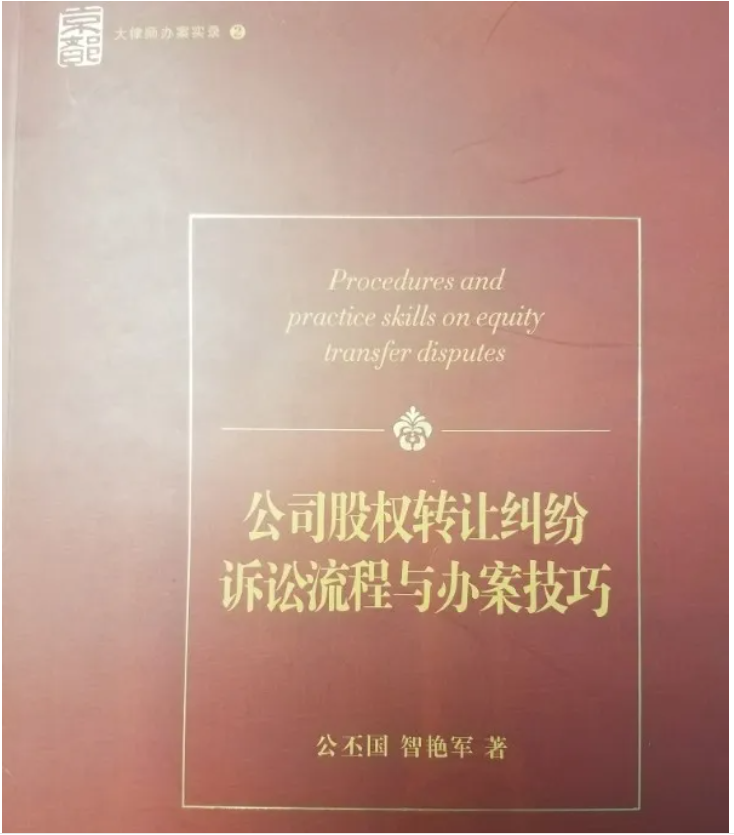
*Litigation Procedures and Case Handling Techniques for Equity Transfer Disputes*
He emphasized that his academic background in Chinese Language and Literature is a unique strength: Complex commercial cases involve voluminous case files and intricately intertwined relationships, making the drafting of legal documents and courtroom advocacy an extreme test of logical proficiency. When drafting legal documents, he excels at distilling core arguments and constructing self-contained lines of reasoning; in court, he eschews the tedious accumulation of legal theories, instead adopting the adjudicator’s perspective to focus on evidence as the core and logic as the foundation, precisely addressing the crux of the dispute.
Penetrative Case Handling
The Path to Reversing a Commercial Impasse Worth Billions
Throughout his legal career, Gong Piguo has developed a distinctive “penetrative case handling mindset”—the key to breaking through a deadlock lies not in mechanically applying rules, but in peeling back the surface of transactions, penetrating nested structures, and directly addressing the underlying true legal relationships.

Attorney Gong Piguo discussing the case with his team
This approach is best illustrated by a dispute over the transfer of trust beneficiary rights involving Hong Kong, with a case value of 4.2 billion yuan. An asset management company established a 4.2 billion yuan trust product using corporate debt claims it had acquired and transferred the subordinate beneficiary rights to a subsidiary of a Hong Kong-based group for 2 billion yuan. After the Hong Kong party paid a 200 million yuan security deposit, the asset management company failed to complete the registration of the transfer of trust beneficiary rights. Consequently, the Hong Kong party withheld the remaining 1.8 billion yuan, leading to an escalation of the conflict between the two parties.
In the first-instance trial, the court relied solely on the written agreement and ruled that the Hong Kong party’s failure to make full payment constituted a fundamental breach of contract, ordering it to bear 420 million yuan in late payment liabilities and joint and several liability. The outcome was extremely unfair: despite having paid 200 million yuan, the Hong Kong party had not acquired any rights, yet was required to bear a massive penalty for breach of contract and 1.8 billion yuan in debt, plunging the company’s operations into a desperate situation. Gong Piguo’s team represented the Hong Kong party in filing an appeal.
The legal team faced an extremely challenging situation—all transaction documents had been drafted by the opposing party, and the Hong Kong party had signed two repayment extension agreements; the written evidence was highly unfavorable, and the first-instance judgment had resulted in a complete defeat. Rather than limiting themselves to the written contracts, the team conducted a comprehensive review of the transaction structure and underlying assets, uncovering a key breakthrough: the underlying assets upon which the trust in question was established were, in fact, fictitious claims created through intercompany accounting entries, rendering the entire transaction fundamentally flawed.
Based on this, the team constructed a multi-layered defense strategy: closely focusing on the fact that the underlying assets were fictitious to argue that the agreements were invalid; focusing on the order of performance to assert that the Hong Kong party’s exercise of the right of prior performance did not constitute a breach of contract; and simultaneously adopting a “civil-focused, multi-pronged” approach by preparing criminal complaints and administrative reports in parallel to comprehensively undermine the factual basis of the first-instance judgment. Ultimately, the appellate court fully accepted these arguments, completely overturned the first-instance judgment, and dismissed all claims brought by the asset management company. This not only recovered massive losses for the Hong Kong party but also provided an important judicial precedent for cutting-edge issues such as the transfer of large-value trust beneficiary rights and the compliance review of underlying assets in asset management.
In an exclusive interview, Gong Piguo summarized: “The outcome of high-end commercial disputes has never depended on the wording of legal documents, but rather on the ability to penetrate complex transaction structures to identify the true rights, obligations, and commercial essence underlying the transactions. Complex cases often involve intertwined civil, administrative, and criminal relationships; only through the coordinated implementation of multi-dimensional strategies can true justice be achieved in individual cases.”
Commercial Legal Services in the New Era
Trends of Transformation and Professional Restructuring
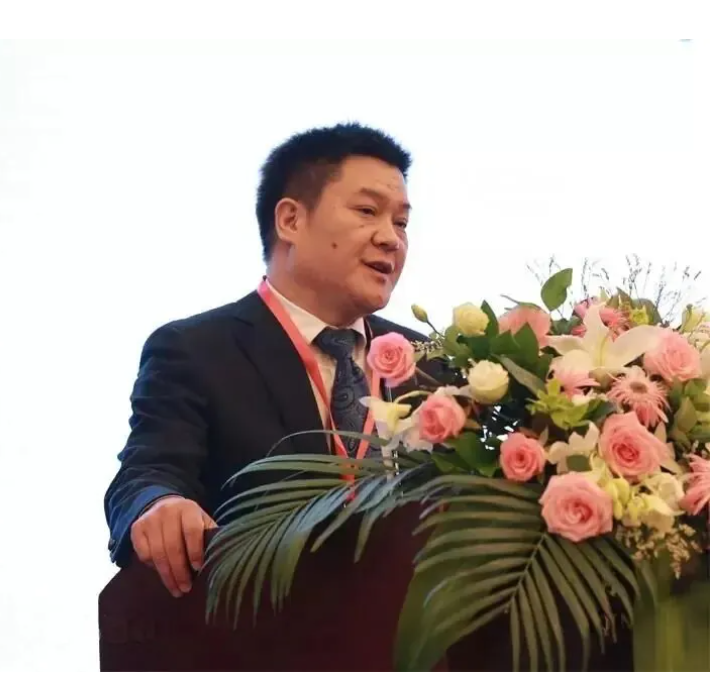
Attorney Gong Piguo delivering a presentation at the Qingdao session of the King&Capital Civil and Commercial Forum
Gong Piguo offers a systematic analysis of industry transformation. With the implementation of the new Company Law, tighter financial regulation, and the normalization of risks at the intersection of criminal and civil law, commercial legal services have moved beyond mere post-event dispute resolution and entered a new phase characterized by full-cycle, multidisciplinary approaches, and stringent compliance requirements.
He argues that the hierarchy of value for commercial lawyers in the new era has been restructured: “The primary focus is on preventing criminal risks, followed by mitigating corporate operational risks, and finally, resolving end-stage disputes.” Accordingly, he argued that commercial lawyers must break down professional barriers and build a multidisciplinary knowledge system encompassing “civil and commercial law, finance, regulation, and criminal law.” They must evolve into corporate commercial advisors who combine legal expertise, business acumen, and risk forecasting capabilities, achieving a full-chain upgrade from “post-incident damage control” to “pre-incident prevention, in-process management, and post-incident resolution.”
Discussing shifts in the industry ecosystem, he identified three major transitions: work methods have shifted from individual efforts to team-based collaboration; service objectives have shifted from resolving disputes to creating commercial value for enterprises; and client acquisition strategies have shifted from relationship-driven to professional product-driven approaches. “Specialization, systematization, and multidisciplinary capabilities have become the core foundation for high-end commercial lawyers.”
Guidance for Young Lawyers
Three Core Competencies and Three Major Misconceptions

Attorney Gong Piguo delivering a lecture at East China University of Political Science and Law
Drawing on his personal experience and industry observations, Gong Piguo summarized the three core competencies essential for commercial lawyers: First, systematic and penetrating thinking—penetrating contract texts and transaction structures to identify the underlying legal relationships as the key to resolving issues; Second, the ability to design commercial structures by breaking down cognitive barriers between law, finance, and accounting; and third, the ability to identify risks at the intersection of criminal and civil law to safeguard the red lines of professional practice.
At the same time, he cautioned young lawyers to avoid three major pitfalls: do not merely memorize legal provisions while disregarding commercial logic, thereby becoming a “legal tool” that mechanically applies the law; do not underestimate preliminary services such as non-litigation compliance and structural design; and do not neglect the study of criminal law, failing to maintain a sense of reverence for risks at the intersection of criminal and civil law. “Professional excellence, broadening one’s horizons, and upholding ethical standards are the core foundations for long-term development.”
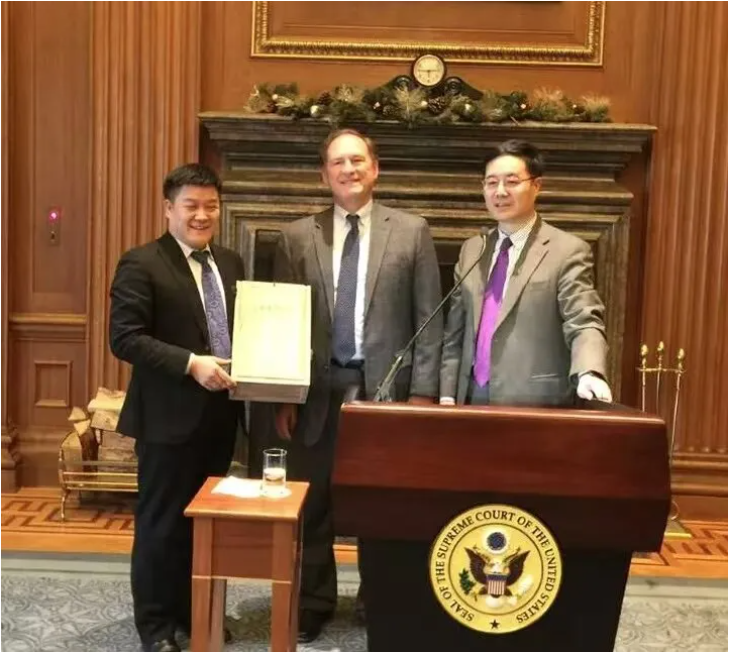
Attorney Gong Piguo poses for a photo with U.S. Supreme Court Justice Samuel Alito
Upholding Justice with Integrity, Embarking on the Long Journey with Professionalism
This exclusive interview with People’s Rule of Law Network not only represents an authoritative media outlet’s recognition of Attorney Gong Piguo’s professional capabilities but also reflects the influence of the King&Capital Commercial Law Service brand. For thirty years, Attorney Gong Piguo has never ceased his efforts. With penetrating insight, he unravels complex commercial puzzles; with systematic expertise, he safeguards market fairness, continuing to write a magnificent chapter in the rule of law for commercial lawyers in the new era.