

I. Introduction
This case involves a dispute over the performance of an investment contract, in which the investor sued the target company and related parties to repurchase equity, fulfill guarantee obligations, and pay investment returns, costs of capital, liquidated damages, and other financing costs, with the total amount in dispute exceeding 100 million yuan.
II. Keywords
Equity Investment and Financing; Performance-Based Agreement; Equity Repurchase; Financing Costs
III. Case Information
Case No.: (2025) Jing 0102 Min Chu 6714 / (2025) Jing 02 Min Zhong 14469
Courts: Xicheng District People’s Court of Beijing / Second Intermediate People’s Court of Beijing
Attorneys: Bi Xiaodong, Gao Huixin
IV. Highlights of the Case
This case is a typical dispute centered on the performance of an investment agreement, with a claim amount exceeding 100 million yuan. The investor sought to hold the target company, its shareholders, guarantors, and the spouses of the guarantors jointly and severally liable for substantial sums, including equity repurchase payments, investment returns, costs of misappropriated funds, and liquidated damages. Acting as counsel for the investee company and related parties, Attorneys Bi Xiaodong and Gao Huixin focused closely on the core issues of the dispute, successfully delineated the boundaries of liability, significantly narrowed the scope of guarantors and their liability, and substantially reduced the costs of misappropriated funds, thereby providing a favorable foundation for subsequent debt restructuring negotiations.
V. Case Background:
A 100-million-yuan Investment Takes a Turn for the Worse; Multiple Parties Sued for Huge Liabilities
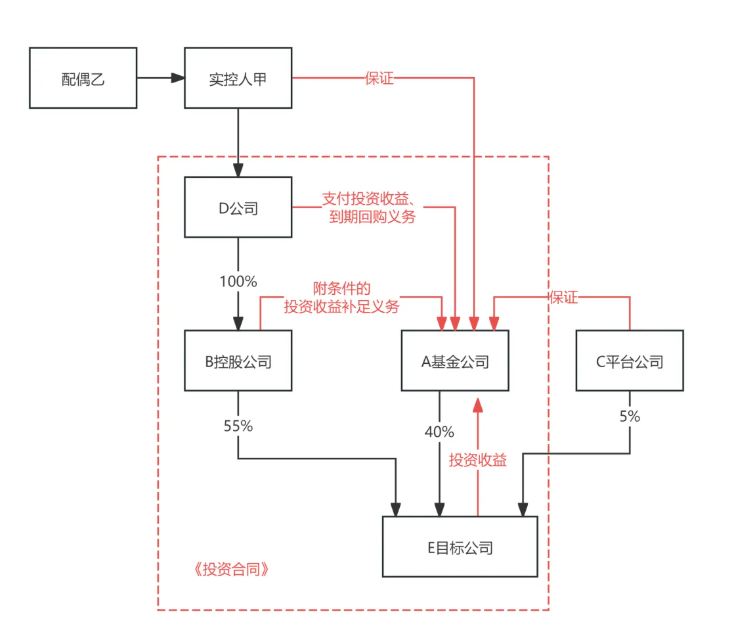
In March 2016, Fund Company A entered into an “Investment Agreement” with Holding Company B, Target Company E, and Company D, stipulating that Fund Company A would inject 100 million yuan into Target Company E for the construction of a certain engineering project; The investment term was 11 years, during which Fund Company A was entitled to receive investment returns at an annualized rate of 2%. Holding Company B was obligated to make up any shortfall in investment returns, limited to the dividends received from Target Company E. Between 2023 and 2027, Company D was required to repurchase 20% of the equity in the target company held by Fund Company A each year; failure to do so would result in daily payments for capital occupation costs and liquidated damages. At the same time, Fund Company A entered into separate “Guarantee Agreements” with Platform Company C and Actual Controller A, stipulating that the aforementioned guarantors would provide joint and several liability guarantees to Fund Company A; A’s spouse, B, signed in the “Guarantor’s Spouse” section of the Guarantee Agreements.
During the performance period, because Target Company E was unable to pay investment returns to investors and Company D failed to repurchase the equity for two consecutive periods as agreed, Fund Company A issued a notice of early repurchase and liability enforcement to Target Company E and the relevant parties on June 30, 2024, requiring the relevant entities to complete the equity repurchase and replenish the funds by July 2, 2024. In December 2024, Fund Company A filed a lawsuit, seeking to compel each obligated party to fulfill their contractual obligations and assume liability for the repurchase of equity and breach of contract. The court was requested to order: Company D to repurchase all equity in the Target Company from Fund Company A; Company D and the Target Company E to pay investment returns based on the agreed-upon rate of return, using the 100 million yuan investment as the principal, until all equity transfer payments, investment returns, and liquidated damages have been fully settled; Holding Company B to bear supplementary liability for the aforementioned debts of Target Company E; Company D to pay Fund Company A the cost of capital tied up, calculated based on the overdue equity transfer payments, until all equity transfer payments, investment returns, and liquidated damages are fully settled; Company D to pay liquidated damages to Fund Company A, calculated based on the total investment amount plus the total investment returns receivable and in accordance with the agreed-upon standards, until all equity transfer payments, investment returns, and liquidated damages are fully settled; C Platform Company, actual controller A, and spouse B shall bear joint and several liability for the aforementioned debts.
VI. Challenges in Representation:
Balancing Contractual Provisions and the Principle of Fairness
Equity investment and financing, as a common cooperation model in capital markets, not only mobilizes capital and facilitates corporate development but is also highly prone to massive disputes due to complex terms and stringent stipulations regarding rights and obligations. When the terms of an investment agreement conflict with the principle of fairness or mandatory legal provisions, the focus of legal representation—in addition to determining whether the repurchase conditions have been met—should also be on minimizing the funding costs for the party obligated to repurchase.
VII. Legal Position:
Precision in Breaking the Deadlock and Distinguishing Legal Principles; Layered Segmentation to Reduce Liability
In investment and financing disputes, standard form clauses and multiple liability provisions often blur legal boundaries; contract terms that appear “legal and valid” may conceal an imbalance of rights and responsibilities. Faced with the investor’s interlinked claims and stringent terms, the legal team constructed a rigorous defense strategy centered on five core points of contention.
(1) A “one-day performance period” is unrealistic; acceleration of maturity must be reasonable
Even when asserting accelerated maturity, the obligor should be granted a reasonable period for performance. In this case, given the objective difficulties in executing the equity transfer and paying over 100 million yuan, Fund Company A’s provision of only one day’s performance period after sending the notice is clearly unreasonable. Therefore, calculating the cost of capital occupation and liquidated damages using that date as the starting point is unfair and should not be supported.
(2) Conflict Between Investment and Capital Occupation; No Basis for Double Counting
The calculation periods and bases for investment returns and the cost of capital occupation should not overlap. The plaintiff invested only one sum of 100 million yuan in Target Company E. If this sum remains within the investment term and is lawfully used by Target Company E in accordance with the contract, investment returns should be calculated; if the term has expired but the obligated party has failed to acquire the corresponding equity as agreed, the cost of capital occupation applies. That is, with respect to the same funds, using the contractually agreed transfer and closing date as the cutoff point, investment returns accrue prior to the closing date, while costs of capital occupation accrue after the closing date. The time periods for these two claims should not be calculated concurrently; otherwise, this would violate the provisions of Article 584 of the Civil Code of the People’s Republic of China regarding the principles of full compensation for losses and foreseeability of losses. Regarding the calculation period for investment returns, it should not exceed the investment term. If the plaintiff considers the investment funds to have matured in full ahead of schedule, then as of the maturity date, the plaintiff is no longer entitled to claim investment returns on those funds. Therefore, the plaintiff’s claim, based on the contractual agreement, for “investment returns up to the date the plaintiff receives the full equity transfer proceeds, investment returns, and liquidated damages” should not be upheld.
(3) No Profits, No Dividends; Corporate Liability is Severed in Accordance with the Law
Target Company E may not distribute profits to shareholders in violation of the mandatory provisions of the Company Law when there are no profits available for distribution. The Investment Contract at issue stipulates that the plaintiff’s method of realizing investment returns under the contract is through “dividends.” According to Article 5 of the Ninth Plenary Session of the Supreme People’s Court, when an investor requests that the target company assume a monetary compensation obligation, such a request must not violate the mandatory provisions of the Company Law of the People’s Republic of China regarding profit distribution. Therefore, in the absence of profits available for distribution, Target Company E should not pay investment returns to the plaintiff. Since B Holding Company, as a shareholder of Target Company E, has not received any profit dividends, the issue of “making up the shortfall from the cash profit distributions received by B Holding Company from Target Company E during the current fiscal year” does not arise; consequently, B Holding Company should not bear any obligation to make up the shortfall.
(IV) Concurrence of Liquidated Damages and Fund Occupancy Costs: Supporting One Option Is Fair
The plaintiff claims fund occupancy costs based on the investment principal and unpaid investment returns corresponding to the equity that Company D failed to repurchase by the due date, while simultaneously claiming liquidated damages calculated based on the total investment amount and the investment returns receivable. Both liquidated damages and the cost of capital occupation serve to compensate the plaintiff for losses incurred due to the defendant’s failure to repurchase the shares and pay investment returns as scheduled. There is overlap in the calculation periods and bases for both, and both fall within the scope of breach of contract liability. In the absence of evidence proving that the plaintiff suffered actual losses, neither liquidated damages nor the cost of capital occupation should be awarded simultaneously.
(5) Spouse’s Signature Indicates Only Knowledge; No Intent to Guarantee, Therefore No Liability
The plaintiff’s claim that the guarantor’s spouse bears joint and several liability for the debt in question alongside the guarantor lacks both legal and factual basis. As the spouse of Guarantor A, Party B’s status in the contract signature section is explicitly stated as “Spouse of the Guarantor” rather than “Guarantor,” and nowhere in the contract is it stipulated that the guarantor’s spouse is required to assume guarantee liability. Furthermore, supported by evidence regarding the number of copies of the contract executed and the service of notices, it can be proven that the spouse did not sign as a party subject to the obligations of the guarantee contract; her signature in the “Guarantor’s Spouse” section merely indicates her awareness of her spouse’s guarantee action and does not constitute an expression of intent to provide a guarantee for the debt in question. Therefore, Party B is not a guarantor of the debt in question and should not bear joint and several liability for it.
VIII. Judgment: Courts at Both Levels Adopted the Counsel’s Position, Significantly Reducing the Scope of Liability
After deliberation, the court held that: the obligor’s continuous breach of contract constituted grounds for acceleration of the debt; however, the investor’s demand for immediate repurchase was unreasonable, and a reasonable two-month performance period was granted at the court’s discretion; the calculation bases and time periods for investment returns and the cost of capital occupation overlapped, and thus could not be calculated twice; Target Company E has no distributable profits and is not obligated to pay investment returns in the form of dividends; since the cost of capital occupation and liquidated damages overlap in nature, only one shall be awarded; the guarantor’s spouse did not expressly indicate an intention to act as a guarantor and therefore bears no joint and several liability.
Following the first-instance judgment, Fund Company A filed an appeal; the second-instance judgment dismissed the appeal and upheld the original judgment.
IX. Legal Analysis
In today’s dynamic and complex investment and financing market, when commercial expectations fall short, the provisions in investment agreements regarding investment returns, exit strategies, compensation, and liquidated damages often become the focal point of intense negotiations among the parties. The core issues in this case directly address several major pain points in investment and financing practices: under what conditions investment funds may become due early, and how their specific due dates should be fairly determined; when investment objectives are not met, who is responsible for paying investment returns and the cost of capital, and what criteria should be used to determine this; and how to determine the reasonable limits of liquidated damages provisions during judicial review. In this case, attorneys Bi Xiaodong and Gao Huixin, acting as counsel for the investee company and its shareholders, effectively delineated the risks and liabilities related to investment returns, exit, compensation, and breach of contract by precisely applying the law and contractual provisions. They argued that “returns on capital during the investment period and the cost of capital occupation (breach damages) after exit have different legal natures; the two are sequentially linked in time and must not overlap in calculation,” and that “ “The costs of capital occupation and liquidated damages stipulated concurrently in the contract share the same legal nature and should not be awarded simultaneously, as this would result in overlapping liability for breach of contract and create an imbalance in the interests of the contracting parties,” “The target company’s payment of investment returns to investors must not violate the mandatory provisions of the Company Law regarding profit distribution; dividends may not be distributed when there are no distributable profits,” and “ A spouse’s signature on a guarantee agreement constitutes merely ‘acknowledgment’ rather than ‘consent to jointly assume guarantee liability’; the spouse’s joint and several guarantee liability must be carefully reviewed and determined.” These arguments were adopted by the court. The final judgment significantly narrowed the scope of liable parties and liability, substantially reducing the company’s capital usage costs, and earned high praise from the client.
In the process of establishing the rule of law in the capital markets, professional legal services are key to balancing commercial interests and mitigating legal risks. We will continue to deepen our expertise in the field of investment and financing dispute resolution, leveraging our professional expertise and commitment to fairness to build robust legal defenses for enterprises and help ensure that commercial transactions proceed steadily and successfully within the framework of the rule of law!