

On the afternoon of August 7, 2026, at Beijing King&Capital (Shanghai) Law Firm, a three-hour seminar on criminal practice was held in the Shanghai Hall on the 39th floor of Tower A, Zhongyi Building, located at 580 West Nanjing Road, Jing’an District, Shanghai, and was simultaneously livestreamed online. The seminar, titled “Comprehensive Determination and Presumptive Rules Regarding the Intent to Illegally Appropriate,” was moderated by Attorney Guo Chunyan, presented by Attorney Lu Xianghui, and featured Attorney Zhu Dongsheng as a panelist. Legal professionals from various fields gathered to collectively address one of the most challenging issues in criminal defense practice—and one most easily skewed by judicial inertia—namely, how to determine the “intent to illegally appropriate,” an intangible concept hidden within a person’s mind.
I. Opening Remarks: An Element That Directly Determines Guilt or Innocence
“Today, we will spend three hours focusing on the most challenging issues in criminal defense practice. ” Moderator Guo Chunyan stated plainly in her opening remarks.
Attorney Guo Chunyan noted that the subjective element of “intent to unlawfully appropriate” spans multiple offenses—including fraud, contract fraud, financial fraud, and embezzlement—and directly determines whether an act constitutes a crime or not, as well as the distinction between one offense and another. However, since it exists within the perpetrator’s mind, it cannot be directly observed—there can be no eyewitnesses to one’s subjective state of mind. She explained that once a defendant refuses to confess, the prosecution must rely on circumstantial evidence to infer subjective intent from objective conduct. Yet, rather than making a comprehensive assessment, judicial practice often involves “identifying specific scenarios and applying them mechanically”: if the defendant squanders assets, flees, or is unable to repay debts, the intent is deemed established. This mechanical presumption—where objective conduct directly substitutes for the examination of subjective elements—is precisely what this lecture aims to systematically deconstruct.
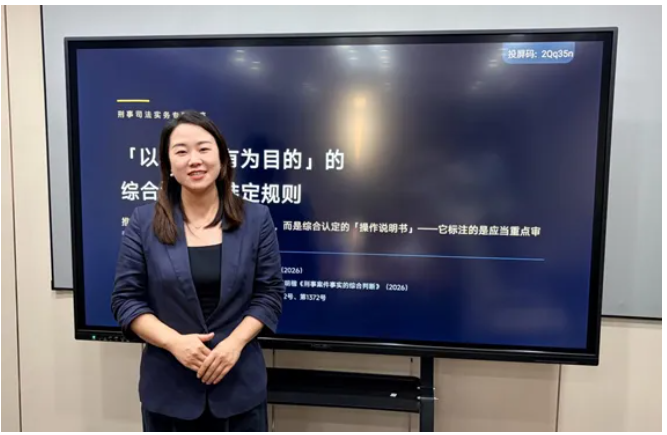
Moderator: Attorney Guo Chunyan
She explained that this lecture is based on three theoretical pillars: “The Dilemma and Way Forward in Proving the Subjective Elements of a Crime,” a paper presented by Mr. Tian Wenchang, founding partner of King&Capital law Firm, at the 7th Advanced Forum on Criminal Defense at Northwest University of Political Science and Law; two important papers published separately in 2026 by Professors Chen Ruihua and Zhang Mingkai; and four typical cases from *Criminal Trial Reference* (Nos. 1120, 1342, 1372, and 1065) as test samples. The lecture provides a comprehensive analysis of the challenges, theoretical frameworks, and practical applications in establishing the facts regarding subjective elements.
II. The Opening Question: Why Was Huang Jinchang Acquitted?
The lecture began with Case No. 1372 in *Criminal Trial Reference*—the Huang Jinchang fraud case.
Attorney Lu Xianghui explained that Huang Jin Zhang, a private entrepreneur from Fujian, borrowed 13.49 million yuan at high interest rates from others during his business operations by using forged corporate and personal real estate certificates as collateral. He used part of the funds for stock market investments and part to repay bank loans, after which he fled. There was no dispute that he had fabricated facts and concealed the truth; the amount involved was enormous, and he had fled. The first-instance court found him guilty of fraud and sentenced him to fifteen years in prison.
However, he further explained that the Fujian High Court overturned the verdict on appeal and acquitted him, citing three reasons: First, at the time of borrowing, his assets were roughly equal to the loan amount, indicating repayment capacity—the relevant time point for assessing repayment capacity is the time of borrowing, not after the cash flow has broken down; second, the funds were used for legitimate business operations; and third, he had made long-term, stable repayments of principal and interest. Accordingly, even though there were instances of forging documents, concealing financial difficulties, and fleeing after the fact, these were insufficient to establish the crime of fraud.
“If the presumption of intent to illegally appropriate funds were applied mechanically, this case would fit the criteria perfectly—‘fleeing after illegally obtaining funds’ is precisely one of the seven scenarios listed in the 2001 ‘Minutes of the National Symposium on the Trial of Financial Crime Cases by People’s Courts.’” Attorney Lu Xianghui pointed out, “Yet, it was specifically acquitted as a guiding case in criminal trial references. Why?” This question ran through the entire lecture.
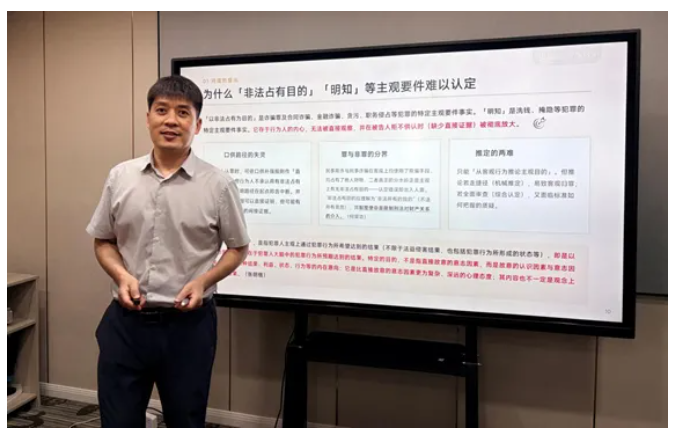
Speaker: Attorney Lu Xianghui
III. Evolution of Regulations:
Twenty-Five Years from “Checking Off Boxes” to “Comprehensive Review”
Attorney Lu Xianghui first traced the evolution of the relevant regulations: The 2001 Summary of the Symposium on Financial Crimes listed seven scenarios as purely presumptive rules—without even mentioning “comprehensive determination”—and remains legally valid and widely cited to this day; the 2009 Interpretation on Obstructing Credit Card Management listed six scenarios, using the phrasing “shall be deemed”; The 2018 amendment to the Credit Card Interpretation did not abolish the six presumptive scenarios but instead added a comprehensive assessment rule at the beginning of the same provision—requiring a comprehensive evaluation of credit history, repayment capacity and willingness, application and overdraft status, use of funds, post-overdraft conduct, and reasons for non-repayment, among other factors; a determination must not be made solely on the basis of failure to repay in accordance with regulations, thereby establishing a model where comprehensive assessment and enumerated presumptions coexist; The 2024 Interpretation on Money Laundering and the 2025 Interpretation on Concealment went a step further, completely removing the enumerated presumption provisions and replacing them uniformly with comprehensive review and judgment.
According to Professor Zhang Mingkai’s statistics, the current judicial interpretations contain as many as approximately 500 instances of phrases such as “comprehensive consideration,” “comprehensive examination,” “comprehensive review,” and “comprehensive analysis and judgment.” Attorney Lu Xianghui summarizes this as a profound paradigm shift: from atomic analysis to systems analysis—exhaustive lists fragment subjects that should be examined holistically into distinct elements, allowing a conclusion to be drawn based on the presence of just one element, which reduces the difficulty of analysis but also sows the seeds of mechanical adjudication; comprehensive determination, however, is a systems-theoretical perspective that requires a return to a holistic review of all evidence in the case.
Corresponding to this is a tension at the normative level of evidence law: Article 400 of the *Rules of the People’s Procuratorate on Criminal Procedure* requires prosecutors to present evidence regarding “whether the defendant acted with intent or negligence, and the motive and purpose of the act,” while Article 401 stipulates that “facts presumed by law” need not be proven by evidence; Meanwhile, Article 72 of the Supreme People’s Court’s Interpretation of the Criminal Procedure Law explicitly states that whether the defendant has criminal responsibility, whether there is culpability, and the motive and purpose of the crime are all facts of the case that must be proven by evidence, with no exceptions. According to the principle of adjudication based on evidence, the intent to unlawfully appropriate property and the element of knowledge must be proven by evidence—this normative basis is precisely what gives defense counsel the confidence to demand that the prosecution “lay out the process of proof” in court.
IV. Three Theoretical Pillars: An Integrated Response to Procedural and Substantive Issues
Professor Tian Wenchang’s concerns served as the source of the problem-consciousness underlying the entire lecture. Professor Tian pointed out that the greatest problem with presumption rules and comprehensive determination rules lies in a “cycle of subjectivity”—ultimately, the defendant’s subjective state of mind is inferred based on the judge’s subjective understanding; while formally a presumption based on objective conduct, in essence, it remains a matter of subjectivity judging subjectivity. How to determine intent when the perpetrator does not admit to it is not an issue confined to difficult individual cases, but rather a common issue across similar cases; Precisely because presumption involves subjectivity against subjectivity, the rigor of the standard of proof and procedural standards becomes particularly crucial. Professor Tian also revealed two fundamental flaws in presumption rules: the rules are incomplete (the reason for fleeing could be violent debt collection or unlawful detention; fleeing for one’s own safety cannot simply be equated with the intent to unlawfully appropriate property) and the content is too rigid (“reckless squandering” or “use for illegal or criminal activities” cannot reliably lead to inevitable conclusions through typification), thereby raising concerns about the over-expansion of criminal liability. However, reverting to a comprehensive assessment presents its own dilemmas: a lack of specific grounds, operational complexity, broad discretion, and significant liability—“neither option stands out.” Where, then, lies the solution? Professor Tian’s approach is to start with the burden of proof and methods of proof, seeking a solution while upholding the bottom line of due process, breaking free from the intellectual constraints of the exegetical school, and moving toward an integrated approach to criminal law research.
Professor Chen Ruihua’s framework serves as the central axis of this lecture. Professor Chen defines a presumption as “an interruption and substitution in the judicial proof process”: the underlying facts (such as “excessive overdrafts while knowing there was no ability to repay”) must be proven by evidence to a standard beyond a reasonable doubt—the burden of proof on this end is not relaxed, though it is often overlooked in practice; the transition from the underlying facts to the presumed facts requires no further proof and is automatically established. The rebuttable nature of the presumption serves as its “safety valve,” but the proviso—“except where there is evidence proving that the perpetrator did not, in fact, have the intent to unlawfully appropriate”—effectively shifts the risk of doubt and the burden of proof to the defendant. Professor Chen further argues that comprehensive determination is neither a presumption nor a rebuttable factual presumption, but rather a more specialized judicial rule of proof—it does not lower the standard but instead imposes stricter requirements, necessitating the fulfillment of the five conditions for convicting based on circumstantial evidence set forth in Article 140 of the Interpretation of the Criminal Procedure Law: the evidence must be verified as true, mutually corroborative with contradictions resolved, form a complete chain of evidence, exclude reasonable doubt and lead to a single conclusion, and the reasoning must be consistent with logic and experience; Judicial officers also bear the obligation to explain the reasoning process and formulate persuasive grounds for their rulings. In terms of order of application, comprehensive assessment takes precedence; statutory presumptions are invoked only as a supplementary and exceptional method when comprehensive assessment alone cannot resolve the issue.
Professor Zhang Mingkai has filled a critical gap from the perspective of substantive law. First, one must not confuse the basis for judgment with the criteria for judgment—credit records, repayment capacity, intended use of funds, flight risk, and extravagant spending are all merely the basis for judgment, not the criteria themselves; treating the basis as the criteria implies a lack of judgment. Second, conclusions must not be drawn based solely on partial evidence—the seven scenarios outlined in the 2001 Summary are “all evidence requiring a comprehensive assessment; conclusions should not be drawn directly from any single one of them,” as this would amount to drawing general conclusions from partial evidence. Third, and this is the point with the greatest practical significance: a comprehensive assessment can serve as a “filtering mechanism” for exoneration—acts that formally meet all elements of the crime but lack the intent to illegally appropriate property in substance may be exonerated through a substantive assessment; however, one must never, when the intent element is in doubt, artificially “fill in the gaps” to meet the conditions for conviction, as this would violate the principle of legality in criminal law. This asymmetrical structure—“exoneration is permitted, conviction is prohibited”—provides defense practitioners with a direct normative tool.
V. Reactions from the Legal Community:
The Hesitation, Caution, and Shifts in Stance of the Highest Judicial Authorities
Reflections from the academic community are not isolated voices. Attorney Lu Xianghui, drawing on the Kunming Meeting Minutes (2023), the Interpretation on Money Laundering (2024), the Interpretation on Concealment (2025), and articles on “Understanding and Application” written by Supreme People’s Court judges, has traced the evolution of the highest judicial authorities’ stance: The Kunming Meeting Minutes on Drug Cases state unequivocally at the outset: “Where a defendant denies having known that the substance was a narcotic after being taken into custody, proof shall be established through a comprehensive application of the evidence on record.” The condition for applying the presumption was prefaced with “where the defendant cannot provide a reasonable explanation,” the phrasing “may be deemed” was used instead of “shall be deemed,” and an exception was retained for cases “where there is evidence proving that the defendant was genuinely unaware or was indeed deceived”; In their “Understanding and Application” commentary, Supreme People’s Court justices clarified that a comprehensive assessment should be conducted first, and the presumption should only be invoked when such an assessment still fails to establish the required proof.
Most importantly, four Supreme People’s Court justices, in their “Understanding and Application” commentary on the Interpretation on Concealment published in *Chinese Applied Jurisprudence*, stated explicitly: The 2009 Interpretation’s approach of directly establishing knowledge based on “any of the following circumstances” “has been distorted in practice into treating a specific exceptional circumstance as a sufficient condition for knowledge”; The original intent of the presumption rule was merely to further refine the comprehensive assessment rule; it serves as a “guidance provision and cautionary provision” linking exceptional circumstances to a high probability of the conclusion, rather than an automatic inference in the substantive law sense. The article’s analysis of the “card fee” interprovincial transfer case and the underground money exchange case—where the organizer’s level of organization could establish knowledge, while the “card fee” recipient, acting under instructions and using their own card, could not be directly deemed to have knowledge even in the presence of anomalies such as interprovincial hotel transfers; and the case of an overseas worker’s father who withdrew cash after receiving his son’s wages exchanged through an underground money exchange, where a single point of suspicion was insufficient to establish the crime of concealment—constitutes a direct critique of the mechanical application of presumption rules. “Strictly determining facts in accordance with the law and exercising caution in applying presumptions” has become a clear judicial guideline.
Of course, the lecture did not shy away from addressing inconsistencies and fluctuations: The judicial interpretation on intellectual property infringement issued in April 2025 not only retained the presumption rule but even allowed “post-facto conduct”—such as the transfer of goods after seizure—to be used to infer prior knowledge, a standard even more aggressive than that applied in drug cases. The lecturer analyzed that this reflects the criminal policy of cracking down on intellectual property crimes with strict measures; however, defense attorneys still have ample room for defense by considering the full body of evidence, including procurement channels, purchase prices, contracts, and invoices.
VI. Comparison of Four Cases and the Five-Step Method: How to Read the Instructions
The lecture concluded by returning to case studies. In Case No. 1120 of *Criminal Trial Reference*—the Liang Baoquan and Liang Boyi credit card fraud case—the court did not rely on the presumption of “knowingly overdrawing large amounts despite lacking the ability to repay.” Instead, it examined three aspects: no falsification during the application process, the funds being used for legitimate business operations, and the defendant’s continued repayment of 40,000 yuan after the card was suspended, along with repeated expressions of willingness to repay during dozens of collection attempts. Ultimately, the procuratorate withdrew the indictment; In Case No. 1342, the Huang Yu Fraud Case, both the first-instance and second-instance courts found the defendant guilty of fraud. However, upon review, the Supreme People’s Court ruled that the facts were unclear and the evidence insufficient, remanding the case for retrial, after which the defendant was acquitted—the court noted that the defendant had proactively and repeatedly offered to repay the debt without being prompted, possessed the financial capacity to do so, and that the victim could seek redress through civil channels. The reasoning specifically pointed out that “there is no必然correlation between objective possession and the subjective intent to unlawfully appropriate property”; Case No. 1065, the Wang Xianjie fraud case, is a rare example of a guilty verdict: burdened with over 40 million yuan in debt and with all real estate assets seized (lacking the ability to repay beforehand), he proactively disclosed his account details and expected deposit dates to creditors, foresaw and sought to have the funds frozen (lacking the intent to repay during the act), intending to use court-ordered deductions to repay his personal debts (the true purpose of disposing of assets after the fact)— —the facts across these three stages corroborate one another, forming a complete chain of evidence with a single, definitive conclusion; upon comprehensive review, the acts were determined to constitute the crime of fraud (attempted).
Three acquittals and one conviction—these four cases share the same judicial reasoning: the courts did not simply “check boxes” by mechanically applying presumptive scenarios, but rather treated the enumerated scenarios as a checklist, conducting a comprehensive assessment from both affirmative and negative perspectives. The acquittal cases in particular demonstrate that the weight of counterevidence often determines the determination of the intent element—the absence of extravagance, the absence of flight, the presence of repayment capacity, and a long-term history of principal and interest payments; these “absences” are equally compelling evidence. When counterevidence is sufficient, it can overturn the presumption.
Consequently, the lecture distilled five practical steps: Establish objective facts (pre-incident assets and liabilities along with repayment capacity; during-incident fraudulent means and the destination of funds; post-incident repayment dispositions and whether the defendant absconded) → Cross-reference the list of anomalies (systematically verify each item against the review checklist comprising the six scenarios, seven scenarios, and eight elements; the checklist is a starting point, not an endpoint) → Weigh evidence from both perspectives (simultaneously examine both supporting and contradictory evidence, while guarding against drawing sweeping conclusions from partial evidence) → Assess the standard of proof (corroborate evidence, resolve contradictions, clarify ambiguities, establish internal conviction, and reach a definitive conclusion; if the standard of “beyond a reasonable doubt” is not met, the determination must be made in favor of the defendant) → Articulate the reasoning process (fully demonstrate the chain of reasoning from objective facts to subjective intent, ensuring that the determination is reviewable and verifiable).
Addressing the惯性 in judicial practice that “once an act is established, the intent is deemed proven,” as well as the resulting “four types of lapses”—including the substitution of the subject of proof, the covert shifting of the burden of proof (the “ghost defense” trap), the circumvention of the standard of proof, and the lack of substantive reasoning in judicial rulings— the speaker further proposes an “evidence-centered” three-stage framework for legal argumentation: Prior to the presentation of evidence, examine whether the prosecution has evidence proving extravagance, flight, or knowledge of an inability to repay; if necessary, communicate with the prosecution before trial to require them to clarify the rules they intend to apply; during the presentation of evidence, immediately challenge whether each set of evidence can prove the intent; and after the presentation of evidence, raise objections—presenting evidence does not equate to completing the burden of proof—by requiring the prosecutor to explain whether they are applying a presumption rule or a comprehensive assessment rule, and how the reasoning process unfolds, thereby identifying logical flaws and mounting an effective defense.
VII. Panel Discussion: Applying the Rules to Real-World Scenarios of Fund-Raising Fraud
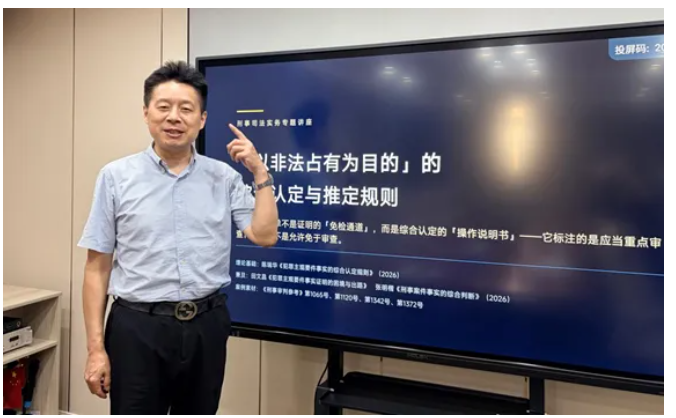
Panelist Attorney Zhu Dongsheng applied these general rules to the frequently contested offense of fund-raising fraud. He first outlined that the phrase “with the intent to illegally appropriate” appears explicitly in 14 provisions of the Criminal Law, primarily concentrated in financial fraud offenses and contract fraud; however, it is also an essential element in crimes such as robbery, theft, fraud, embezzlement, and graft. Drawing on a fundraising fraud case he is currently handling, he explained that the defendant began in the photovoltaic industry—a sector receiving key state support—and subsequently expanded into environmental protection, ecological agriculture, health, and digital industries.