

In 2026, the *Ecological and Environmental Code of the People’s Republic of China* officially came into effect, marking the entry of China’s legal framework for ecological, environmental, and resource protection into a new era of codification. The four key areas—environment, food, pharmaceuticals, and intellectual property—are closely tied to people’s well-being, ecological security, and innovative development, and represent the key priorities, challenges, and focal points of current criminal justice and administrative law enforcement.
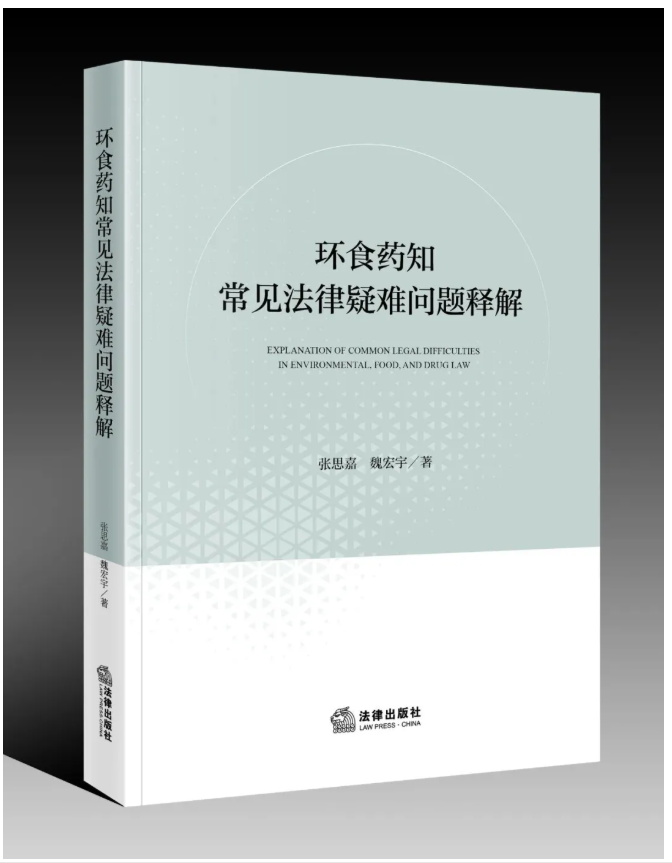
To address practical needs following the codex’s implementation and resolve long-standing challenges in handling crimes related to the environment, food, pharmaceuticals, and intellectual property, this book was co-authored by two frontline experts: Zhang Sijia, a seasoned criminal defense attorney specializing in environmental, food, pharmaceutical, and intellectual property crimes, and Wei Hongyu, a national-level expert in procuratorial affairs. with a foreword personally written by Yuan Bin, Professor and Ph.D. advisor at the School of Law and the Institute of Criminal Legal Science at Beijing Normal University. This landmark practical work—*Explanation of Common Legal Difficulties in Environmental, Food, Drug, and Intellectual Property Crimes*—has been fully endorsed by four authoritative experts: Wang Canfa, Level 2 Professor and Ph.D. advisor at China University of Political Science and Law; Su Haopeng, Professor at the School of Law, University of International Business and Economics, and President of the Beijing Food and Drug Safety Legal Research Association; Liu Yunyun, Professor at the School of Law, Beijing Technology and Business University, and Director of the Food Safety Law Research Center; and Ma Tao, Associate Professor at North Minzu University and Ma Tao, Associate Professor and Master’s Supervisor at Northern Minzu University—have all endorsed this landmark practical work in full: *Explanations of Common Legal Issues in Environmental, Food, Drug, and Intellectual Property Crimes*, which was officially published by China Law Press in early April 2026!
Rooted in judicial practice, closely aligned with the latest legislation, and focused on core legal challenges in the fields of environmental protection, food and drug safety, and intellectual property, this book is an authoritative practical reference that truly serves judges, prosecutors, attorneys, administrative law enforcement officers, and legal scholars.
Professor Yuan Bin writes the foreword, providing a precise analysis of the book’s six key features

First, it focuses on key areas to address judicial pain points. The book precisely targets core crime types across four major fields—all of which currently feature a high volume of cases, concentrated disputes, and significant public attention in judicial practice. Rather than offering a general discussion of the theoretical foundations of criminal charges, the book directly addresses the most critical “difficult issues” within each category of crime—specifically those points of divergence frequently encountered in judicial proceedings and in urgent need of clarification—demonstrating strong targeted focus.
Second, the book features a clear systematic division and a well-structured, logical framework. The book adopts a “general-to-specific” structure, organizing its content into three parts centered on the four major crime categories (with food and drug crimes combined into a single part). Within each part, specific complex issues are organized based on the relationship between criminal charges and the nature of the problems. All discussions revolve around six core judicial issues—“standards for applying criminal charges, determination of key elements, distinctions between offenses, determination of accomplices, assessment of amounts and circumstances, and the interface between criminal and administrative penalties”—forming a unified framework for problem analysis.
Third, grounded in judicial practice, the book emphasizes a problem-oriented and solution-oriented approach. The writing philosophy of “prioritizing practical needs” runs throughout the book; all topics stem from real-world challenges encountered in judicial practice rather than purely theoretical discussions. In terms of the issues addressed, the book covers both traditional challenges and new challenges posed by emerging forms of crime, balancing traditional and contemporary issues to align with current judicial practice. It provides clear adjudication guidance for judicial practitioners, emphasizing a solution-oriented approach.
Fourth, the book provides a detailed breakdown of elements, focusing precisely on key factors. It delves deeply into the complex issues of each type of crime, concentrating its analysis on the “key points of ambiguity” within the elements of criminal offenses to avoid generalizations. It proceeds layer by layer in the areas of determining the elements of a crime, establishing liability, and sentencing and disposition, forming a complete analytical chain of “element breakdown—controversy analysis—rule clarification” to provide precise guidance for judicial adjudication.
Fifth, it balances the integration of administrative and criminal enforcement to address diverse governance needs. The book pays close attention to the important issues of “integration of administrative and criminal enforcement” and “reverse integration of administrative and criminal enforcement” in current rule-of-law development. It dedicates specific sections in all three parts to explore these issues, reflecting a comprehensive focus on the entire chain of crime governance.
Sixth, it covers both traditional and emerging crimes, responding to the demands of the times. While the book remains committed to in-depth exploration of complex issues surrounding traditional crimes, it also actively addresses the judicial challenges posed by new forms of crime and emerging transaction models. It precisely responds to the new demands for crime governance arising from the development of the digital economy and cross-border trade, ensuring the content remains contemporary and forward-looking.
Jointly Recommended by Multiple Authoritative Experts

The challenges in judicial practice are the focal points of legal research. Adopting a problem-oriented approach, this book systematically examines common legal challenges related to environmental pollution, food and drug safety violations, and intellectual property infringement. Covering fifty core topics and dozens of practical points of contention, it features clear logic and comprehensive content. By closely aligning with the spirit of the latest legislation and judicial interpretations while incorporating lessons from typical case rulings, the book achieves an organic integration of theoretical analysis and practical application, providing an important reference for precisely combating relevant crimes and unifying judicial standards.

Combating crimes against the environment and natural resources, food and drug safety, and intellectual property is a vital task in the rule of law in the new era, and a key lever for safeguarding people’s well-being and facilitating high-quality development. This book precisely targets major complex issues in judicial practice across these four fields. From the delineation of criminal charges to the liability of accomplices and the coordination between administrative and criminal enforcement, it breaks down each layer and provides precise answers. It offers both in-depth analyses of traditional challenges in case handling and cutting-edge explorations of new forms of crime, combining theoretical depth with practical relevance. It serves as an indispensable practical guide for frontline judicial personnel and legal researchers.

Moving beyond the framework of traditional theoretical research and centering on practical needs, this book systematically organizes the legal application challenges in environmental and resource, food and drug, and intellectual property crimes into separate sections. Each topic is rooted in real-life cases, featuring in-depth analysis and pragmatic perspectives. It not only clarifies gray areas in judicial application but also builds a bridge between theory and practice. It holds significant practical importance for enhancing the case-handling capabilities of judicial personnel, deepening legal research in relevant fields, and advancing the modernization of crime governance.

How should causation be established in environmental pollution crimes? How should the value of illegally felled timber be calculated? These thorny issues that have long plagued the judicial community have finally found a “book of answers.” Both authors of this book come from the front lines of case handling: one is a seasoned criminal defense attorney with deep expertise in the field, and the other is a nationally recognized outstanding prosecutor with extensive case experience. Drawing on the dual perspectives of “defense” and “prosecution,” they focus on the most challenging issues in crimes related to the environment, food, drugs, and intellectual property. The book offers both in-depth analyses of legal principles and practical wisdom for resolving real-world challenges, successfully uniting theoretical depth with practical value. It is an indispensable reference for judicial officials and legal practitioners.
Core Content and Theoretical/Practical Value of This Book
Closely aligned with the latest legislative spirit of the *Ecological and Environmental Code*, this book centers on criminal judicial practice in the fields of environmental protection, food and drug safety, and intellectual property. Divided into three parts—environmental and resource crimes, food and drug crimes, and intellectual property crimes—it systematically addresses fifty core legal challenges in these areas, covering dozens of high-frequency practical points of contention. Grounded entirely in real-world case scenarios and focused on the pain points of legal application, the book avoids abstract theoretical discourse, making it a professional work deeply rooted in judicial practice.
I. Key Features of the Content
Problem-oriented: All topics are drawn from real-world challenges on the front lines of the judiciary, directly addressing bottlenecks in case handling and discrepancies in judicial rulings
Practice-centered: Closely aligned with the latest legislation, judicial interpretations, and landmark cases, while addressing both traditional legal challenges and emerging crimes
Systematically structured, the book organizes content around the application of criminal charges, determination of essential elements, distinctions between offenses, liability of accomplices, monetary thresholds and aggravating circumstances, and the interface between criminal and administrative penalties, featuring rigorous logic and a clear hierarchical structure
Aiming for precision, the book systematically dissects ambiguities in legal application, difficulties in determining essential elements, and key points in evidence review, providing clear practical guidance
II. Theoretical Significance
Closely aligned with the implementation of the *Ecological and Environmental Code*, this work fills a professional gap in research on the application of the Code and practical practices in the fields of environmental, food, drug, and intellectual property law
It builds a bridge between theoretical research and judicial practice, deepening research on the rule of law in the governance of environmental, food, drug, and intellectual property crimes
It unifies judicial reasoning, clarifies standards for the application of law, and helps advance the modernization of crime governance in these relevant fields
III. Practical Value
Provides judges and prosecutors with practical references for consistent adjudication standards, improving the quality and efficiency of handling complex cases
Offers criminal defense attorneys precise defense strategies, enabling them to quickly identify breakthroughs in cases and enhance the effectiveness of professional defense
Provides administrative law enforcement officers with operational guidelines for coordinating administrative and criminal proceedings, standardizing case transfers and the application of law
Provides legal researchers with practical case studies, facilitating a deeper integration of theoretical research and practical teaching
Author Biography
Zhang Sijia, attorney at Beijing King&Capital Law Firm; Master’s degree holder; Deputy Director and Secretary-General of the King&Capital Legal Research Center for Environment, Food, Drugs, and Intellectual Property; member of the Environment and Resources Committee of the Beijing Lawyers Association and head of its Criminal Defense Group; researcher at the Food Safety Law Research Center of Beijing Technology and Business University; expert in the “Rule of Law Daily” attorney expert database; off-campus mentor for undergraduates at the School of Food and Pharmacy, Xuchang University; council member of the Civil and Commercial Law Research Association of the Ningxia Law Society; expert on the Drug Safety Expert Committee of the Ningxia Drug Administration; and expert advisor to multiple administrative and judicial agencies, including the Shizuishan Municipal Market Supervision Administration in Ningxia and the Nanhua County Public Security Bureau in Yunnan Province. He is the author of *Theoretical Exploration and Practical Analysis of Ecological and Environmental Crimes*, *Handbook on Handling Food and Drug Cases*, and *Explanations of Complex Legal Issues in Environmental, Food, Drug, and Intellectual Property Law*.
Wei Hongyu holds a Master of Laws from China University of Political Science and Law. He has been honored as a National Outstanding Public Prosecutor, a National Expert in Procuratorial Affairs, and an Advanced Worker in the National Procuratorial System. He was awarded a First-Class Merit by the Supreme People’s Procuratorate and has received multiple Second- and Third-Class Merits. He has been selected for the National Procuratorial System’s Expert Pool for Serious Crimes, the Autonomous Region’s Expert Pool for Rule of Law Construction, and the Regional Public Security Bureau’s Expert Pool for Economic Crime Investigation. He has served as Chief Prosecutor of the Lingwu City People’s Procuratorate and Deputy Chief Prosecutor of the Yinchuan City People’s Procuratorate. He currently serves as a member of the Procuratorial Committee and Director of the Department of General Criminal Prosecution at the People’s Procuratorate of the Ningxia Hui Autonomous Region. He is the author of *Theoretical Exploration and Practical Analysis of Ecological and Environmental Crimes* and has led or participated in more than 10 research projects commissioned by the Supreme People’s Procuratorate, the Ningxia Autonomous Region Law Society, and the People’s Procuratorate of the Ningxia Hui Autonomous Region.
New Book Release Information
Title: *Explanations of Common Legal Issues in Environmental, Food, and Drug-Related Crimes*
Authors: Zhang Sijia, Wei Hongyu
Publisher: China Law Press
Publication Date: Early April 2026