

Recently, the People’s Rule of Law Network published an exclusive interview titled “Understanding Judgments, Understanding Defense Even Better: From Chief Judge of the Criminal Court to Criminal Defense Attorney, Attorney Zang Desheng Forges a Path of Constructive Interaction Among Prosecution, Defense, and the Judiciary.” The article takes an in-depth look at the professional journey of Zang Desheng—a senior partner at King&Capital law Firm and director of the King&Capital Research Center for Complex Criminal Cases—from judge to defense attorney. It introduces Attorney Zang’s systematic defense methods, unique defense philosophy, and the positive results achieved in actual cases, showcasing the proactive thinking and tireless efforts of King&Capital lawyers toward the development of the legal profession and the advancement of the rule of law.
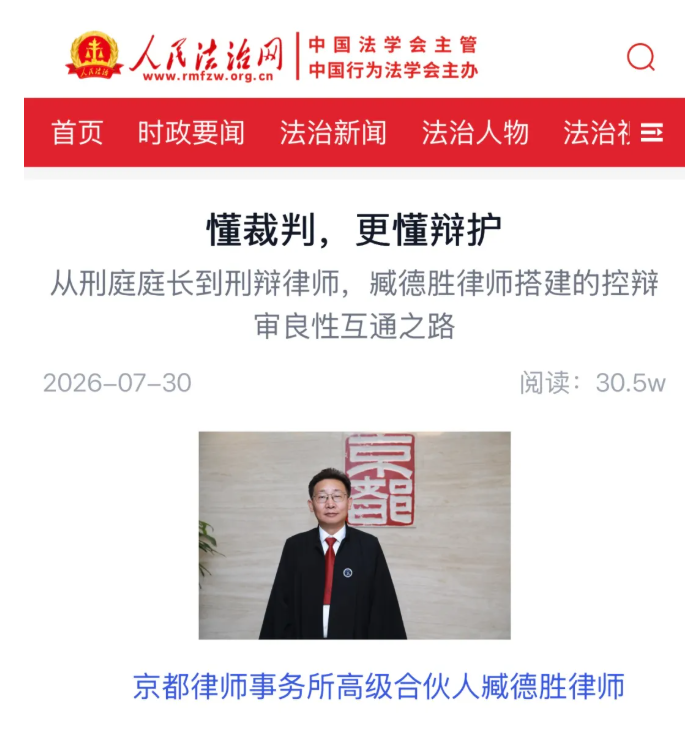
Dual Professional Background:
The Original Aspiration for the Rule of Law—From the Bench to the Defense Table
Attorney Zang Desheng holds a Master’s degree in Criminal Law from China University of Political Science and Law and a Ph.D. in Procedural Law from City University of Hong Kong. With nearly two decades of experience serving as a frontline criminal judge and division chief at grassroots-level courts, he has presided over more than 2,000 criminal cases and possesses a deep understanding of judicial reasoning, standards for admitting evidence, and the underlying rules governing judicial proceedings.

Attorney Zang Desheng previously served as the Chief Judge of the Criminal Division at a Beijing court
After hanging up his judicial robe, Attorney Zang Desheng joined King&Capital law Firm as a senior partner, completing his career transition from criminal judge to full-time criminal defense attorney. This choice was not merely a career trade-off, but a continuation of his original commitment to the rule of law. During his many years of judicial work, he witnessed firsthand how many individuals caught up in criminal proceedings struggled to protect their legitimate rights and interests due to a lack of legal expertise, creating an urgent need for professional criminal legal services.
After changing roles, he fully transformed the judicial standards, rules of evidence, and case adjudication logic he had honed over two decades of judicial practice into defense capabilities. As a judge, he upheld impartiality and fairness; as a lawyer, he directly addresses his clients’ most fundamental rights—personal liberty, reputation, and family stability—building a strong defense to safeguard the rights of those in distress.
While deeply engaged in case handling, Attorney Zang Desheng has also actively dedicated himself to industry development and academic research. He serves as a council member of the Case Law Research Association of the China Law Society and is the author of several professional works on criminal defense, including *The Three-Step Method for Effective Defense*, *How Judges Think*, and *How Judges Render Judgments*, continuously advancing the standardization and systematization of criminal defense.
Empowering Defense Through a Judicial Perspective:
Tackling Complex Cases with Meticulous Defense
Since transitioning to criminal defense, Attorney Zang Desheng has specialized in major, complex, and challenging criminal cases. His practice covers a wide range of cases, including major official misconduct, economic crimes committed by corporate executives, sexual assault cases involving acquaintances, fraudulent litigation, and corporate crimes. In numerous cases, he has achieved favorable outcomes such as no indictment, acquittal on appeal, remand for retrial, suspended sentences, and significant reductions in penalties.
This report uses the second-instance case of Zhang Moumou, who was accused of rape, as a representative example to illustrate his unique defense strategy rooted in judicial reasoning. In this case, the first-instance court, relying on the victim’s statement that her memory was hazy after drinking alcohol, presumed that she had lost the capacity for sexual self-defense and ruled that the defendant was guilty of attempted rape.
After the defense team intervened in the second-instance proceedings, they analyzed the prosecution’s line of reasoning based on the totality of the evidence: the victim’s unclear memory did not equate to a loss of the ability to recognize or defend against the act; the objective fact of alcohol consumption could not directly imply that the sexual act was against the woman’s will; and it was necessary to examine the defendant’s subjective intent to determine whether the required mental element for the crime of rape was established. The defense team actively obtained key electronic evidence, such as WeChat chat records, and submitted legal opinions on multiple occasions. Through effective defense, the client’s coercive measures were changed to release on bail pending trial, the case was remanded for retrial, and subsequently, the procuratorate withdrew the indictment and issued a decision not to prosecute, ultimately clearing the client’s name.
The handling of this case also serves as a reference for the examination of evidence in sexual assault cases involving acquaintances under the influence of alcohol. It challenges the simplistic judicial mindset that “reporting an incident while intoxicated automatically constitutes sexual assault” and establishes defense strategies emphasizing the priority of securing easily perishable electronic evidence in cases involving private settings.

Attorney Zang Desheng attending a seminar
Drawing on his experience as a judge, Attorney Zang Desheng has developed a distinctive defense strategy: he precisely identifies the focal points of court proceedings and challenges evidence directly at its core; his courtroom arguments align with judicial logic, presenting clear and pragmatic arguments; his sentencing defense thoroughly references the sentencing standards of similar cases to propose realistic and feasible solutions; and he maintains rational and constructive communication with investigative authorities to minimize fruitless confrontation, ensuring that defense arguments are genuinely accepted by the court.
The Three-Step Method for Effective Defense:
Building a Reproducible System for Criminal Defense Practice
Based on experience gained from adjudicating over 2,000 cases, Attorney Zang Desheng has distilled a core case-handling methodology—the Three-Step Method for Effective Defense. Rooted in the three fundamental principles of criminal law, this approach establishes a standardized, step-by-step defense pathway.
Fact-Based Defense—Grounded in the Presumption of Innocence
Comprehensively review all evidence in the case file, identify contradictions in the evidence, procedural flaws, and breaks in the chain of corroboration, and argue that the facts alleged are in doubt, thereby undermining the foundation for conviction at its source. The aforementioned rape case on appeal is a classic example of this fact-based defense.
Argument Against Conviction—Grounded in the Principle of Legality
Even if the underlying facts can be confirmed, we conduct a meticulous analysis of the elements of the crime to clarify the boundaries between criminal and non-criminal conduct, as well as between different offenses, striving to secure an acquittal or a reduction to a lesser charge.
Sentencing Defense—Grounded in the Principle of Proportionality Between Crime and Punishment
When the scope for an acquittal defense is limited, we exhaustively identify statutory and discretionary mitigating factors, combine them with judicial precedents, and propose pragmatic sentencing recommendations to seek favorable outcomes such as a lighter sentence, probation, or a decision not to prosecute.
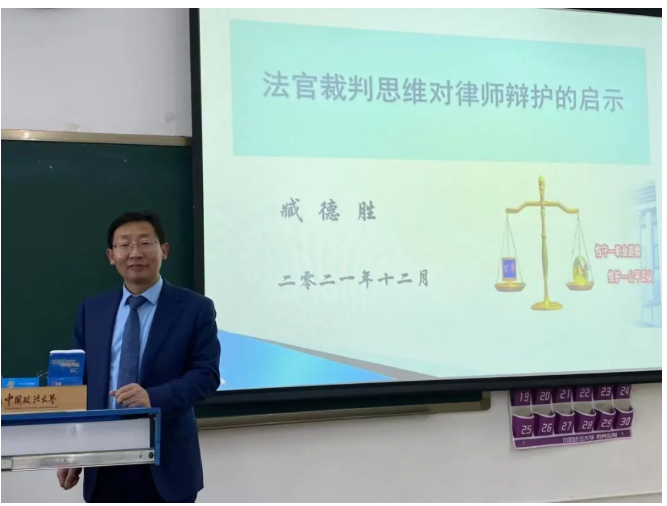
Attorney Zang Desheng teaching graduate students at China University of Political Science and Law
This methodological framework permeates the entire process—from evidence analysis and courtroom arguments to sentencing negotiations and case forecasting. It breaks down the mental barriers between the prosecution and the defense, moves beyond a purely adversarial mindset, and designs defense strategies from the perspective of judicial adjudication. It is applicable not only to major and complex cases but also provides a practical, actionable guide for fellow criminal defense attorneys. At the same time, it redefines effective defense: the value of defense is not limited to acquittals or dismissals; a defense that influences the judge’s conviction and drives the outcome in the client’s favor constitutes a substantively effective defense.
Industry Observations and Advice for Young Professionals:
Building a Healthy Criminal Legal Ecosystem
In an exclusive interview, Attorney Zang Desheng drew on his dual professional experience to interpret the industry changes brought about by the implementation of the universal defense coverage system. He believes that extending universal defense coverage to the investigation and prosecution review stages can help clients obtain legal assistance earlier, secure evidence in a timely manner, avoid the adverse consequences of making uninformed confessions, and achieve a further balance of power between the prosecution and the defense.
At the same time, he also pointed out that there is still room for improvement in the industry’s institutional framework: professional rights—such as lawyers’ access to clients, review of case files, investigation and collection of evidence, and full courtroom debate—should be strictly enforced; a standardized response mechanism should be established for various applications submitted by lawyers, with written justifications required for any denials; channels for redress should be improved when lawyers’ rights are infringed; rules regarding professional immunity should be refined to clarify the boundary between lawful defense and obstruction of justice; establish a regular communication platform between the public security, procuratorial, judicial, and correctional authorities and lawyers to build consensus within the rule-of-law community.

Attorney Zang Desheng Attends the Criminal Defense Summit Forum at Northwest University of Political Science and Law
Addressing young criminal defense attorneys, Attorney Zang Desheng summarized his nine-character advice for professional growth: “Act with integrity, argue with precision, and maintain clarity.”
“Conduct with integrity” is the foundation of practice: be candid with clients without exaggerating case outcomes, and communicate with investigative and prosecutorial authorities with neither subservience nor arrogance;
“Argue with precision” is the core of professionalism: identify key defense arguments based on the facts of the case and the law, and formulate appropriate defense strategies;
“Maintain clarity” reflects strategic wisdom: distinguish between primary and secondary issues in a case, view litigation outcomes rationally, and manage the pace of the defense.
These three qualities complement one another and serve as the vital foundation for young legal professionals to proceed steadily and achieve long-term success.
Upholding Faith in the Rule of Law:
Applying the standards of a judge with the heart of a judge, and safeguarding individual rights with the responsibility of a lawyer
“Applying the standards of a judge with the heart of a judge, and safeguarding individual rights with the responsibility of a lawyer.”
This is the most vivid commentary on Attorney Zang Desheng’s two phases of his legal career. When presiding over a court, he strictly upholds neutrality and balances the interests of all parties; when standing at the defense table, he exhausts all lawful means to safeguard the freedom and dignity of ordinary people. Though his role has changed, his original commitment to seeking justice in individual cases remains unwavering.
In his view, high-quality criminal defense does not lie in fierce confrontation, but in rationality, precision, and a solid factual basis. Moving forward, Attorney Zang Desheng will continue to leverage the platform provided by King&Capital Law Firm: on the one hand, he will delve deeply into major and complex criminal cases, practicing meticulous defense; on the other hand, he will continue to share practical insights to empower the development of the criminal defense industry, using his professional expertise to safeguard the legitimate rights and interests of every client.