
On July 10, 2026, Beijing King&Capital (Shanghai) Law Firm successfully hosted a practical seminar on the validity of wills and family wealth succession. The seminar was led by Attorney Gong Ke, a senior partner at King&Capital’s Shanghai office, with Jin Jia serving as a discussant. Senior Partner Jiang Yongqian delivered a presentation on family wealth succession, while Attorney Guo Chunyan explained the continued validity of wills following changes in the form of assets. The seminar featured in-depth discussions on core topics such as the review of formal requirements for wills, the determination of substantive intent, the continued validity of wills following changes in the form of assets, and the combination of family wealth succession tools. Attorneys Zhu Jilei, Ba Bo, Guo Hepu, and Lu Xianghui from King&Capital’s Shanghai office participated in the discussion.
I. The Dual Challenges of the Era: A Surge in Will Disputes and Soaring Demand for Wealth Succession
As China’s population ages at an accelerating pace, the number of inheritance disputes has remained consistently high. According to publicly available judicial data, the annual caseload for inheritance disputes has reached tens of thousands in recent years, exhibiting notable characteristics such as increasingly complex asset structures and diversified family relationships. At the same time, the wealth accumulated over more than four decades of reform and opening-up is entering a concentrated phase of intergenerational transfer. A senior population of 323 million has created a massive demand for wealth succession, giving rise to an urgent need for professional and systematic succession planning services.
As the foundational tool for wealth succession, the validity of a will directly impacts the fulfillment of the decedent’s true intentions and the stability of family relationships. Against this backdrop, the Shanghai branch of King&Capital Law Firm organized this thematic seminar, aiming to enhance the legal team’s comprehensive service capabilities in the fields of inheritance law and family wealth planning through in-depth analysis of typical cases and a systematic review of succession tools.
II. Attorney Gong Ke Shares Challenges in Proving Handwriting Authentication for Holographic Wills
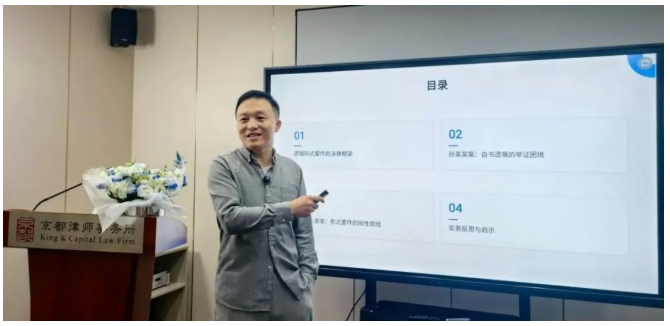
Taking a holographic will dispute—which went through first-instance proceedings, an appeal, and was remanded for retrial—as a starting point, Attorney Gong Ke systematically examined the allocation of the burden of proof in cases where handwriting authentication yields an “inconclusive” result.
Key Points of the Case: While critically ill, the decedent, Sun XX, executed a holographic will, bequeathing one-third of his total estate to his sister, one-third to his brother, and one-third to his former brother-in-law (from whom he had been divorced for over twenty years), leaving nothing to his spouse or only son. The party in possession of the will submitted a front-view photograph of the decedent holding the will, a top-down photograph of the writing process, and witness testimony. The defendants (the spouse and son) challenged the authenticity of the will. After requesting a handwriting analysis, the forensic institution issued a conclusion stating, “Based on the available samples, it is impossible to determine whether the handwriting on the specimen was written by the test subject.”
Discussion Focus:
• Boundaries of the Burden of Proof: Has the party asserting the will’s validity fulfilled its preliminary burden of proof? When the expert conclusion is “unable to determine,” has the party questioning the will’s authenticity exhausted all means of proof?
• Integrity of the Chain of Evidence: How do factors such as the absence of original media for photographic evidence, the loss of the original draft, and the fact that the photographer is an interested party affect the rules for admitting evidence?
• Legal Capacity of the Deceased: Whether the deceased’s legal capacity was sufficient to support an independent and clear expression of intent when the will was executed while in a critical condition (end-stage uremia, having just completed CRRT treatment).
The participating attorneys engaged in a lively discussion on the above issues. The majority opinion held that, within the framework of existing rules of evidence, although the photographic evidence lacks an original medium, it has been appraised as showing no signs of tampering. When combined with the front-view photograph of the decedent holding the will and photographs of the writing process, it constitutes a preliminary chain of evidence. If the opposing party argues that the will is invalid, they must provide further evidence supporting their claim from the perspectives of the authenticity of the expression of intent (such as whether coercion or inducement existed) or a lack of legal capacity, rather than focusing solely on the single dimension of the authenticity of the handwriting.
III. Core Issue 2: The Rigid Bottom Line of Formal Requirements That Cannot Be Transgressed
The second case shared by Attorney Gong Ke in his lecture focused on a “classification-defying” will. The decedents, an elderly couple named Chen and Xue, executed a will in 2003. The entire text was written by the wife, Xue, while the husband, Chen, merely signed it; two witnesses also signed the document. The will bequeathed the real estate to their eldest grandson. The dispute in this case centered on whether the will constituted a holographic will, a dictated will, or some other form.
The Dilemma of Formal Review:
• If it is deemed to be a holographic will written by the wife, Xue, then the portion disposing of her own share of the property is formally flawless; however, since the husband, Chen, only signed it without writing it himself, it does not meet the requirements for a holographic will.
• If it is deemed to be a written-on-behalf will of the husband, Chen, then the scribe, Xue, is simultaneously a direct party with a stake in the disposition of the estate (one of the heirs), and the two witnesses did not witness the entire process of dictation and writing, resulting in significant procedural defects.
• The court of first instance avoided determining the statutory type of the will on the grounds of “joint expression of intent,” thereby effectively blurring the boundaries of formal requirements.
Consensus from the seminar: A will is a formal legal act, and formal requirements serve as the final line of defense established by the legislature to ensure substantive justice through procedural justice. When a will is formally “neither one thing nor another,” judges must not bypass formal review and directly deem it valid on the grounds of “substantive authenticity.” Otherwise, a “will” would lose its legal status as a sacred end-of-life testament and degenerate into an ordinary document that can be arbitrarily forged after the fact. The relevant guiding principles of the Supreme People’s Court also make it clear: a holographic will that does not meet the statutory formal requirements should not be deemed valid; by analogy, a document whose type cannot be determined should certainly not be granted legal effect.
IV. Core Issue 3: A Six-Tool Combination for Family Wealth Succession
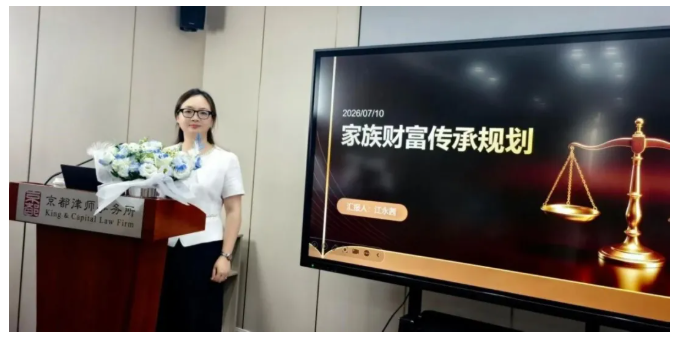
In the second half of the lecture, Attorney Jiang Yongqian delivered a special presentation on family wealth succession planning, systematically outlining the practical challenges faced by high-net-worth individuals in wealth succession and the tools available to address them.
The Three Dimensions of Succession Challenges:
• Population Aging: With 323 million elderly people, we are entering a peak period for intergenerational wealth transfer, and inheritance cases are on the rise.
• Increasingly Complex Asset Structures: The shift from a single “property” to diversified “asset portfolios” encompassing real estate, financial assets, business assets, digital assets, and intellectual property has significantly increased the difficulty of asset division.
• Diversifying Family Structures: New family dynamics—such as remarried families, blended families, childless and empty-nest families, and children born out of wedlock—have led to frequent disputes over the identification of heirs and the allocation of shares.
Six Major Wealth Transfer Tools and Their Functions:
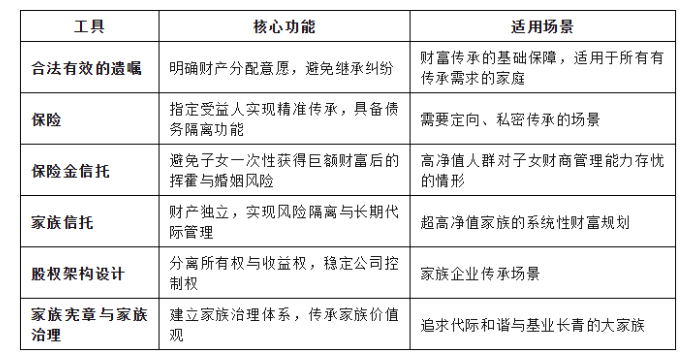
Attorney Jiang Yongqian particularly emphasized that the best legacy is not merely assets, but love and sound family values. She noted that wealth succession planning is not just about applying legal tools, but also about perpetuating family values; the value of a lawyer extends beyond representing clients in court to helping them “prevent problems before they arise,” fostering an awareness of “advance planning and systematic arrangements.”
V. Core Issue 4: Continuation of a Will’s Validity Following Changes in the Form of Property
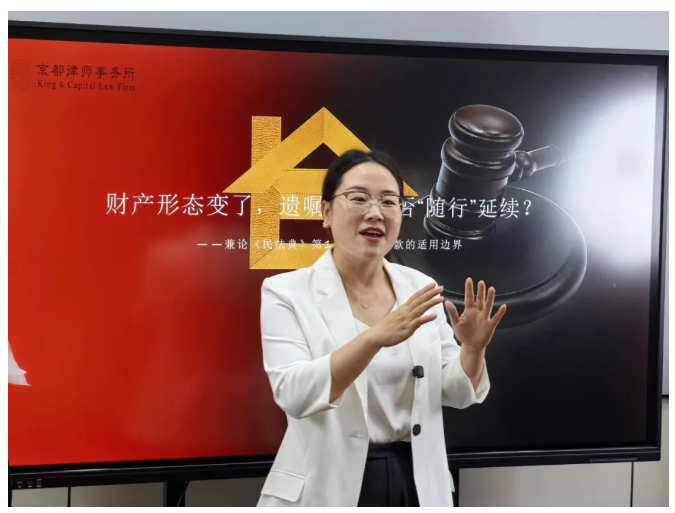
Attorney Guo Chunyan from King&Capital Law Firm’s Shanghai office delivered a special presentation on the application of Article 1142, Paragraph 2 of the Civil Code in the context of housing demolition and expropriation.
Evolution of Legal Provisions: From Article 39 of the 1985 “Opinions on the Law of Succession” to Article 1142, Paragraph 2 of the Civil Code, the legislation has adjusted the concept from “acts contrary to the testator’s intent” to “civil legal acts contrary to the content of the will,” replacing “revocation” with “withdrawal,” thereby enhancing the flexibility of the provision.
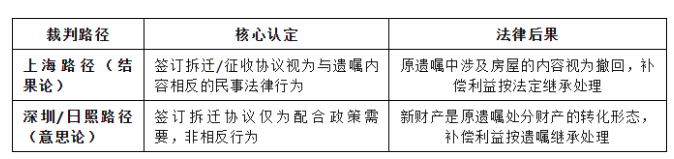
Attorney Guo Chunyan pointed out that courts in the Shanghai region generally favor a “consequentialist” approach to adjudication, whereby the testator’s act of signing a demolition agreement is presumed to constitute an implied revocation of the will. However, in specific cases, it is still necessary to comprehensively consider evidence—such as whether the testator possessed the objective conditions to execute a new will, the existence of a catch-all clause, and records of the testator’s日常 statements—to determine whether the testator subjectively intended to revoke the will.
Practical Recommendations:
1. At the time of drafting the will: Include a catch-all clause explicitly stipulating that “in the event of demolition or expropriation of the property, the compensation received shall still be inherited by the designated heirs in accordance with the proportions set forth in this will.”
2. After the demolition process begins: Promptly advise clients to consider updating their wills to preserve their decision-making flexibility.
3. Dispute resolution stage: Construct a chain of evidence centered on “objective conditions” and “subjective intent,” and apply the rules of interpretation of expressions of intent to argue that the signing of the will does not constitute a “contrary civil legal act.”
4. Consider regional differences: In regions such as Shenzhen, which lean toward the “theory of intent,” one can more boldly assert the continued validity of the will; in Shanghai, however, litigation risks must be assessed with greater caution.
VI. Conclusion: Striking a Balance Between Form and Substance
Through in-depth analysis of typical cases and a systematic review of wealth succession tools, this lecture revealed the core tension in the fields of testamentary succession and wealth succession: How to balance the rigid bottom line of formal requirements with the flexible exploration of substantive intent? When a handwriting analysis concludes that “it cannot be determined,” how is the burden of proof allocated? After changes in the form of assets, does the testator’s true intent refer to the physical form or the property rights themselves? Faced with complex family structures and diverse forms of property, how can legal tools be combined and applied to ensure a smooth transition of family wealth?
The participating attorneys unanimously agreed that a will is the testator’s final message to the world, and the role of the law is to ensure that this message is as free from misunderstanding and distortion as possible. The true essence of family wealth succession lies in making wealth the cornerstone of family happiness, rather than a source of conflict. As professional legal service providers, attorneys should engage in risk prevention and control from the very outset of the will-drafting process. By employing measures such as full audio and video recording, incorporating fallback clauses, regularly updating wills, and comprehensively utilizing tools like insurance and trusts, they can minimize the likelihood of future disputes. When disputes do arise, attorneys must construct a multi-dimensional argumentative framework—drawing on evidence rules, the interpretation of expressions of intent, and regional judicial trends—to safeguard their clients’ original intentions.
King&Capital law Firm will continue to monitor practical developments and theoretical advancements in the fields of inheritance law and family wealth planning, providing clients with high-quality legal services through a professional, rigorous, and rational approach.
Translated with DeepL.com (free version)