

The China Securities Regulatory Commission (CSRC) determined that a certain listed company had failed to truthfully and accurately disclose information regarding related-party transactions totaling over 4 billion yuan and an acquisition totaling over 5 billion yuan. As a result, the CSRC imposed administrative penalties on the listed company and its senior management and referred the case to public security authorities for investigation on charges of illegal disclosure and failure to disclose material information. Wang, the company’s vice chairman and executive vice president, was placed under criminal detention by public security authorities.
Attorneys Zhang Qiming and Xu Ming of King&Capital Law Firm served as Mr. Wang’s defense counsel. Within more than 30 days, they carried out a series of legal actions and successfully secured a decision not to approve his arrest.
I. Thoroughly Reviewing Administrative Proceedings Materials,
Quickly Identifying the Key Points of Dispute
In most securities crime cases, after administrative penalties are imposed, the case is transferred to public security authorities to enter criminal proceedings either during or after the conclusion of administrative litigation. Defense work during the arrest approval phase is characterized by tight deadlines and a lack of transparency; the ability to quickly identify the focal points of the dispute and take appropriate countermeasures is crucial to the case’s outcome.
After attorneys Zhang Qiming and Xu Ming became involved in the case, they promptly collected materials from the administrative proceedings. With nearly 400 GB of relevant administrative documents and electronic data, the legal team divided responsibilities and worked overtime to analyze the information. Preliminary analysis revealed that the administrative penalty had identified eight instances of information disclosure violations, with the client suspected of six of them; each instance involved complex transaction structures. The legal team meticulously analyzed the transaction processes and created charts to visualize each instance, thereby clarifying the sequence of events and the logic behind the penalties (see selected charts below).
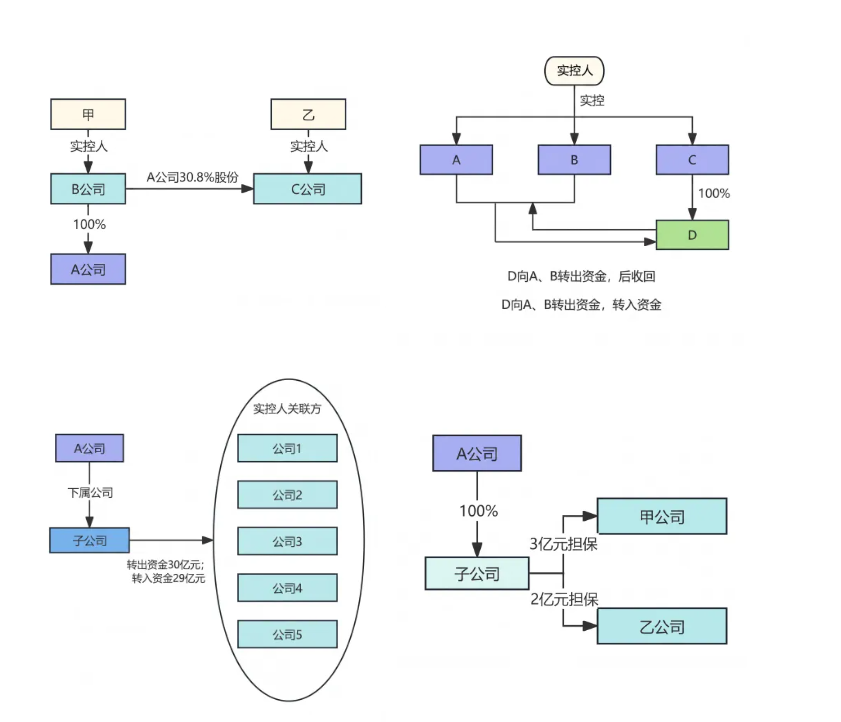
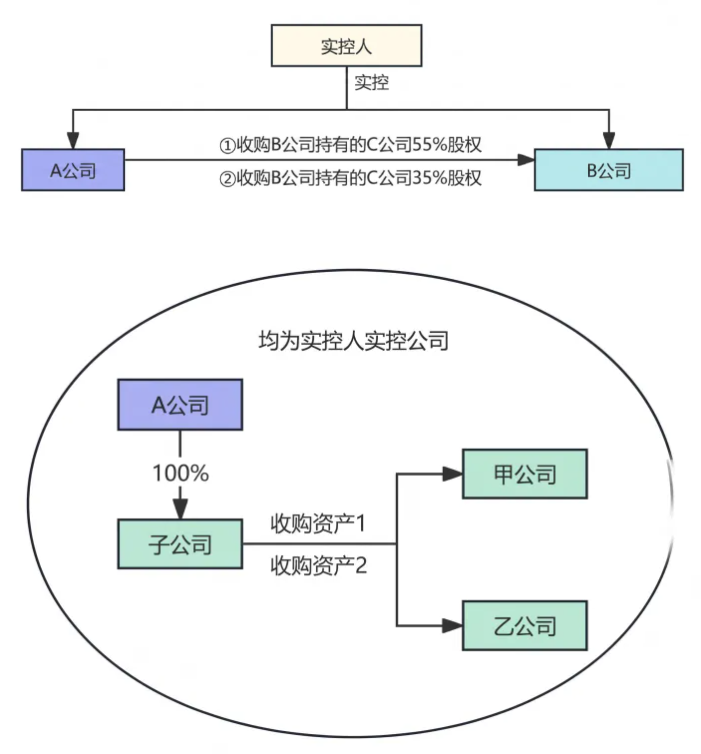
After thorough analysis, the legal team concluded that the six alleged violations centered on a change in the actual controller, while the remaining five—including related-party transactions and non-operational misappropriation of funds—were highly correlated with the issue of the actual controller. The lawyers noted that the client’s tenure as vice chairman coincided with a transition of power among the controlling shareholders. Consequently, whether the client was aware of the true actual controller—and whether there was contrary evidence to the contrary—became the key breakthrough in this case.
II. Multiple Meetings with the Client to Unify the Defense Strategy
The client’s fear stemming from the sudden loss of access to external information upon detention, the difficulty of adapting to group living in the detention center, emotional fluctuations caused by separation from family, and anxiety arising from uncertainty about the case’s outcome—all these emotions compounded, making meetings during the arrest approval phase crucial. These meetings were essential not only to reassure the client but also to clarify the direction and unify the defense strategy. Drawing on extensive experience in defending securities crime cases, the legal team clearly defined the focus and approach for each meeting, gradually clarifying and unifying the defense strategy.
III. Gathering Favorable Evidence Through Multiple Channels and Providing Thoroughly Reasoned Defense Arguments
Defense during the arrest approval phase is a “race” between the prosecution and defense over the facts of the case, and it represents the most critical window of opportunity to secure the support of the procuratorate. For defense arguments to be effective, they must be grounded in factual evidence. In securities crime cases, relying solely on formulaic arguments such as “first-time offender” or “occasional offender” fails to quickly address the core of the case’s facts and evidence—it is akin to a blind man riding a blind horse.
After clarifying the focus of the defense, the attorneys conducted a comprehensive investigation and evidence-gathering effort. They reviewed materials provided by the family, publicly available information, the company’s approval processes, financial records, and WeChat electronic data, collecting more than ten sets of evidence totaling over 100 pages. They annotated each piece of evidence to highlight the matters it proved and its key content. Based on this, they presented the defense’s version of the facts, drafted the defense brief, and submitted it immediately after the public security authorities filed the arrest warrant application.
The legal team argued as follows: First, the company’s meeting minutes confirm that Wang only became aware of the related-party transactions during a meeting held after the annual report was issued and had no prior knowledge of them. Second, after the annual report was issued, the company released a special statement regarding the misappropriation of funds, which aligns with Wang’s account and confirms that he immediately demanded the company disclose the facts truthfully upon learning of the related-party transactions. Third, the relevant intermediary institutions responded to the stock exchange’s inquiry letters with specialized opinions, confirming that they had also failed to detect the related-party transactions, thus refuting the allegation that Wang had knowledge of the transactions but failed to report them. Fourth, the company’s approval records show that the business line under Wang’s supervision did not involve the related-party transaction in question, making Wang’s account credible.
Prosecutorial authorities also paid close attention to the facts of the case and decided not to approve the arrest of Mr. Wang. After 37 days in custody, Mr. Wang was finally released.
IV. Summary of Key Defense Points in Cases Involving Improper Disclosure or Failure to Disclose Information
Since the General Office of the State Council issued the “Opinions on Further Strengthening Comprehensive Prevention and Punishment of Financial Fraud in the Capital Market” on July 5, 2024, the China Securities Regulatory Commission (CSRC) has investigated a total of 247 financial fraud cases, imposed administrative penalties in 156 cases, and referred 134 leads on financial fraud crimes to prosecutorial authorities. Prosecutorial authorities have filed indictments against 267 individuals involved in 95 financial fraud cases. Against this backdrop of stringent enforcement, this case has achieved positive interim defense results, and the defense strategies employed can serve as a reference for similar cases. Overall, the defense in cases involving the unlawful disclosure or failure to disclose material information can be structured around the following key points:
First, whether the defendant was subjectively aware of the financial fraud. The crime of non-disclosure of material information is an intentional offense, requiring the perpetrator to possess both the cognitive and volitional elements regarding the financial fraud. Defense counsel can review the entire course of the case with the client to understand the facts and determine whether subjective intent was present. Key areas to focus on include the client’s tenure, the signing of financial documents, and meeting minutes.
Second, whether the client objectively organized, decided upon, or directed the financial fraud, or merely signed the annual report. This aspect reflects the extent of the client’s involvement and their level of authority; generally, such determinations are already included in administrative penalty decisions. As a defense attorney, if the client is identified by regulatory authorities as having organized, decided upon, or directed the financial fraud, the primary focus should be on verifying whether there is corresponding evidence. Conversely, if the client is deemed by regulatory authorities to bear only managerial responsibility for signing the annual report, this indicates a relatively low level of involvement and lesser liability, thereby leaving room for a defense based on subjective intent.
Third, the distinction between administrative and criminal liability. In our previous report, *Observation Report on Securities Law Violations and Crimes in 2025, Part III: Annual Review of Information Disclosure Cases*, we conducted a comprehensive analysis of information disclosure violations throughout the year. We found that executives involved in such cases often defend themselves by citing reasons such as reliance on external audit results, having consulted the corporate secretary, having sought advice from professionals, or having been in office for a short period; however, these arguments are generally not accepted by regulatory authorities. Regulatory authorities generally hold that executives should either refrain from signing altogether or, if they do sign, must ensure the accuracy of the information; therefore, executives should exhaust all reasonable measures to proactively investigate and obtain the information necessary for decision-making. They must cast a dissenting vote on any issues already identified; otherwise, once they sign, they must bear responsibility. However, during the determination of criminal liability, defense counsel should focus on an independent assessment of criminal illegality. If an executive has exercised due diligence in conducting a review and formed a reasonable belief that there was no financial fraud, the executive should not be unduly required to conduct investigative activities akin to “administrative investigations” or “criminal investigations.” Defense counsel may argue that even if the executive committed an administrative violation, they should not bear criminal liability, building the defense on the hierarchical differences and substantive distinctions between administrative and criminal violations.
Judging by the current trends in combating financial fraud in the capital markets, a three-pronged accountability system encompassing civil, administrative, and criminal liability has essentially been established. The efficiency of the coordination between administrative and criminal proceedings has significantly improved, the scope of liable parties has continued to expand to lower levels, and, similarly, the standards for judicial determinations are becoming increasingly refined. Under this new normal, defending cases involving non-compliant information disclosure requires us to continuously monitor regulatory policies, enforcement precedents, and judicial rulings, and to consistently build up defense experience in similar cases. Only then can we provide more professional and comprehensive legal services to all market participants. Moving forward, we will continue our efforts to secure favorable outcomes for our clients in all aspects of their cases.
Translated with DeepL.com (free version)