

Recently, Attorney Qi Xiaoling, a senior partner at Beijing King&Capital Law Firm, was invited to participate in the expert symposium titled “Addressing Criminal Legal Risks in the Platform Economy,” hosted by the Center for Criminal Legal Science at Renmin University of China. Numerous experts, scholars, and practitioners from the fields of administrative law, social law, and criminal law—representing both academic and professional circles—attended the event via a hybrid online and in-person format.
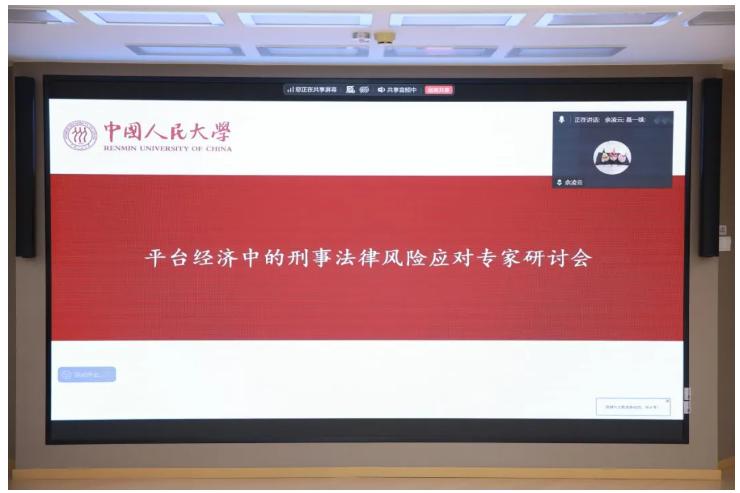
The platform economy employs a large number of flexible workers and is an important component of the national economy. This seminar focused on the current state of development of new platform-based business models, such as on-demand delivery and ride-hailing services, and conducted systematic discussions on core issues including the legal relationships among diverse entities in the platform economy, the application of workplace safety regulations, and the delineation of legal responsibilities across departments.

Attorney Qi Xiaoling began her presentation by discussing the 2018 case of a young woman from Wenzhou who was murdered while using Didi’s carpooling service. Drawing on recent traffic safety incidents involving ride-hailing and on-demand delivery services across various regions, she emphasized the need to be vigilant against the absence of risk control mechanisms amid rapid platform expansion and to prevent platforms from evading safety management obligations by citing “technology neutrality” or their status as intermediaries. Platforms should shift criminal risk prevention and control from post-incident damage control to the entire process of business design and daily operations, establish a routine criminal compliance system, and incorporate criminal risks into their corporate compliance frameworks. At the same time, criminal liability in the platform economy sector should adhere to the principles of restraint and precise attribution of liability. Criminal penalties should not be indefinitely expanded to cover platform negligence; furthermore, criminal liability must be predicated on specific breaches of duty, and the causal relationship between management actions and accident outcomes must be rigorously examined to avoid simplistic upward attribution merely because a platform is large or its workforce is involved in numerous accidents.

At the conclusion of the meeting, the moderator, Professor Shi Yanan of Renmin University of China, summarized the experts’ presentations. He noted that the symposium had identified the core challenges in managing criminal risks in the platform economy, and that the findings would serve as a theoretical reference for future legislative improvements, corporate compliance initiatives, and judicial rulings. He added that the research team would continue to conduct in-depth studies on the legal regulation of new business models.