

On August 24–25, 2026, the 24th China-South Korea Academic Symposium on Criminal Law was grandly held at the Cologne Hotel in Gyeongju, South Korea. Co-hosted by the Korean Society of Comparative Criminal Law, the Chinese Society of Criminal Law, and the Korea Institute of Criminal and Judicial Policy, and supported by the Chinese Consulate General in Busan, the symposium centered on the theme “The Unfolding of Criminal Justice Reform and the Paradigm of Investigative Oversight: Focusing on a Comparison of Criminal Investigation Procedures in Korea and China.” It brought together leading scholars, judicial practitioners, and senior attorneys from the criminal law communities of both countries to engage in in-depth comparative discussions on cutting-edge topics such as the investigative oversight system, the restructuring of the relationship between investigation and prosecution, regulations on supplementary investigations, constraints on non-prosecution procedures, judicial review of communication data in the digital age, and remedies for victims’ rights. Attorney Liang Yali—Executive Council Member of the Chinese Society of Criminal Law, Senior Partner at Beijing King&Capital Law Firm, and Director of the King&Capital Criminal Defense Research Center—was invited to attend the symposium as a member of the Chinese delegation. During the eighth thematic session, she delivered a keynote speech titled “Reflections on the Current Status of ‘Open-Door Evidence’ in Criminal Cases: Abuse and Correction of the Supplementary Investigation System,” in the eighth thematic session, systematically establishing a differentiated review framework for delayed supplementary evidence and a three-stage correction mechanism spanning investigation, prosecution, and trial.
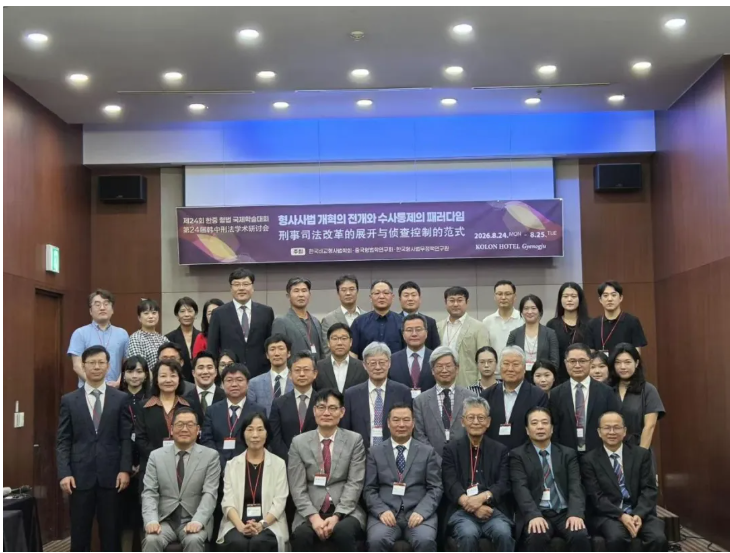
Group photo of conference participants
Gyeongju is a historic and cultural city in South Korea and the host city of the 2025 APEC Summit. Since Chinese and South Korean criminal law scholars jointly signed an academic exchange agreement in Beijing in 2002, the China-South Korea Criminal Law Academic Symposium has spanned twenty-four years. It has been successfully held 23 times in numerous cities across both countries, including Beijing, Shanghai, Chongqing, Kunming, Seoul, Busan, Daegu, and Jeju, and has become an indispensable, regular, high-level academic platform for communication between the criminal law communities of the two nations. The Chinese delegation for this symposium was led by Professor Liu Renwen, Vice President of the Chinese Society of Criminal Law and a professor at the School of Law, University of the Chinese Academy of Social Sciences. A total of nine Chinese scholars and legal practitioners attended the event.
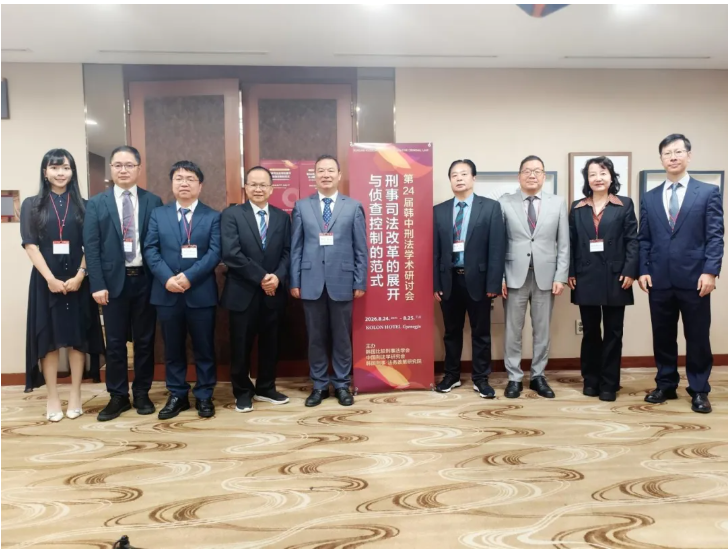
Group photo of Chinese delegates (from right to left: Wang Yinglong, Liang Yali, Wu Ge, Han Yi, Liu Renwen, Liu Pinxin, Fu Yuming, Yuan Bin, Zhong Peiting)
The symposium consisted of an opening ceremony, keynote speeches, nine thematic discussion sessions, and a closing ceremony. At the opening ceremony, Professor Ha Tae-in, President of the Korean Society of Comparative Criminal Law, and Professor Liu Renwen, Vice President of the Chinese Society of Criminal Law, delivered speeches in succession. Ding Xiongsheng, President of the Korea Institute of Criminal and Legal Policy (represented by Vice President Kim Han-gyun), and Chen Ribiao, Consul General of the Chinese Consulate General in Busan, each delivered congratulatory remarks. The four speakers fondly recalled the establishment and development of the China-South Korea Criminal Law Academic Symposium, fully affirmed the theme and value of this symposium, and sincerely looked forward to the prospects and future of academic exchanges in criminal law between China and South Korea.
In his opening remarks, Professor Liu Renwen pointed out that China and South Korea both belong to the East Asian legal civilization sphere, share similar roots in traditional culture of ritual and law, and have each charted successful paths in modern criminal legal system development that suit their respective national conditions; This year, South Korea passed a major amendment to its Criminal Procedure Act, comprehensively abolishing the prosecution’s authority to conduct direct investigations and supplementary investigations. China continues to optimize the mechanism for cooperation and mutual checks between the prosecution and police, while improving oversight of the entire investigative process. The challenges both countries face in their reforms—regarding the balance of power and procedural norms—are highly similar. Ongoing comparative law exchanges allow both sides to avoid repeating trial-and-error processes and to draw on each other’s practical experiences—both successes and failures—to optimize their domestic legislation and judicial practices.
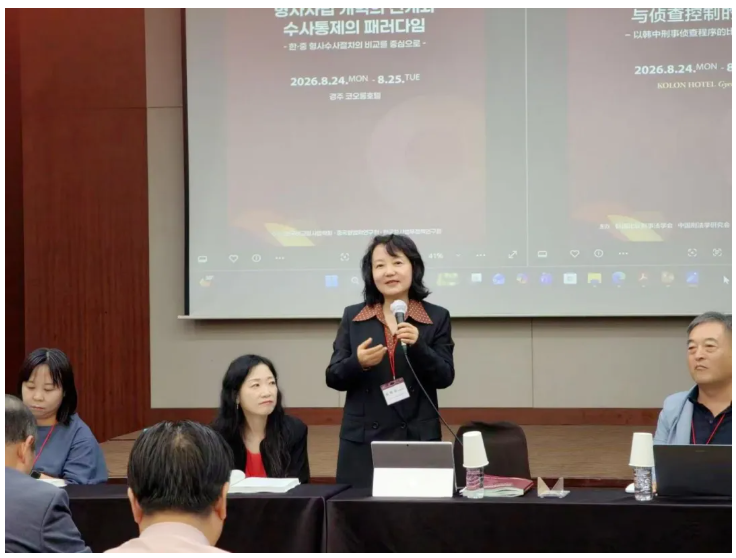
Attorney Liang Yali Delivers a Keynote Speech
Keynote Speech: A Systematic Reflection on “No Closing the Door on Evidence,”
Establishing a Differentiated Review Framework for Delayed Evidence Submission
During the eighth thematic session held on August 25, Attorney Liang Yali delivered a keynote speech, with Dr. Jeong Moo-na from the Korea Institute of Criminal and Legal Policy serving as a discussant. Centered on the core concept of “the door to evidence remains open,” the presentation began with the regulatory boundaries of supplementary investigation and progressively delved into the identification of delayed evidence submission, the resulting harm, comparative legal insights, and a differentiated review framework. Ultimately, it proposed a procedural corrective mechanism that integrates the efforts of the investigation, prosecution, and trial phases, forming a comprehensive theoretical system characterized by rigorous logic and strong practical applicability.
I. The Starting Point: Formal Supplementary Investigation Has Clear Boundaries, but Not All Evidentiary Activities Do
Article 175 of the Criminal Procedure Law stipulates that a case may be remanded for supplementary investigation no more than twice, with each period not exceeding one month; if evidence remains insufficient after two rounds of supplementary investigation, the prosecution shall not file charges. However, Attorney Liang Yali points out that only formal remands for supplementary investigation have clearly defined boundaries; after a case is indicted, evidentiary activities continue to enter the proceedings through four distinct channels: supplementary investigation conducted by the procuratorate on its own initiative; the introduction of materials under the guise of “retrieving or providing materials”; the presentation of evidence during trial; and the introduction of new evidence during appellate proceedings. Although these channels take different forms, they all serve the same function of strengthening the evidence, thereby creating a genuine regulatory gap.
She further analyzed this gap on four levels: Horizontally speaking, the methods of supplementary investigation during the review and prosecution stage have shifted from procedural backtracking to flexible evidence collection; the practical implications of the general transfer of materials differ significantly from those of re-interrogation, data recovery, and supplementary expert appraisals. Vertically speaking, although pretrial conferences after indictment attempt to establish a deadline for the centralized submission of evidence, the law simultaneously permits multiple forms of supplementary evidence submission; informal evidence-gathering documents, such as “Notices to Obtain Materials,” lack clear time constraints; and when different channels serve the same evidentiary purpose, there is a lack of uniform standards for reviewing the causes of delay and determining procedural consequences.
II. Identification of Forms of Delayed Evidence Submission and Multiple Forms of Harm
Liang Yali summarized three typical forms of delayed evidence submission: first, evidence that has already been obtained but disclosed late; second, evidence where leads existed but investigation was delayed; third, evidence that is newly created or altered after a dispute arises. Digital evidence complicates the timeline of “existence—discovery—acquisition—creation—submission,” requiring a continuous retrospective review of the entire process to distinguish between evidence that genuinely introduces new sources of facts and evidence that merely restates existing material in a new form.
Delayed submission of evidence causes four types of substantive harm: it weakens the evidentiary requirements for prosecution and the pretrial filtering function, resulting in “defective indictments”; repeated extensions prolong the period of pretrial detention, leading to irreversible deterioration of the crime scene, electronic data, and witness recollections; it undermines the defense’s ability to present counterevidence, conduct expert evaluations, and cross-examine witnesses, as supplementary expert reports or new testimony often catch the defense off guard; and procedural inertia erodes the neutrality of investigations, as subsequent supplementary investigations may become targeted efforts to reinforce the presumption of guilt.
III. Comparative Legal Insights and a Five-Step Framework for Differentiated Review
At the comparative law level, Attorney Liang Yali compared the rules of China and South Korea: China adopts a necessity review model, under which prosecutors must provide reasons for presenting evidence not submitted prior to the trial, and the court grants permission only when “the reasons are valid and it is indeed necessary”; however, in practice, there is an excessive focus on the objective authenticity of evidence and insufficient scrutiny of the reasons for the delay; South Korea adopts a model of scrutiny based on attribution of liability for delay. Article 266-13 of the Criminal Procedure Act stipulates that evidence not presented during the preparatory proceedings may be investigated only if it will not significantly delay the proceedings or if the applicant proves the absence of gross negligence and the existence of unavoidable circumstances. Furthermore, the Supreme Court of Korea’s 2020Do7802 ruling explicitly prohibits the prosecution from using appellate proceedings to remedy omissions in the prior trial.
Based on this, she argues that China should not adopt the rule of absolute forfeiture but should instead establish a five-step framework for differentiated review: ascertaining the entire process of evidence collection; determining liability for delay (objective obstacles/failure to exercise due diligence/gross violation of obligations/selective supplementation); distinguishing between stages of litigation; assessing the possibility of restoring the defense; and applying graduated procedural consequences. Procedural consequences are divided into four levels: full disclosure with preparation time granted when the grounds are justified and the harm is remediable; where liability is generally attributable but the defense is restorable, full disclosure is permitted, but the party responsible for the delay bears the costs of remediation; where there is a clear breach of duty or selective supplementation, the scope of investigation and the probative value of the evidence are restricted; and where there is intentional evasion resulting in permanent loss of evidence, the fundamental gap cannot be remedied, leading to forfeiture of the evidence. At the same time, she emphasized the distinction between the prosecution and the defense—delays by the prosecution in submitting incriminating evidence should be subject to strict scrutiny, while evidence discovered later by the defense that suggests innocence or a lesser charge should not be mechanically forfeited, and the court should remain neutral.
IV. A Corrective Mechanism Leveraging Synergy Across the Three Stages of Investigation, Prosecution, and Trial
Finally, Attorney Liang Yali proposed a three-stage procedural corrective mechanism: the investigation stage focuses on procedural documentation, establishing a system to record failures in evidence collection; supplementary investigations that merely add similar transcripts without resolving contradictions cannot be deemed to have improved the evidentiary status; The review and prosecution stage should focus on evidence scrutiny; filing an indictment must be premised on an evidentiary basis sufficient to support clear charges; where key facts remain unclear after necessary investigation, a “no prosecution due to reasonable doubt” decision should be applied; new evidence submitted after indictment must be accompanied by a verifiable explanation for the delay; At the trial stage, the focus is on final control: the necessity review should be expanded to include liability for delays and procedural harm; a specialized procedure for objections to delays should be established; and opportunities for supplementary evidence should not be granted indirectly through continuous requests for additional evidence or repeated extensions.
She concluded with a core proposition: The true “closing of the evidence window” does not lie in physically sealing off all avenues for supplementing evidence, but rather in using the attribution of responsibility for delays as the lock—one that both preserves an open space for correcting errors in substantive truth and erects a closed barrier to safeguard the bottom line of procedural justice.

Comparative Perspective:
A Lawyer’s Perspective on the Transformation of Investigative Control Paradigms in China and South Korea
The core theme of this symposium is the transformation of investigative control paradigms. South Korea has achieved the separation of powers and checks and balances through the division of authority and functions, completely abolishing the prosecution’s direct investigative authority and supplementary investigative authority, and shifting to a fully separated structure where the police are exclusively responsible for investigations and prosecutors are exclusively responsible for public prosecution; China, on the other hand, adheres to a framework of division of responsibilities, mutual cooperation, and mutual checks and balances between the prosecution and the police, with the prosecution, as the legal supervisory body, intervening throughout the process to achieve dynamic constraints. These two distinct models of investigation and prosecution essentially address the same contemporary challenge: how to prevent the unlimited expansion of investigative powers and avoid the infringement of citizens’ rights to personal liberty, property, and freedom of communication by public authorities.
As a representative of frontline criminal defense attorneys attending the conference, Liang Yali provided authentic observations from the “last mile” of procedural implementation for the comparative study of Chinese and South Korean investigative control paradigms, drawing on her unique perspective as a defense practitioner. As Professor Liu Renwen pointed out in his opening remarks, this symposium specifically invited frontline attorneys to share practical experience, thereby breaking through the limitations of purely academic theoretical research and achieving mutual enrichment between theory and practice. Attorney Liang Yali’s systematic discussion on “keeping the door open for evidence” and correcting flaws in the supplementary investigation system is a prime example of this “theory plus practice” integration—the dilemma of delayed supplementary evidence she revealed is not an abstract deduction confined to statutory provisions, but rather a practical judgment distilled through the handling of specific cases, repeated communications with investigative authorities, and the drafting of defense briefs; The differentiated review framework and three-stage corrective mechanism she proposed are not mere conceptual exercises confined to the ivory tower, but rather operational solutions that can be directly translated into defense strategies, institutional recommendations, and judicial rulings.
For a long time, Attorney Liang Yali has consistently adhered to the professional philosophy of “using practice to enrich theory and using theory to guide practice,” maintaining a sustained focus on reforms to the criminal procedure system and cutting-edge issues in the judiciary. From the criminal governance of the offense of illegal mining and the boundaries of applying “unspecified offenses,” to defense strategies for the disposition of case-related assets and the methodology of courtroom debate, and now to correcting the abuse of the supplementary investigation system at this symposium, she has consistently remained on the front lines of criminal defense practice, elevating her experience from individual cases into institutional reflections, and actively participating in high-level academic exchanges both domestically and internationally.
Attorney Liang Yali’s invitation to attend the 24th China-Korea Criminal Law Academic Symposium and deliver a keynote speech is a significant demonstration of Chinese criminal defense attorneys making their professional voices heard on the international comparative law stage. In the future, Attorney Liang Yali will continue to lead the King&Capital Criminal Defense Research Center in deepening practical and theoretical research in criminal defense, actively participating in academic exchanges and the advancement of the rule of law both domestically and internationally, and contributing more professional insight and effort to improving the criminal justice system, safeguarding the legitimate rights and interests of clients, and promoting mutual learning and exchange in criminal law between China and South Korea.