

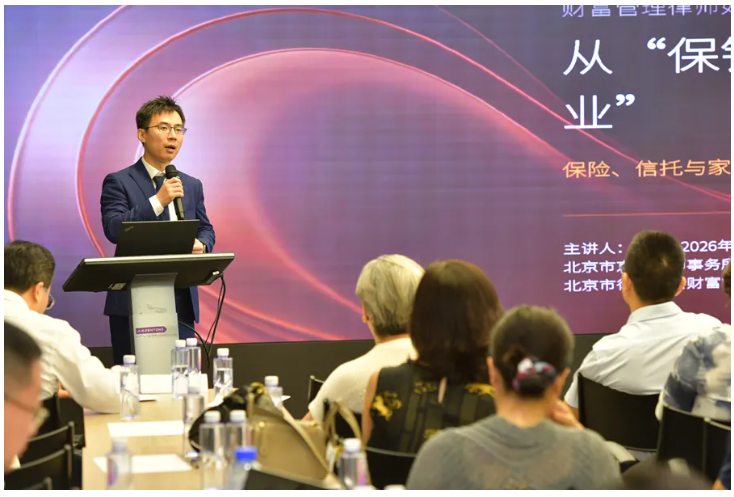
On July 11, the Wealth Management Law Committee of the Beijing Lawyers Association (hereinafter referred to as the “Wealth Management Committee”) held a training and exchange session titled “The Role of Insurance and Insurance Proceeds Trusts in Wealth Management and the Expansion of Legal Practice.” Teng Jie, a member of the Wealth Committee and partner at Beijing King&Capital Law Firm, was invited to deliver a presentation titled “How Wealth Management Lawyers Can Assist Clients in Transitioning from ‘Protecting Assets’ to ‘Protecting the Business’—The Symbiotic Logic of Insurance, Trusts, and Family Governance.”
Drawing on cutting-edge practices in wealth management legal services, Attorney Teng Jie systematically explained the professional paradigm shift from “protecting wealth” to “protecting the family business.” He first analyzed the structural limitations of traditional wealth management—characterized by “isolated tools, static perspectives, and superficial value”—and pointed out that the role of wealth management lawyers should evolve from that of passive, post-event compliance reviewers to that of proactive family structure designers and cross-tool resource integrators.
Building on this foundation, he delved into the legal attributes of three key tools—insurance, trusts, and family governance—to deconstruct their core values: insurance uses leverage to generate cash flow and provide a safety net against personal risks, trusts achieve asset isolation and targeted succession through the separation of ownership and beneficial ownership; and family governance, with the spirit of contract at its core, lays the institutional foundation for the sustainable continuity of the family enterprise. Through functional complementarity, legal integration, and symbiotic value, these three elements form a synergistic closed loop where “1+1+1>3.”
He then used the equity succession of technology founders as a typical case study to demonstrate practical implementation pathways. Drawing on cutting-edge policies such as Beijing’s pilot program for equity trust registration, he provided professional guidance on compliance boundaries, cross-disciplinary collaboration, and risk prevention in legal practice, stating, “Protecting capital is the means; safeguarding the business is the goal; tools are the vehicle; governance is the soul.”