

On September 5, 2026, the 20th Shangquan Criminal Defense Forum was held in Beijing. With the theme “Amendments to the Criminal Procedure Law and High-Quality Development of Criminal Defense,” a paper titled “Improving the Rules on the Exclusion of Witness Testimony in the Amendment of the Criminal Procedure Law,” written by Attorney Xu Wei, a partner at Beijing King&Capital Law Firm, was selected for inclusion in the forum’s proceedings. As the author of the selected paper, Attorney Xu Wei was invited to attend the forum.
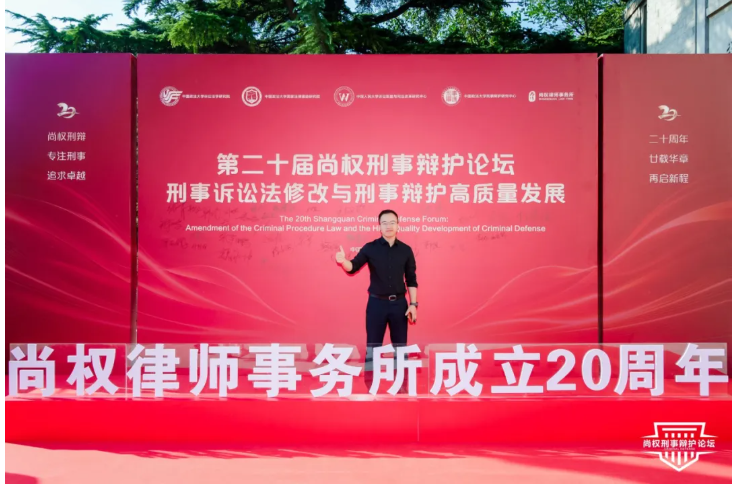
Attorney Xu Wei Attends the 20th Shangquan Criminal Defense Forum
The forum began accepting paper submissions in June 2026, with a submission deadline of August 20. Following review and selection by the organizers and a panel of experts and scholars, a total of 89 papers were included in the forum proceedings. The content covered eight areas: the criminal defense system, the criminal evidence system, compulsory measures in criminal proceedings, reforms to the trial-centered litigation system and the substantive nature of court hearings, the system of leniency for guilty pleas and acceptance of punishment, the criminal legal aid system, procedures for the disposal of case-related property, and the application of artificial intelligence in criminal proceedings.
I. Selected Paper: From the Institutional Discrepancy of “Prohibition Without Exclusion” to Four Legislative Amendment Proposals
Attorney Xu Wei’s paper takes as its starting point the inconsistency between Article 52 and Article 56, Paragraph 1 of the current Criminal Procedure Law. The former strictly prohibits the collection of evidence through inducement or deception, while the latter lists only violence and threats as grounds for excluding witness testimony; even after judicial interpretations added “unlawful restriction of personal freedom” to the list, enticement and deception remained excluded from the scope of exclusion.
Citing empirical research, the paper notes that between 2013 and 2020, there were a total of 126 cases in which motions to exclude witness testimony were filed on the grounds of enticement or deception; the courts excluded only one case, resulting in an exclusion rate of 0.79%. The gap between the prohibition on evidence collection and the exclusion of evidence means that leading questions during the investigative phase carry no corresponding institutional consequences; even if defense counsel discovers traces of leading questions in the case files, they find it difficult to locate a normative basis for exclusion.
In terms of causes, this paper analyzes the issue from four perspectives: the exclusion rule centers on “distress” as the core criterion for judgment, making it difficult to evaluate inducement and deception that affect cognition and judgment; there is no obligation to record witness interrogations in full via audio and video, making it difficult for the defense to provide evidence to initiate the exclusion procedure; once testimony is excluded, investigative authorities may re-interrogate the same witness, limiting the effect of exclusion to a single transcript; while defense counsel who induce a witness to alter their testimony contrary to the facts commit a crime, investigative officers who engage in similar inducement face no corresponding consequences; this disparity in liability itself constitutes grounds for amending the law.
Accordingly, the paper proposes four amendments: Add “coercion” and “deception” to Article 56, Paragraph 1, and establish a threshold for the severity of such conduct; establish an obligation to record the entire questioning of key witnesses via audio and video, and clarify that testimony that should have been recorded but was not may not be used as the basis for a conviction; clarify the prosecution’s burden of proof regarding the legitimacy of questioning methods, and lower the threshold for the defense to provide evidence; restrict re-questioning after exclusion by reference to the rules on repetitive confessions, thereby imposing actual costs for exclusion.
II. Practice Informs Theory: King&Capital Lawyers Continue to Participate in Seminars on Amending the Criminal Procedure Law
For a long time, Attorney Xu Wei has been working on the front lines of criminal defense, focusing on research into the defense of economic crimes and emerging crimes, and persistently identifying systemic issues through practical case handling. From jurisdictional reviews during the arrest approval phase, to practical analyses of crimes involving virtual currencies, to his current systematic proposals regarding the rules for excluding witness testimony, Attorney Xu Wei’s practical research has consistently focused on real-world issues in criminal proceedings, striving to transform defense experience into proposals that can inform legislative decision-making.
The inclusion of Attorney Xu Wei’s paper in the proceedings of the 20th Shangquan Criminal Defense Forum and his invitation to attend the forum demonstrate King&Capital Law Firm’s active participation in discussions regarding amendments to the Criminal Procedure Law and its commitment to advancing the high-quality development of criminal defense through academic research.