

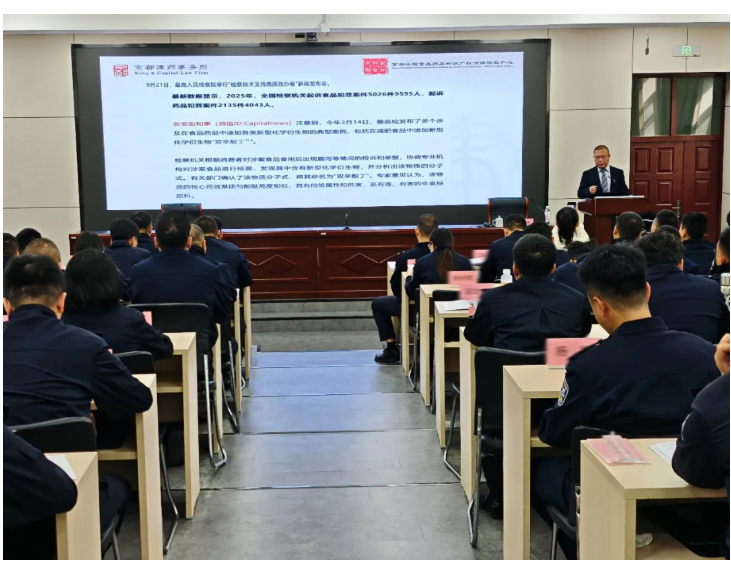
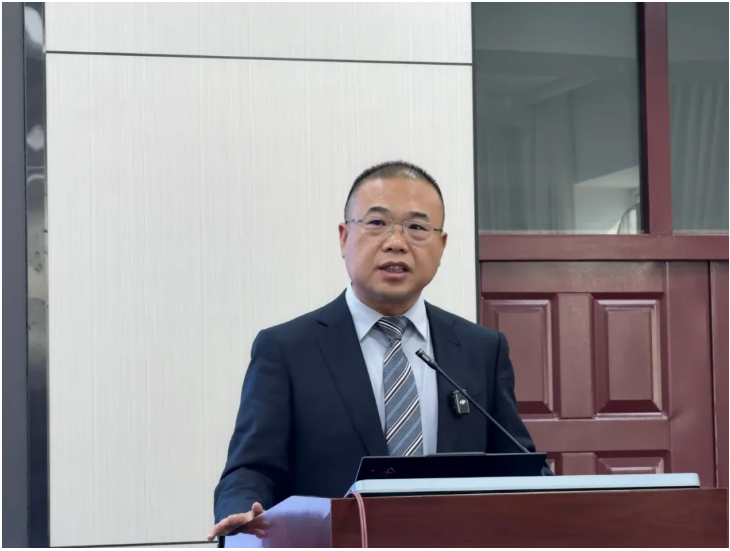
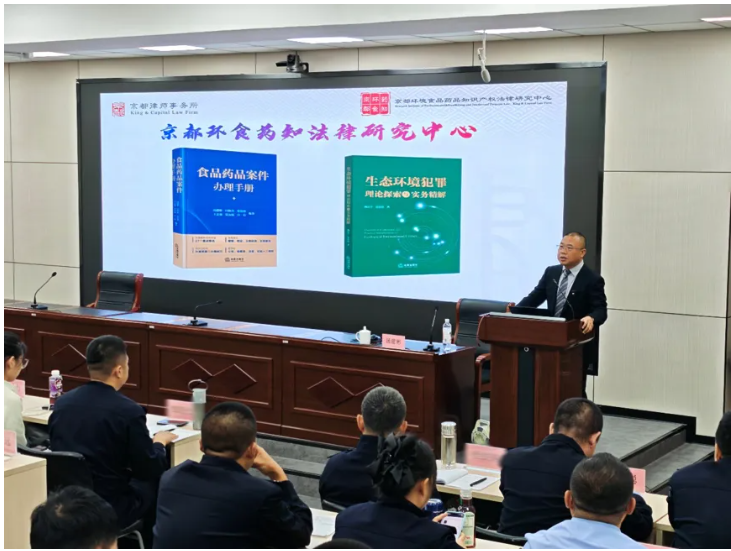
On September 23, 2026, Attorney Tang Jianbin—Senior Partner at Beijing King&Capital Law Firm and Director of the King&Capital Research Center for Environmental, Food, Drug, and Intellectual Property Law—was invited to deliver a professional training session at the “Provincial-wide Training Program for Key Personnel in Environmental, Food, Drug, and Intellectual Property Investigation” organized by the General Brigade for Environmental, Food, and Drug Crime Investigation of the Heilongjiang Provincial Public Security Department.
This training was designed for frontline police officers responsible for case handling. In his lecture, Attorney Tang Jianbin addressed practical challenges in criminal investigations, focusing on the preservation of evidence in food and drug crimes, the review of test reports and administrative determination opinions, and common issues regarding the application of laws. He analyzed risks throughout the entire case handling process from an integrated criminal justice perspective, promoting standardized handling of food and drug crime cases through the coordination of criminal and administrative laws.
I. Focusing on the Lifeline of Physical Evidence:
Closed-Loop Review of Seizure–Sampling–Sealing–Custody–Submission for Testing
Attorney Tang Jianbin pointed out that the complete closed loop formed by seizure, sampling, sealing, custody, and submission for testing constitutes the lifeline of handling food and drug criminal cases; the identity of the evidence samples and the integrity of the chain of custody are prerequisites for testing reports to possess evidentiary value. He emphasized that once the chain of custody is broken, the testing report loses its basis for determining the case. In practice, a distinction must be made between fundamental procedural violations and general procedural flaws: fundamental violations can directly negate the evidentiary value of the evidence, while general flaws can be remedied through a statement of circumstances; however, not all procedural issues should be addressed indiscriminately through such statements.
At the same time, during his lecture, he also outlined common violations in the investigative phase, covering the entire process from seizure approval, on-site execution, documentation and witnessing, to storage and transfer, as well as the entities responsible for sampling, the objects of sampling, sealing and labeling, and the circulation and submission of samples for testing. For example, during the seizure phase, violations include conducting seizures without approval, a single person carrying out the seizure, non-compliant witness identities, failure to conduct on-site inventory and sealing, and missing elements in the seizure inventory list; during the sampling phase, issues included mixing samples from different product batches and directly submitting samples purchased online by victims as evidence; during the sealing phase, problems included failure to use anti-counterfeiting numbered seals and off-site sealing; and during the submission phase, prominent issues included transporting temperature-controlled samples at room temperature, failure to retain backup samples, and exceeding authority by requesting testing institutions to provide legal characterizations.
II. Key Points for Reviewing Evidence in Testing Reports and Administrative Determination Opinions
Testing and inspection reports, along with administrative determination opinions, are the two key pieces of evidence that directly influence the legal characterization of food and drug crime cases. Regarding testing and inspection reports, Attorney Tang Jianbin advises that particular attention should be paid to verifying the validity of the testing institution’s CMA accreditation and its scope of authority, as well as the qualifications of the testing personnel and authorized signatories, and the legality and scientific validity of the testing methods. He further stated that when commissioning testing, the scope of the commission should be limited to requiring the testing institution to objectively identify the composition and content of substances; it is inappropriate to ask the testing institution to directly make legal characterizations such as “toxic or harmful substances” or “counterfeit drugs.” Legal characterizations should be made comprehensively by judicial authorities based on a combination of testing data, administrative determinations, and expert opinions.
He proposed that administrative determination opinions, serving as reference materials for specialized issues in criminal proceedings, should be formed by combining three components: inspection and testing reports, expert assessment opinions, and determination opinions from the competent administrative authorities—none of which can be omitted. Addressing the chaos surrounding administrative determination opinions in practice, Attorney Tang Jianbin elaborated on common issues such as incomplete commission information, ineligible expert designations, and illegal sources of source materials for reports. Using correct examples, he highlighted key points that case handlers must scrutinize to ensure a complete body of evidence supporting subsequent proceedings.
III. Interpretation of Common Issues in the Application of Law to Food and Drug Crimes
In the section on the application of law, Attorney Tang Jianbin focused on frequent disputes regarding the characterization of crimes in the field of food and drug offenses, systematically addressing several groups of criminal charges that are most easily confused in practice. Through a comparative analysis of offenses such as the production and sale of toxic or harmful food, the production and sale of food that fails to meet safety standards, the production and sale of counterfeit drugs, and the production and sale of substandard drugs—grouped by category—and by drawing on typical cases such as “weight-loss tablet candies” and new derivatives of “bisphenol butyl,” he clarified the distinctions between these offenses and identified the key focus areas for each during the investigation and evidence-gathering phases. Regarding the handling of statutory concurrence and constructive concurrence, Attorney Tang Jianbin emphasized that during the investigation phase, evidence-gathering strategies should not be limited to the initial charge filed; evidence for all concurrent offenses must be collected comprehensively to prevent gaps in the evidence chain caused by subsequent changes in the legal characterization of the case.
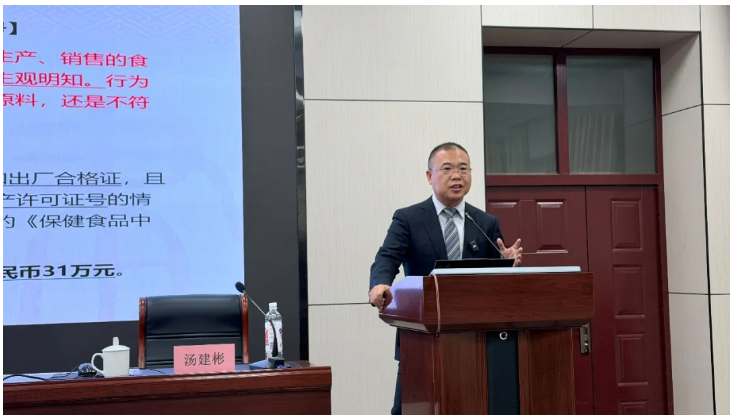
Attorney Tang Jianbin’s lecture was closely aligned with the practical realities of frontline case handling, featuring detailed content and a wealth of case studies. It included both in-depth interpretations of legal provisions and precise analysis of pain points in investigation and evidence collection. Through warnings about “common pitfalls in investigations,” “key points for public security authorities in securing evidence,” and “interpretations of common issues in legal application,” the session provided robust professional support for environmental, food, and drug investigation officers in Heilongjiang Province to handle food and drug crime cases efficiently and effectively.
After the session, participating police officers actively engaged in discussions with Attorney Tang Jianbin regarding practical challenges such as the identification of new types of illegal additives and the determination of the amount involved in cases.
