

Recently, several farmers in Tongliao City, Inner Mongolia Autonomous Region, were held criminally liable for “illegal occupation of agricultural land” after planting crops in forested areas, sparking widespread attention within the legal community. The core of the controversy centers on the interpretation of a comma in the Supreme People’s Court’s 2023 revised judicial interpretation—whether it signifies “and” or “or.” This directly determines whether the farmers involved are guilty. In an interview with Southern Weekly, Attorney Zhang Sijia—Deputy Director of the Beijing King&Capital Environmental, Food, Drug, and Intellectual Property Law Research Center; member of the Environment and Resources Committee of the Beijing Lawyers Association; and head of the Criminal Defense Group—provided an in-depth analysis of this controversy.
One Comma, Two Fates
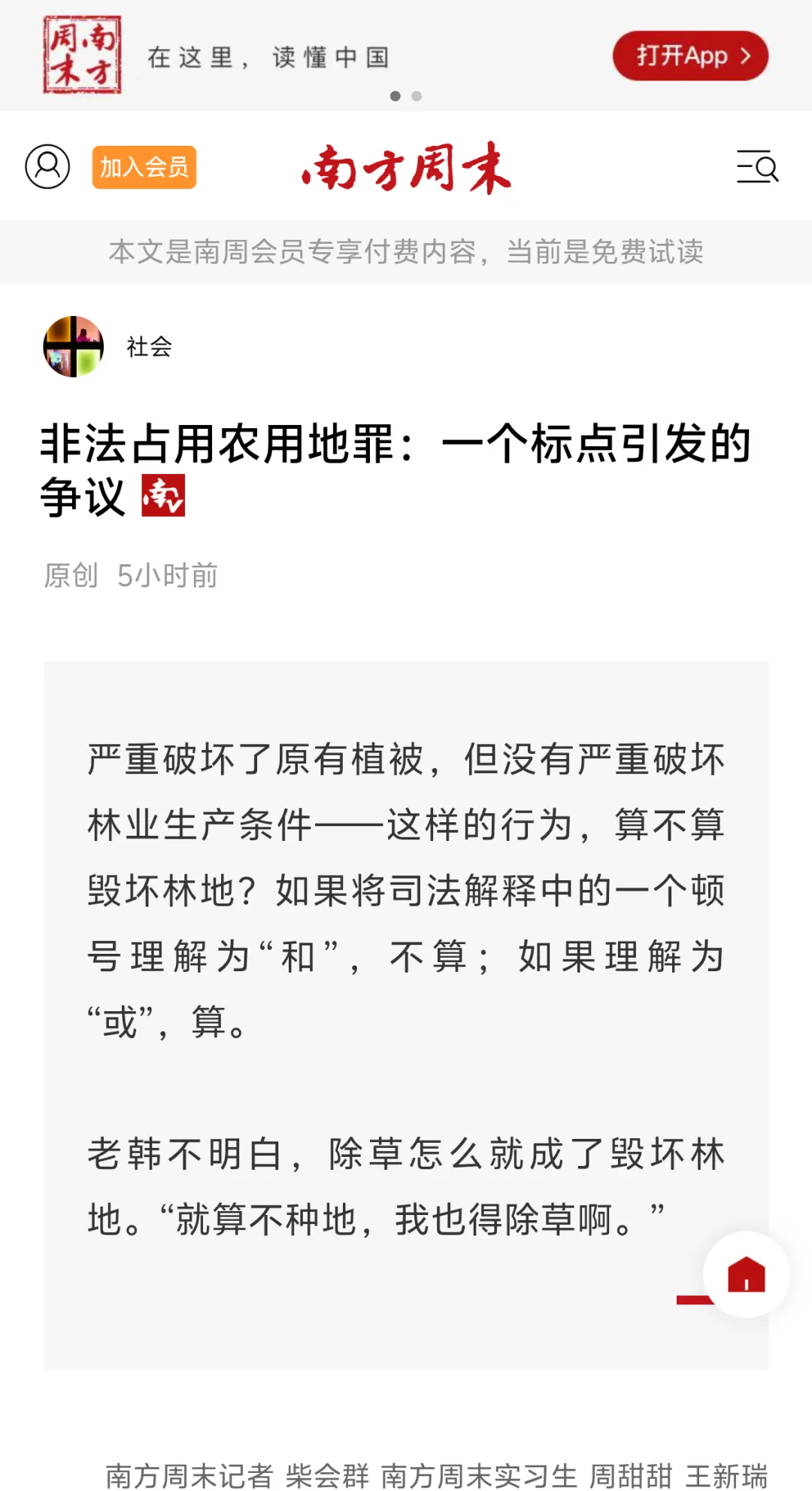
In 2023, the Supreme People’s Court issued the “Interpretation on Several Issues Concerning the Application of Law in the Trial of Criminal Cases Involving the Destruction of Forest Resources,” replacing the 2005 version of the judicial interpretation. Article 1, Item (3) of the new interpretation stipulates: “Discharging pollutants, piling up waste, or engaging in non-forestry production or construction on forested land, resulting in severe pollution of the forested land or severe destruction of the original vegetation or forestry production conditions, shall be deemed to have caused the ‘destruction’ of the forested land.” .
The core of the controversy lies in whether the comma between “original vegetation” and “forestry production conditions” should be interpreted as “and” or “or.”
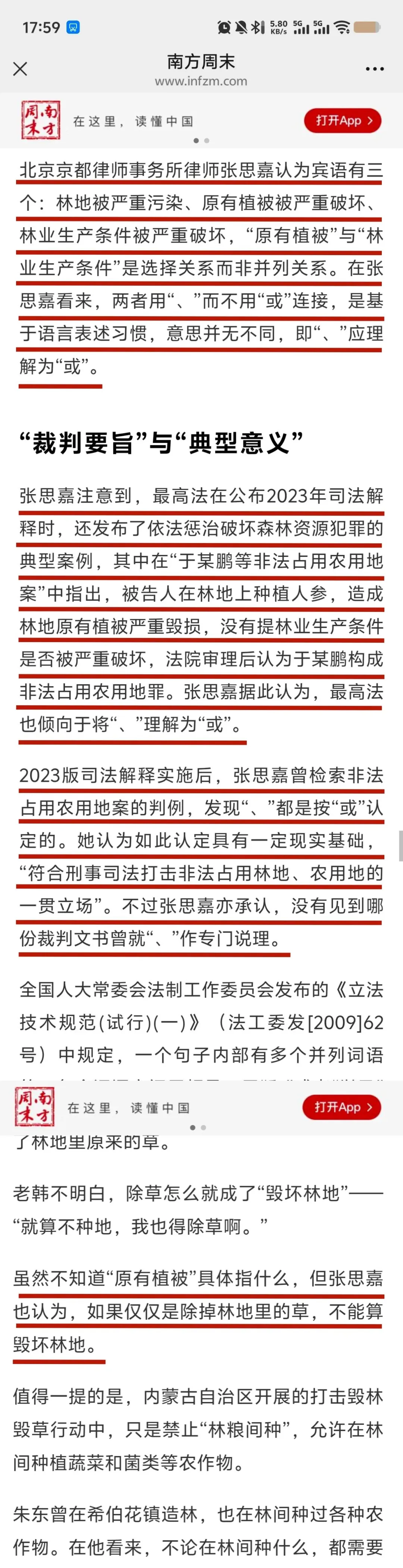
Attorney Zhang Sijia argues that this provision has three objects: severe pollution of forest land, severe destruction of original vegetation, and severe destruction of forestry production conditions. “Original vegetation” and “forestry production conditions” represent an alternative relationship rather than a parallel one. In her view, the use of a comma rather than “or” to connect the two is based on linguistic convention; the meaning remains the same—that is, the comma should be interpreted as “or.”
This implies that as long as either “original vegetation” or “forestry production conditions” is severely damaged, it constitutes destruction of forest land, and the person involved may be convicted.
Trends in Judicial Practice
Attorney Zhang Sijia noted that when the Supreme People’s Court released the 2023 version of the judicial interpretation, it simultaneously published typical cases regarding the legal punishment of crimes involving the destruction of forest resources. Among them, the “Case of Yu Mopeng et al. for Illegal Occupation of Agricultural Land” noted that the defendants planted ginseng on forest land, causing severe damage to the original vegetation. Although the judgment did not mention whether forestry production conditions had been severely damaged, the court still found them guilty of the crime of illegal occupation of agricultural land. Based on this, Attorney Zhang Sijia believes that the Supreme People’s Court itself tends to interpret the comma as “or.”
After the 2023 version of the judicial interpretation took effect, Attorney Zhang Sijia reviewed a large number of case precedents involving the illegal occupation of agricultural land and found that, in judicial practice, the comma is generally interpreted as “or.” She believes this interpretation has a certain practical basis and “aligns with the consistent stance of the criminal justice system in combating the illegal occupation of forest land and agricultural land.” However, she also admitted that she has yet to see any judicial document that specifically provides a rationale for this interpretation of the comma.
Does Weeding Equate to Destruction of Forest Land?
In the case of Xiao Han, a farmer from Kezuo Zhongqi Banner in Tongliao City, the forensic appraisal concluded that his act of planting sunflowers in the forest “resulted in severe damage to the forest land’s original vegetation,” but “the current soil conditions of the forest land have not been severely damaged, and the forest land remains suitable for forestry cultivation.” Based on this, Xiao Han and her defense attorney argued that, according to the 2023 version of the judicial interpretation, both conditions—“serious destruction of the original vegetation” and “serious destruction of forestry production conditions”—must be met simultaneously for a crime to be established, and therefore Xiao Han should not be convicted.
Attorney Zhang Sijia commented that simply removing weeds from forest land does not constitute destruction of the forest land. She pointed out that, according to the law, “original vegetation” should refer to “trees and other vegetation growing on forest land,” rather than weeds found there. Farmers who clear weeds to cultivate crops in the woods do not harm the trees and should not be deemed to have destroyed the original vegetation.
A single punctuation mark holds the fate of countless farmers in the balance. During Inner Mongolia’s special campaign against deforestation and grassland destruction, there has been a significant increase in cases where farmers have faced criminal charges for growing crops on forested land. How to strike a balance between protecting the ecosystem and safeguarding farmers’ rights, and how to unify the interpretation and application of judicial interpretations, remain urgent issues to be resolved. Attorney Zhang Sijia’s analysis offers a professional perspective on this controversy and prompts deeper reflection on the relationship between methods of legal interpretation and judicial practice. In the future, Attorney Zhang Sijia will continue to focus on the interpretation and application of judicial interpretations regarding the crime of illegal occupation of agricultural land. Grounded in the practice of criminal defense, she will continue to observe relevant legal disputes from a professional perspective, contributing to the clarification of legal application issues, the protection of clients’ legitimate rights and interests, and the promotion of a balance between ecological conservation and the safeguarding of people’s livelihoods.