

On October 24, 2026, the Second Guangdong-Hong Kong-Macao Greater Bay Area Crime Governance Symposium was grandly held in Guangzhou. Co-hosted by the Guangdong-Hong Kong-Macao Greater Bay Area Crime Governance Specialized Committee of the Chinese Society of Criminology, the Guangdong-Hong Kong-Macao Greater Bay Area Crime Governance Research Institute at Guangdong University of Foreign Studies, and the School of Law (School of International Law) at Guangdong University of Foreign Studies, the conference centered on the theme “Research on Practical Issues in Criminal Justice Coordination in the Guangdong-Hong Kong-Macao Greater Bay Area.” It brought together over 100 experts and scholars from research institutions and universities across the country, as well as practitioners from judicial and procuratorial agencies, judicial authorities in Hong Kong and Macao, the legal profession, and academic journals and media. Together, they explored practical pathways for modernizing the governance of cross-border crime in the Guangdong-Hong Kong-Macao Greater Bay Area under the “One Country, Two Systems, Three Jurisdictions” framework. Attorney Liang Yali, Senior Partner at Beijing King&Capital Law Firm, Director of the King&Capital Criminal Defense Research Center, and Vice Dean of the Guangdong University of Foreign Studies Institute for Crime Governance in the Guangdong-Hong Kong-Macao Greater Bay Area, attended the opening ceremony and delivered a speech.
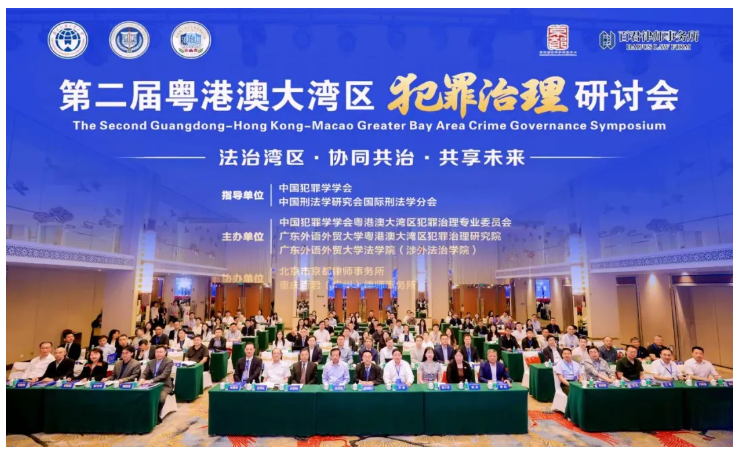
Scene from the opening ceremony
This year’s symposium featured in-depth discussions on four core topics: “Harmonization of Standards for the Conviction and Sentencing of Cross-Border Crimes and Resolution of Inter-regional Legal Conflicts,” “Criminal Justice Cooperation in the Guangdong-Hong Kong-Macao Greater Bay Area and Cross-Border Disposal of Case-Related Assets,” “Cross-Border Governance of Blockchain and Cryptocurrency Crimes,” and “Harmonization of Cross-Border Criminal Evidence Rules and Collaborative Evidence Collection in the Guangdong-Hong Kong-Macao Greater Bay Area.”
At the opening ceremony, Ge Xiaoyue, Deputy Secretary of the Party Committee at Guangdong University of Foreign Studies; Zhang Mingqi, Member of the Standing Committee of the 12th National People’s Congress and Deputy Director of the Legal Affairs Committee; Wan Chun, President of the Chinese Society of Criminology; Gao Bo, Member of the Party Leadership Group and Deputy Procurator-General of the Guangdong Provincial People’s Procuratorate; Yin Jianfeng, Vice Chair of the International Criminal Law Branch of the Chinese Society of Criminal Law; Attorney Liang Yali; and Chen Zexian, former Director of the Institute of International Law at the Chinese Academy of Social Sciences and Honorary Dean of the Research Institute, delivered speeches in succession.
In her address, Attorney Liang Yali noted that the Guangdong-Hong Kong-Macao Greater Bay Area bears a major strategic mission for the nation, and that “One Country, Two Systems, Three Legal Jurisdictions” is its most distinctive feature in terms of the rule of law. The unique three-jurisdiction framework—where the mainland’s codified law, Hong Kong’s common law, and Macao’s local civil law coexist—endows the Bay Area with unique developmental advantages while also presenting numerous practical challenges in the field of criminal governance. With the rapid cross-border flow of people, capital, and data within the Bay Area, new forms of complex crimes—such as cross-border telecommunications and cybercrime, drug-related crimes, financial crimes, and cryptocurrency money laundering—continue to occur at high rates. Criminal chains are fragmented across legal jurisdictions, with perpetrators, criminal acts, and involved assets often located in different jurisdictions.

Attorney Liang Yali Delivers Remarks
She emphasized that objective institutional gaps objectively exist among the three regions regarding standards for conviction and sentencing, rules for the disposal of assets involved in cases, litigation procedures, and criminal evidence systems. These gaps give rise to practical bottlenecks such as difficulties in cross-border evidence collection, mutual recognition of evidence from outside the jurisdiction, recovery of assets and compensation for losses, and coordination of criminal jurisdiction. Cross-jurisdictional crime governance cannot be accomplished independently by a single entity or within a single jurisdiction; there is an urgent need for the academic community, practical departments within the public security, procuratorial, judicial, and correctional systems, and the legal profession to work closely together to translate theoretical achievements into judicial practice.
As Vice Dean of the Guangdong University of Foreign Studies’ Guangdong-Hong Kong-Macao Greater Bay Area Crime Governance Research Institute, and working on the front lines of criminal defense practice, Attorney Liang Yali shared her profound insights gained from handling a large number of cross-border criminal cases in the Greater Bay Area: the standards for reviewing and admitting evidence from outside the jurisdiction need to be further clarified; differences in legal provisions across jurisdictions can easily lead to discrepancies in the determination of jurisdiction and sentencing standards; procedures for the cross-border recovery and disposal of assets involved in cases are cumbersome; and digital crimes, such as those involving cryptocurrency, continue to pose new challenges to the existing governance system.
She particularly emphasized that as an integral part of the criminal justice community, attorneys—rooted in frontline case practice—must not only assist in combating cross-border crimes but also strictly uphold the bottom line of safeguarding human rights, equally protect the legitimate rights and interests of parties and market entities from the Mainland, Hong Kong, and Macao, and safeguard the Greater Bay Area’s market-oriented, rule-of-law-based, and international business environment.
Reflecting on the work of the Guangdong University of Foreign Studies’ Guangdong-Hong Kong-Macao Greater Bay Area Crime Governance Research Institute over the past year, Attorney Liang Yali noted that from last year’s first symposium to this year’s second conference, in just one short year, the Institute has continued to delve deeply into the field of crime governance in the Greater Bay Area, consistently building channels for dialogue among legal professionals from the Mainland, Hong Kong, and Macao, elevating practical issues to academic topics, and ensuring that academic research informs judicial practice. The two conferences share a common thread, directly addressing the real issues and practical challenges of criminal cooperation in the Bay Area. King&Capital Law Firm and the King&Capital Criminal Defense Research Center are willing to continue sharing frontline case handling experience and case analysis; as Vice Dean of the Institute, she will also continue to devote herself to research projects and legal exchanges among the three regions, serving as a bridge between theory and practice to help transform research findings into practical solutions that are both applicable and implementable.
In closing her remarks, Attorney Liang Yali stated that the rule of law is the bedrock of high-quality development in the Greater Bay Area. Advancing criminal justice coordination in the Guangdong-Hong Kong-Macao Greater Bay Area requires respecting the institutional differences among the various jurisdictions, seeking common ground while setting aside differences, and exploring feasible pathways for the integration of rules. She expressed hope that this symposium would facilitate in-depth exchanges and deliberations among all parties, forge greater consensus, and contribute insights toward improving the governance of cross-border crime in the Greater Bay Area; she also looked forward to further deepening the construction of a legal community among the Mainland, Hong Kong, and Macao in the future, and continuously refining regional collaborative governance mechanisms.
For many years, under the leadership of Attorney Liang Yali, the King&Capital Criminal Defense Research Center has consistently adhered to the professional philosophy of “using practice to enrich theory and using theory to guide practice.” While deepening its expertise on the front lines of criminal defense and focusing on cutting-edge areas such as cross-border crime, the disposal of assets involved in criminal cases, and corporate compliance, the Center has actively promoted research on crime governance in the Guangdong-Hong Kong-Macao Greater Bay Area and legal exchanges among the Mainland, Hong Kong, and Macao. It continues to contribute professional wisdom and strength to promoting inter-regional criminal justice coordination, building a safer Greater Bay Area at a higher level, and a “Rule of Law Bay Area.”