

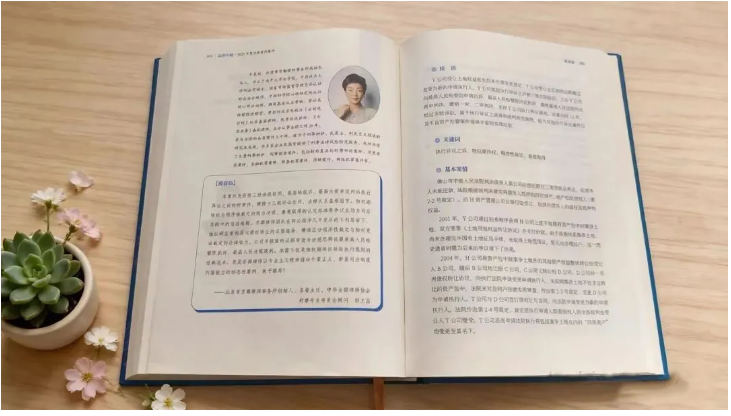
In commercial judicial practice involving the disposal of non-performing assets and the transfer of land rights, the interplay between enforcement procedures and substantive rights has long been a major source of controversy. *Rule of Law Annals · 2025—An Anthology of Classic Cases* features a case handled by attorneys Gong Piguo and Niu Xingli. This retrial case involving an objection to enforcement—which spanned thirteen years and went through the entire civil litigation process—was reviewed by the Supreme People’s Procuratorate and subsequently reheard and overturned by the Supreme People’s Court. clarifying the boundary between procedural rulings and changes in property rights and establishing rules for the protection of expectant rights in property. It has become a landmark case that exemplifies the judicial spirit of seeking truth from facts and correcting errors without fail.
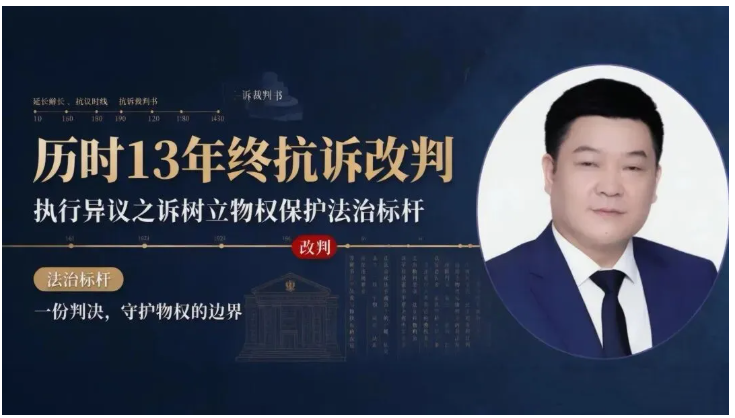
The case originated from the disposal of non-performing assets many years ago. Unable to repay a bank loan, the debtor had four properties and parcels of land ruled by the court to be used as collateral to settle the debt; H Asset Management Company subsequently acquired the debt asset package. In 2001, Company Y acquired the land rights involved in the case through an auction, signed a transfer agreement, and paid the full purchase price. Due to historical policy restrictions on the expropriation and conversion of collectively-owned land, title registration for the plot could not be processed at that time. This objective obstacle laid the groundwork for a subsequent rights dispute that lasted more than a decade.

In subsequent asset transfers, Company H successively transferred the remaining assets—excluding the land in question—to Companies B, C, and D. When Company D applied to be designated as the applicant for enforcement, it failed to truthfully disclose the scope of the assets. Without conducting a substantive review, the enforcement court ruled to designate Company D as the applicant for enforcement; Company D subsequently transferred the assets to its affiliated entity, Company T, and the court again ruled that Company T succeeded to all creditor’s rights. Based on this, Company T claimed ownership of all four assets transferred in lieu of debt and applied for compulsory enforcement of the land in question.
Beginning in 2011, Company Y embarked on a long journey to protect its rights: its objection to enforcement was dismissed; it lost its case in both the first instance and the retrial; the second-instance court upheld the lower rulings; and its application for retrial to the Supreme People’s Court was also rejected. The core logic underlying these multiple rounds of rulings was to equate the ruling changing the applicant for enforcement with a document transferring property rights, thereby determining that Company T had acquired the land use rights in good faith, while Company Y held only ordinary contractual claims, which were insufficient to challenge the enforcement. This seemingly self-contained procedural conclusion masked oversights regarding substantive facts, such as the scope of the debt assignment, the relationships between the parties involved, and the determination of good faith.
When conventional avenues of relief had been nearly exhausted, Company Y applied to the Supreme People’s Procuratorate for prosecutorial oversight. After several years of review, the Supreme People’s Procuratorate decided to file an appeal with the Supreme People’s Court. The representing attorney focused on four key points, systematically dismantling the errors in the original rulings: First, Company Y entered into the contract lawfully, paid the full amount, and had long-term actual possession of the land; the failure to transfer the title was due to historical policy reasons, with no fault on its part, and it lawfully enjoyed a legitimate expectation of property rights worthy of protection; Second, the price differentials across all asset transfers, the explicit statement in the transfer notice that “one plot has been disposed of, with three remaining,” and the explanations provided by subsequent transferees form a complete chain of evidence proving that the transferred assets did not include the land in question from the outset; Third, the ruling to change the applicant for enforcement is merely a procedural document, distinct from a ruling on debt-for-asset settlement; it does not give rise to a change in property rights and cannot be directly used as a basis for establishing title; Fourth, Company T and the prior transferee are closely affiliated companies; they share senior management and legal counsel, and were fully aware of the scope of the assets, thus failing to meet the statutory requirements for acquisition in good faith.
In August 2025, after a retrial and deliberation by the Judicial Committee, the Supreme People’s Court issued a retrial judgment. The court adopted the prosecution’s appeal, overturned the original judgment, determined that the claims acquired by Company T did not include the land in question and did not constitute acquisition in good faith, and ruled that the land rights at issue could not be enforced. After a thirteen-year legal battle, justice was finally served.
The landmark significance of this case extends far beyond the outcome of this individual case; it has established a clear judicial benchmark for similar cases. First, it delineates the boundaries of enforcement procedures: a procedural ruling to change the applicant for enforcement is not equivalent to a ruling on title confirmation. The review of the transfer of non-performing financial claims must not be limited to formal documentation; it must involve a substantive verification based on the transfer agreement and asset inventory to prevent the infringement of another party’s prior rights through procedural loopholes. Second, it strengthens the foundation for protecting expectant rights in property: as long as a real estate purchaser meets the criteria of having signed the contract first, paid the full purchase price, taken lawful possession, and been unable to complete the property transfer for reasons beyond their control—even if they have not yet obtained the title certificate—such expectant rights are effective in precluding compulsory enforcement. Coinciding with the issuance of the new judicial interpretation on objections to enforcement in July 2025, the reasoning behind this case resonates with the spirit of the new regulations, affirming the principle of fairness underlying the system. Furthermore, it reaffirms the unique function of retrial supervision: the value of retrials and prosecutorial oversight lies in piercing through solidified procedural conclusions, comprehensively reviewing the entire chain of evidence, correcting fundamental errors in fact-finding and legal application, and upholding the final line of defense for judicial correction.
This article is excerpted from “Annual Rings of the Rule of Law · 2025—A Collection of Classic Cases,” Publication No. 001 of the “China Lawyers’ Thousand-Author Book Publication Project.”
Translated with DeepL.com (free version)