

On December 19, 2025, the 1st Guangdong, Hong Kong and Macao Greater Bay Area Crime Governance Seminar was held in Guangzhou under the guidance of the Chinese Society of Criminal Law and the Chinese Society of Criminology, hosted by Guangdong University of Foreign Studies, organized by the Guangdong, Hong Kong and Macao Greater Bay Area Crime Governance Research Institute of Guangdong University of Foreign Studies, and organized by Guangdong, Hong Kong and Macao Greater Bay Area Crime Governance Specialized Committee of the Chinese Society of Criminology, with the participation of King&Capital Law Law Firm of Beijing Municipality as a co-sponsor, with the theme of “Current Dilemma and Countermeasure Innovation of Crime Governance in Guangdong, Hong Kong and Macao Greater Bay Area”.
Mr. Tian Wenchang, advisor of China Criminal Law Research Society, advisor of Criminal Professional Committee of All China Lawyers Association and founding partner of King&Capital Law Firm, and Ms. Liang Yali, executive director of China Criminal Law Research Society, senior partner of King&Capital Law Firm and director of King&Capital Law Research Center for Criminal Defense were invited to attend the conference and make a conference speech and keynote speech respectively. Mr. Tian Wenchang and Ms. Liang Yali were appointed as the consultant and vice president of the Institute of Criminal Governance of Guangdong, Hong Kong and Macao Greater Bay Area of Guangdong University of Foreign Studies respectively.
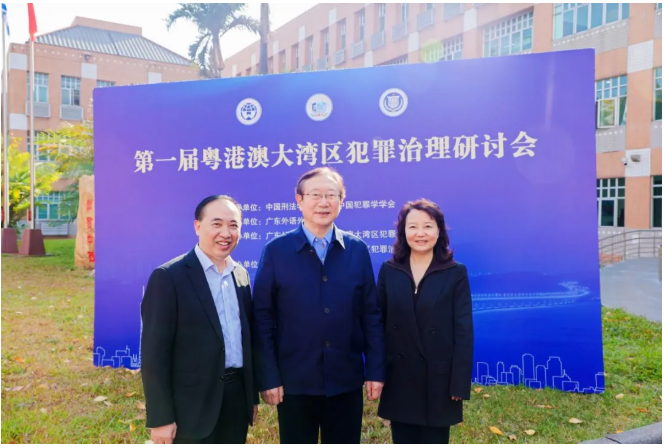
Mr. Tian Wenchang (second from left), Ms. Liang Yali (first from right) and Mr. Shi Jinghai, Director of Guangdong University of Foreign Studies Guangdong, Hong Kong and Macao Greater Bay Area Crime Governance Research Institute (first from left) before the conference.
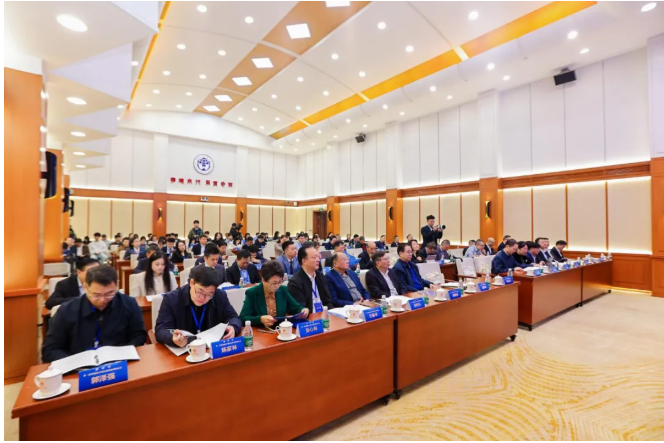
Conference site
From academic organizations such as the Chinese Society of Criminal Law, the Chinese Society of Criminal Procedure Law and the Chinese Society of Criminology, from universities in Hong Kong and Macao such as the University of Hong Kong, the Hong Kong University of Education and the University of Macao, and from the Mainland such as the Institute of Law of the Chinese Academy of Social Sciences, the National Prosecutors College, Renmin University of China, Wuhan University, Jilin University, China University of Political Science and Law, Zhongnan University of Economics and Law, Southwestern University of Political Science and Law, East China University of Political Science and Law, Northwestern University of Political Science and Law, Qingdao University of Political Science and Law and the National University of China. University, Northwest University of Political Science and Law, Tsinghua University, Zhejiang University and other mainland universities, from the Hong Kong Independent Commission Against Corruption, the Macao Lawyers Association and other practical departments of more than 130 people attended the meeting.
Jia Yu, Party Secretary and President of Shanghai Higher People's Court and President of China Society of Criminal Law, as well as Wan Chun, former deputy ministerial-level member of the Supreme People's Procuratorate and President of the China Society of Criminology, delivered speeches via video, while Prof. Shi Youqi, Party Secretary of Guangdong University of Foreign Studies, Gao Bo, Party Member and Deputy Procurator General of Guangdong Provincial People's Procuratorate, Shen Zhongping, former Chief Crown Counsel of the Department of Justice of Hong Kong, Zhao Qiang, Guest Professor of the Chinese University of Macau, and Gao Bo, Vice Procurator General of Guangdong Provincial People's Procuratorate. Zhao Guoqiang, visiting professor of the University of Macau, Tian Wenchang, consultant of the Criminal Committee of the All-China Lawyers Association, and Prof. Chen Zexian, former director of the Institute of International Law of the Chinese Academy of Social Sciences and consultant of the Chinese Society of Criminal Law, delivered speeches one after another. The opening ceremony was presided over by Mr. Affirmative Hao, member of the Standing Committee of the Party Committee and Vice President of Guangdong University of Foreign Studies.
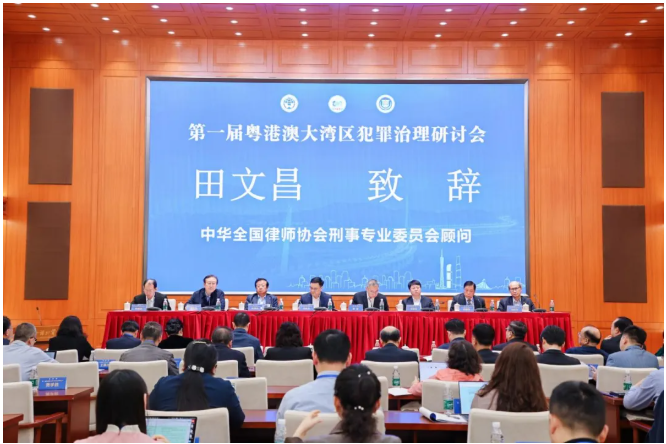
Speech by Mr. Tian Wenchang
At the opening ceremony, Mr. Tian Wenchang, advisor of the Criminal Committee of the All-China Lawyers Association and founding partner of King&Capital Law Firm, delivered a speech as an important guest. The following is the summary of Mr. Tian Wenchang's speech:
Today, I am very pleased to participate in this meeting to exchange and discuss the topics related to crime governance in Guangdong, Hong Kong and Macao Greater Bay Area, and I would like to share two personal feelings.
First, the seminar topic has both importance and urgency.
At present, we are in a situation of great change that has not been seen in a thousand years, and the rapid development of big data, artificial intelligence and other technologies in the information age, the complexity and speed of change far exceed the period of the Agricultural Revolution and the Industrial Revolution, with unprecedented unpredictability.
The evolution of crime types has always been accompanied by changes in the social environment and lifestyles, and in such a context, the occurrence of new types of crimes is inevitable and their manifestations are equally unpredictable. Therefore, this seminar focusing on the predicament of crime governance in the Greater Bay Area and the innovation of countermeasures is not only very necessary, but also timely.
Second, crime governance should uphold the “regulation priority, prudent sanctions” principle
Governance contains two levels of prevention and combating, the relationship between the two arrangement of the core lies in the establishment of concepts and principles, I believe that “focus on regulation, prudent sanctions, prevention as the main, supplemented by combating” should become the core principle.
From the point of view of legal characteristics, the law itself has a lag, the need to have the phenomenon before the rules; criminal law is more obvious lag, often preceded by criminal behavior before setting sanctions. The basic concept of the rule of law is “teach first and punish later”, and there should be no “punishment without teaching”.
For new forms of crime, first of all, clear rules should be formulated on the basis of a serious violation of the rules of the harmful act of setting the appropriate penalties; secondly, the formulation of penalties to avoid ambiguity in the formulation of the crime, to reduce the uncertainty of the conditions of incrimination. If this principle is violated, it is very easy to stifle new things and innovative attempts.
There have been many lessons learned in practice, for example, in the financial field, the use of letters of credit, promissory note financing is often misjudged as fraud; false invoicing of value-added tax special invoices, illegal absorption of public deposits, organization and leadership of pyramid schemes and other cases, the boundaries between crime and non-crime are often confused, and some of the exploratory business activities are improperly recognized as crimes. This problem involves both deviations in judicial application and is closely related to the ambiguity in the formulation of crimes in the legislative provisions. What is more alarming is that there is a tendency for analogical thinking to return years after the abolition of the analogical system, which needs to be guarded against in the governance of new types of crimes.

Speech by Mr. Tian Wenchang
At the end of his speech, Mr. Tian Wenchang emphasized that his long-term practical experience has made him deeply appreciate that it is crucial to set up the relationship between the formal system and sanctions. Criminal sanction is a means to maintain order and promote reform. Properly utilized, it can protect and promote reform, while the opposite will be counterproductive. Therefore, the topics of this conference are of great significance, and it is even more crucial to establish a correct concept of governance.
The conference has set up three parallel forums on the sub-topics of “Coordinated Governance Mechanism of Cross-border Crimes”, “Governance Response to New Types of Crimes” and “Crime Prevention System in the Context of Regional Integration”. The parallel forums were organized in three sub-themes, namely In the parallel forum of “Coordinated Governance Mechanism of Cross-border Crimes”, Mr. Liang Yali, Senior Partner of King&Capital Law Firm and Director of Kyoto Criminal Defense Research Center, made a special speech on the topic of “Protection of Private Economy and Convergent Law Enforcement and Justice”, which hit the pain points of law enforcement and justice related to enterprises, and put forward a full-dimensional response strategy. The topic was “Private Economy Protection and Profitable Law Enforcement and Justice”.

Ms. Liang Ya-Li delivered a keynote speech.
Liang Yali pointed out that the phenomenon of profit-oriented law enforcement and justice not only directly infringes on the legitimate rights and interests of enterprises and entrepreneurs, but also destroys the business environment and weakens the credibility of the judiciary, which is contrary to the demand for high-quality development of the private economy, and urgently needs to be cracked systematically from the legal level.
She proposed that the entity defense should focus on the “crime and non-crime, this crime and the other crime, the amount of crime identified” three dimensions. The defense process needs to firmly grasp the social harm of crime, criminal illegality and should be punished by the three core features of the penalty, strictly follow the principle of the law of crime and punishment, and accurately carry out the analysis of the elements of the criminal constitutive elements. Both to avoid by “pull up the crime” the pursuit of heavy punishment or facilitate the phenomenon of confiscation, but also prudent determination of the amount of the crime, can not be all the enterprise input expenditure simply attributed to the cost of the crime, but should be combined with the actual value of the victim, whether to make up for the loss of factors such as a comprehensive judgment, from the root of the crack tendency to prosecute the entity basis.
Liang Yali lawyer called for, curbing the tendency to law enforcement, optimize the development of private economic environment is a systematic project, the need for lawyers and even the whole society to work together, the lawyer group should follow the national policy guidance, to professional defense for the development of private economic development in the Bay Area to build a solid rule of law barrier.
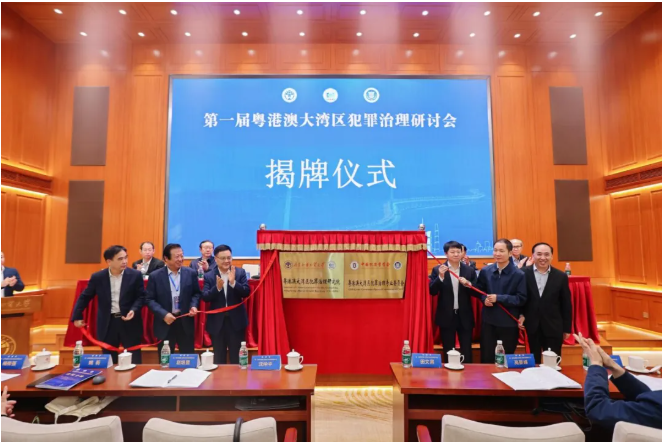
The scene of the unveiling ceremony
During the meeting, the Guangdong University of Foreign Studies Guangdong, Hong Kong and Macao Greater Bay Area Crime Governance Research Institute and the Chinese Society of Criminology Guangdong, Hong Kong and Macao Greater Bay Area Crime Governance Professional Committee unveiling ceremony was also held. Mr. Tian Wenchang and Ms. Liang Yali were appointed as the advisor and vice president of the Institute of Crime Governance of Guangdong, Hong Kong and Macao Greater Bay Area of Guangdong University of Foreign Studies respectively.

Group photo of the participants
As an important platform to gather consensus on crime governance in the Bay Area, the convening of this seminar further builds a bridge for communication and collaboration between the Mainland, Hong Kong and Macao on crime governance, provides multiple solutions to get rid of governance dilemmas, and is of great significance to improve the crime governance system and enhance the modernization level of governance in the Bay Area.
In the future, King&Capital Law Firm will continue to plough into the field of crime governance and private economy protection in Guangdong, Hong Kong and Macao Bay Area, and actively promote the deep integration of theoretical research and practice, so as to improve the system of crime governance in the Bay Area and enhance the modernization level of governance to contribute more “Kyoto Wisdom”.