

Recently, Li, the chairman of a trading company represented by attorneys Zhang Qiming and Xu Ming, was released from bail pending investigation by public security authorities and had his case dismissed on charges of contract fraud and issuing fraudulent VAT invoices, resulting in a successful acquittal.
Li, the chairman of a trading company, became involved in the trade financing chain of a state-owned enterprise through a friend’s introduction. The basic business model was as follows: Li’s trading company signed a coal procurement contract with the state-owned enterprise; the state-owned enterprise advanced funds to purchase coal from a designated supplier; downstream enterprises then purchased from Li’s company. The three companies processed paperwork without actual goods moving, forming a closed-loop trade cycle (as illustrated in the diagram below). This financing-based trade lacked substantive commercial activity; in reality, it constituted a loan extended by the state-owned enterprise to Li’s trading company. Subsequently, due to operational losses, Li was unable to repay nearly 80 million yuan, prompting the state-owned enterprise to file a police report.
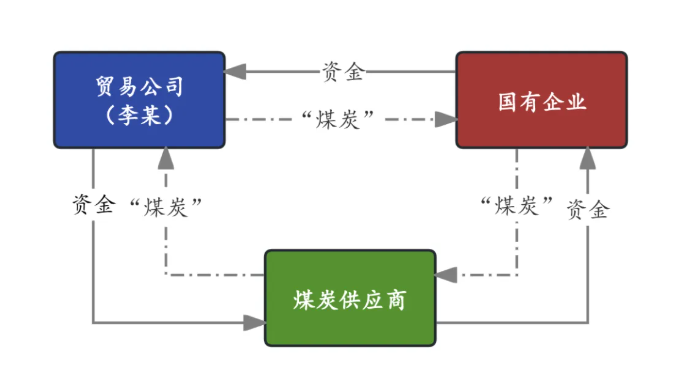
In 2025, public security authorities placed Mr. Li under criminal detention on charges of contract fraud and issuing fraudulent VAT special invoices. After attorneys Zhang Qiming and Xu Ming became involved, they obtained the relevant contracts and interviewed relevant personnel to understand the business chain. They concluded that Mr. Li had consistently repaid the state-owned enterprise’s funds in a normal cycle over the past three years, and that the victim was fully aware of the true nature of the loan, thus the act did not constitute contract fraud; After encountering business difficulties, Li had mortgaged his personal property and exhausted all his assets to make repayments, demonstrating a lack of subjective intent to defraud. Considering the nature of financing-based trade, no loss of state tax revenue had occurred, and the actions did not constitute the crime of issuing fraudulent VAT invoices. The defense counsel applied to the procuratorate to deny the arrest warrant.
After the procuratorate issued a decision not to approve the arrest, the public security authorities placed Li Mou under bail pending investigation to continue the inquiry. During the one-year bail period, the defense counsel assisted the client in organizing evidence, reconstructing the objective facts of the case, and submitting evidence materials to the public security authorities. Recently, the public security authorities lifted Li Mou’s bail pending investigation and dismissed the case.
Translated with DeepL.com (free version)