


On April 28, 2026, the 18th installment of the “Criminal Case Debate Forum” organized by the Third Criminal Law Department of King&Capital Law Firm was successfully held at the firm’s offices. Centered on the newly issued “Interpretation (II) on Several Issues Concerning the Application of Law in Handling Criminal Cases of Embezzlement and Bribery” (hereinafter referred to as “Interpretation II on Embezzlement and Bribery”), the event brought together several senior criminal defense attorneys from King&Capital Law Firm for in-depth analysis and discussion regarding the legislative background, key provisions, practical application, and defense strategies related to the judicial interpretation. The event was moderated by Attorney Feng Wang of King&Capital Law Firm. Senior attorneys including Wang Jiuchuan, Zhu Yalin, Meng Fen, Nie Sufang, Xia Jun, Peng Jiyue, Qi Xiaoling, Xu Ying, Weng Xiaoping, and Sun Guangzhi took turns sharing key insights, providing professional, cutting-edge, and practical guidance for handling embezzlement and bribery cases.

In his opening remarks, moderator Feng Wang noted that the release of the Second Judicial Interpretation on Embezzlement and Bribery—after a decade—not only resolved numerous practical controversies but also gave rise to new challenges in its application. As frontline practitioners in the application of the law, criminal defense attorneys must accurately grasp the changes in the provisions, analyze judicial trends, and leverage their professional expertise to address new challenges in defending against official misconduct cases.
I. Wang Jiuchuan: Core Interpretation of Article 8—Background, Characteristics, and Impact of Changes in Sentencing Standards for Non-Public Official Duty Crimes

Wang Jiuchuan, Senior Partner at King&Capital Law Firm in Beijing, focused on Article 8 of the Judicial Interpretation, noting that Article 8 marks a shift in anti-corruption efforts targeting private enterprises from a policy of “strict enforcement against public officials and leniency toward private individuals” toward a direction of equal regulation and standardized standards, a shift rooted in profound historical context. In recent years, criminal legal issues involving private enterprises have become increasingly prominent, and the number of cases linked to official misconduct by public officials has risen significantly, creating an urgent need for legislative adjustments. Previous amendments to criminal laws at various levels had already pointed in this direction, and this interpretation serves as a milestone in their implementation.
This provision exhibits several characteristics: First, it is highly policy-driven and grants investigative authorities considerable discretion, as evidenced by the use of the phrase “by reference” and the inclusion of “provided that” clauses; Second, the reduction in the threshold for initiating criminal cases contrasts with the increase in thresholds for certain crimes committed by public officials; third, it applies the principle of “equal punishment for equal crimes” to a limited extent, without altering the existing gradations in sentencing; fourth, the adjustment to the threshold for initiating criminal cases will affect the statute of limitations for certain suspected offenses, and cases falling within this “window period” may give rise to disputes regarding the application of the principle of applying the older, more lenient law.
Attorney Wang emphasized that Article 8 will have far-reaching implications: at the legislative level, it will prompt a reinterpretation of the authority of judicial interpretations and the application of the principle of legality; the number of criminal cases involving private enterprises will rise, potentially leading to inconsistent rulings in similar cases; private enterprises must conduct comprehensive self-inspections of criminal legal risks to address compliance loopholes; and in criminal defense, the weight given to factors such as the amount involved may decrease, placing higher demands on strategic defense capabilities.
II. Zhu Yalin: New Regulations on Embezzlement of Public Funds—Practical Application of Articles 9 and 10 and the Transformation of Defense Strategies

Zhu Yalin, Senior Partner at King&Capital Law Firm in Beijing, analyzed the disruptive impact of the new interpretation on embezzlement cases, focusing on Articles 9 and 10.
Article 9 explicitly defines covert financial operations—such as fabricating payment reasons, failing to record accounts receivable, and evading organizational oversight—as “using public funds in one’s personal name for the benefit of other entities.” By adopting a substantive determination standard, it moves beyond the traditional formal review of fund flows, significantly expanding the scope of the offense of embezzlement of public funds.
In practice, acts such as fabricating contracts, off-the-books transactions, and acting as an intermediary for collection and payment have all been brought under regulation. The focus of evidence collection by investigative authorities has shifted from bank statements to financial ledgers, approval processes, and forensic accounting assessments, significantly increasing the difficulty of defense. The traditional defense strategy of arguing “no personal liability because funds passed through public accounts” has been narrowed. The defense must now focus on three core elements: examining the entity’s intent, whether regulatory oversight was evaded, and whether personal gain was sought. While seeking personal gain does not affect the legal classification of the offense, it reflects subjective malice and may influence sentencing.
Article 10 clarifies that the cutoff point for “failure to return funds in cases involving a ‘huge amount’” has been moved forward from before the first-instance verdict to before the filing of the indictment, thereby narrowing the window of opportunity for perpetrators to return ill-gotten gains and mitigate their risks. Attorney Zhu advises that defenses must distinguish between objective inability to return funds and refusal to return them, guiding clients to actively cooperate with asset recovery efforts prior to prosecution to seek mitigating factors for sentencing. Additionally, the rules for determining embezzlement of public funds may extend to the crime of misappropriation of funds in private enterprises; corporate compliance must therefore prioritize standardizing fund approval processes and accounts receivable management.
III. Meng Fen: Determination of the Amount of Bribery—Regulations on New Forms of Bribery in Articles 11 and 12

Meng Fen, a partner at King&Capital Law Firm in Beijing, interprets the significant changes regarding the determination of the amount of bribery in Articles 11 and 12 based on practical cases. Article 11 introduces groundbreaking provisions regarding bribery involving equity and stock-based bribes, clarifying that where expected returns constitute the subject matter of the bribe, the amount is determined based on actual profits for realized gains and on the difference between market value and the par value of the shares for unrealized gains. This resolves the practical controversy over whether the full purchase of original shares constitutes a crime.
The implementation of this provision indicates that the value orientation of bribery convictions has expanded from “power must not be bought” to “protecting equal investment opportunities.” In practice, there remains some room for defense: if it can be proven that the parties involved did not agree to anchor the expected returns on the shares in question, criminal liability may be excluded.
Article 12 establishes the rule that authenticity appraisal must precede valuation, resolving pricing disputes regarding property of uncertain authenticity, such as jade and calligraphy and paintings, and standardizing appraisal procedures.
IV. Nie Sufang: Expansion of Bribery Determination—Articles 13 and 14 Further Expand the Determination of “Circumstances of Seeking Profit” in Mediation Bribery and “Official Convenience” in General Bribery
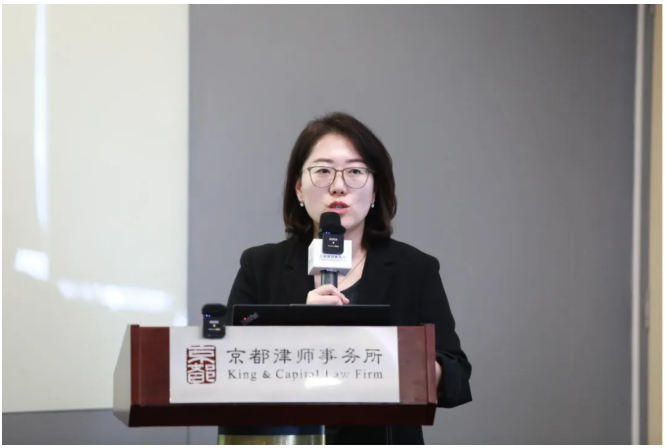
Nie Sufang, Senior Partner at King&Capital Law Firm in Beijing, focuses on Articles 13 and 14 of the Interpretation, analyzing the expanded boundaries for determining brokerage bribery and general bribery.
Article 13 clarifies that in cases of bribery through mediation, a promise to secure benefits constitutes the act of securing benefits; accepting property while knowing of a specific improper request is deemed a promise; and it further clarifies that whether the request was conveyed does not affect the determination of guilt. Although the 2003 symposium minutes and the 2016 judicial interpretation contained similar provisions regarding the determination of “securing benefits” in bribery offenses, it was unclear whether these applied to intermediary bribery. The clarification in this interpretation can be said to have further lowered the threshold for criminal liability in intermediary bribery cases.
Article 14, for the first time at the level of judicial interpretation, includes the official powers of other state officials who have a subordinate or regulatory relationship with the recipient within the scope of “abusing official position.” It further clarifies that such subordinate or regulatory relationships are not limited to supervisory relationships or direct superior-subordinate relationships, posing a potential risk of expanding the boundaries for determining “abuse of official position.” The core of the defense must focus on the two key elements of lack of free will and the binding nature of official duties, distinguishing between official constraints and ordinary social interactions to avoid an unlimited expansion of the scope of prosecution.
V. Xia Jun: Distinguishing Between Corporate and Individual Bribery Crimes and Defense Strategies—An Interpretation of Articles 15 and 16

Xia Jun, a senior partner at King&Capital Law Firm in Beijing, shared her defense strategy regarding the distinction between corporate bribery and individual bribery offenses, as well as between corporate bribery and individual bribery offenses. She pointed out that defense efforts should focus on key issues such as the subject of the offense, the will of the entity, and the attribution of benefits, with the latter being particularly crucial.
Attorney Xia Jun believes that defense counsel should identify the various signals conveyed in judicial interpretations and strive to uncover favorable defense provisions within them. For example, Article 16 stipulates that if the actual controller of an entity makes the decision and the illicit gains accrue to the entity, it shall be deemed bribery by the entity. This implies that in such cases, the absence of a collective resolution does not affect the characterization of the crime as an entity offense.
Furthermore, Attorney Xia Jun suggested paying close attention to situations where corporate assets are highly commingled with personal or family assets. During defense proceedings, attorneys can assist the implicated entity in presenting evidence by conducting financial audits to examine the ownership of assets, submitting financial audit reports, and detailing the actual distribution of benefits, thereby securing the best possible defense outcomes for both the implicated entity and individuals.
VI. Peng Jiyue: Criminal Liability for Intermediaries—The Narrowing of the Scope for Misdemeanors Under Article 17

Peng Jiyue, a senior partner at King&Capital Law Firm, analyzed judicial data (indicating that intermediaries account for 65% to 70% of bribery crimes) to interpret Article 17’s comprehensive regulation of the entire chain of bribery intermediation activities.
This provision establishes a four-dimensional criminal liability framework encompassing the crime of introducing bribery, complicity in bribery (both giving and receiving), the crime of accepting bribes by exploiting influence, and the crime of fraud, thereby covering all behavioral patterns of intermediaries.
The new regulations significantly narrow the scope for treating bribery mediation as a lesser offense. Situations where informants were previously exempt from prosecution have been drastically reduced. The focus of defense strategies has shifted from “guilt versus innocence” to disputes over legal characterization and the distinction between single and multiple offenses, with particular emphasis on examining whether intermediaries have embezzled funds or fabricated relationships, thereby ensuring precise differentiation in the application of criminal charges.
VII. Qi Xiaoling: Embezzlement, Bribery, and Dereliction of Duty—Tightening the Legal Net in Articles 18 to 20

Attorney Qi Xiaoling, Senior Partner at King&Capital Law Firm, interprets Articles 18 to 20, clarifying the rules for identifying and adjudicating new forms of corruption.
Article 18 distinguishes between the misappropriation of state-owned assets and personal embezzlement: it classifies acts of misappropriation by management or leadership that involve deliberate concealment and the exclusive enjoyment of benefits as embezzlement, thereby dispelling the misconception that “collective decision-making” provides immunity, and further narrowing the scope for corporate criminal liability; it further clarifies the boundaries for determining the misappropriation of state-owned assets: the breadth of the misappropriated scope, the transparency of the distribution plan, and the reasonableness of the distribution ratios. Article 19 fills a regulatory gap in Article 396 of the Criminal Law. As a state supervisory organ established under the Constitutional Amendment and the Supervision Law, the Supervisory Commission’s acts of misappropriating confiscated or forfeited property shall be charged as the crime of abuse of power if they constitute corporate crime, and as the crime of embezzlement if they constitute individual crime. Article 20 establishes the rule of concurrent punishment for bribery and dereliction of duty, clarifying the handling of concurrent offenses between bribery and dereliction of duty. This effectively addresses the issue of insufficient evaluation of complex and covert corrupt acts, severs the chain of bribery using public funds, and tightens the criminal law net.
VIII. Xu Ying: New Rules on the Recognition of Voluntary Surrender—Article 21’s Special Provisions on Voluntary Surrender Break the Deadlock in Recognizing Voluntary Surrender for the Same Type of Offense

Xu Ying, a senior partner at King&Capital Law Firm in Beijing, focuses on Article 21 to interpret the new standards for recognizing special voluntary surrender in official duty crimes. This provision stipulates: Where the embezzlement or bribery acts known to the supervisory authorities do not reach a “substantial amount,” and the perpetrator voluntarily confesses the vast majority of the criminal facts not yet known to the authorities, such conduct shall be deemed voluntary surrender.
Attorney Xu Ying points out that existing legal provisions regarding special self-surrender for official misconduct have created a practical dilemma in determining special self-surrender for the same type of offense. This contradicts the original intent of the self-surrender system, conflicts with the general public’s understanding of legal norms and emotional expectations, and discourages subjects of investigation from voluntarily confessing to criminal facts. The new regulations have, to some extent, broken through the traditional constraints of “difficulty in recognizing self-surrender for the same type of offense.”
Key Defense Points: Distinguish between “clues” and “facts”; supervisory authorities must have already clarified criminal facts involving a “substantial amount”; supervisory authorities bear the burden of proof regarding the clues or criminal facts they possess; the term “the vast majority” should be comprehensively determined based on factors such as the timing of the voluntary confession, the extent of the confession, the attitude toward admitting guilt, and the return of ill-gotten gains, thereby providing a new pathway for defense in cases of voluntary surrender for official misconduct.
IX. Weng Xiaoping: Restitution and Asset Recovery—Revolutions in Property Defense Under Articles 22 and 23

Beyond substantive rules regarding voluntary surrender, dereliction of duty, and bribery, leniency in sentencing for official misconduct and the disposition of assets are equally critical aspects of judicial practice and defense work. Weng Xiaoping, a senior partner at King&Capital Law Firm, focuses on Articles 22 and 23, centering on the two core issues of restitution and asset recovery, to systematically analyze the profound changes the new regulations bring to sentencing defense and asset defense.
Article 22 defines “active restitution of ill-gotten gains” through explicit enumeration, covering four common scenarios: full restitution, the vast majority of restitution, restitution of proceeds from joint criminal activities, and restitution made on behalf of the defendant by relatives or friends. This unifies the long-standing ambiguous standards in practice and provides a clear basis for defense counsel to argue for leniency in sentencing. Article 23 establishes a comprehensive, penetrative system for the recovery of illicit gains, clarifying that the original proceeds, converted assets, and commingled property may be recovered. Under specific circumstances, property of equivalent value may be confiscated. It also stipulates that where illicit funds have not yet been delivered to or have been returned to the bribe-giver, recovery shall be sought directly from the bribe-giver.
Attorney Weng Xiaoping points out that the acquittal rate for official misconduct cases is currently extremely low, and the scope for defense based on the nature of the offense continues to narrow. The new regulations further drive the shift in the focus of defense toward sentencing and asset-related arguments. On the one hand, the clarification of standards for the active return of ill-gotten gains provides defense counsel with a precise lever for seeking lenient sentencing; on the other hand, the “piercing” recovery rules significantly intensify the enforcement of asset disposal, requiring defense counsel to strictly distinguish between illicit gains and lawful assets to prevent the improper entanglement of family members’ lawful property, and to conduct meticulous defense in areas such as the verification of asset leads, valuation, and the legality of recovery procedures.
X. Sun Guangzhi: Retroactive Application—Defense Strategies Regarding the Temporal Effect of Judicial Interpretations

Sun Guangzhi, a senior partner at King&Capital Law Firm in Beijing, systematically outlines the retroactive application rules of Judicial Interpretation No. 2 on Embezzlement and Bribery: Judicial interpretations have no independent temporal effect and are dependent on the provisions of the Criminal Law; when old and new interpretations coexist, the principle favorable to the defendant applies; if no interpretation existed at the time of the offense but one exists at the time of trial, the new interpretation applies; if interpretations exist at both the time of the offense and the time of trial, the provision with the lighter penalty applies.
By examining offenses such as embezzlement of corporate assets, this presentation clarifies the application logic for scenarios involving combinations of new laws with old interpretations and old laws with new interpretations. It provides a defense strategy regarding retroactive effect for cases falling within a “grace period,” aiming to secure a more lenient sentence through the alignment of new and old laws and interpretations.
Interactive Exchange: Attorneys Ma Lixi and Peng Jiyue Share Practical Insights

Attorney Ma Lixi, a partner at King&Capital Law Firm, shared his insights based on his participation in the conference and practical case handling experience.
He noted that the new judicial interpretation clarifies many contentious issues from past practice, further narrowing the scope for dispute, which places higher demands on the professionalization of defense in official misconduct cases; Some provisions have increased the severity of penalties. For example, in bribery offenses involving the acceptance of expected returns from stocks or equity interests, the old rules treated the value of the stocks or equity at the “time of acceptance” as the bribery amount, while subsequent appreciation and dividends were considered criminal proceeds. In contrast, the new judicial interpretation determines the amount of bribery based on the “actual profit” at the “time of the incident”; for assets that have not yet yielded actual profit, the amount is determined based on the premium between the market price and the payment price of the involved assets at the “time of the incident.” In other words, the new rules no longer distinguish between principal and proceeds; instead, all gains—including principal, appreciation, and dividends—at the “time of the incident” are included in the bribery amount (if the principal was originally paid by the recipient, it is deducted from the gains as a payment cost); Defense work during the review and prosecution stage of official misconduct cases will become even more critical. For instance, Article 10 of the new judicial interpretation addresses the impact on factual determinations when specific circumstances arise “prior to the filing of an indictment.” An unavoidable practical reality is that, given the high level of maturity in legislation, judicial practice, and even criminal defense regarding official misconduct—where the scope for disputes over case characterization has narrowed in individual cases while new disputes have yet to emerge—there remains significant room for defense strategies regarding sentencing and assets involved in the case. Through continuous learning, by aligning professional capabilities with the requirements of the new regulations, and by adopting a defense strategy focused on practical results, effective defense in official misconduct cases can still be achieved even under the high-pressure anti-corruption campaign.

Toward the end of the event, in response to the widespread pessimism within the industry—the view that the new regulations have significantly reduced the scope for criminal defense and exacerbated professional challenges—Attorney Peng Jiyue offered a positive response.
He argued that following the implementation of the “Second Judicial Interpretation,” the scope for criminal defense in the field of official misconduct has expanded rather than contracted, based on four key points: