

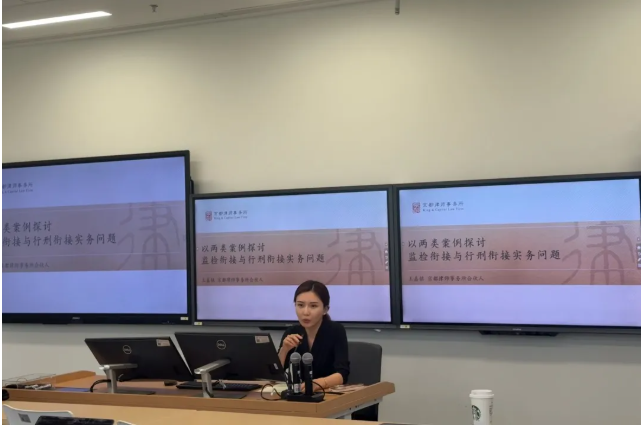
On May 14, 2026, Wang Jiaming, a partner at King&Capital Law Firm, was invited by the School of Law at Renmin University of China to deliver a lecture titled “Practical Issues in the Coordination of Supervisory and Criminal Proceedings,” using two types of case studies to provide master’s students with a vivid, practical, and authentic analysis of typical cases. The lecture was moderated by Professor Li Fenfei, a dual-appointed professor at both the School of Law and the School of Discipline Inspection and Supervision at Renmin University of China, and a doctoral advisor.
Drawing on his personal case experience, Attorney Wang Jiaming focused on core issues in the two major procedures—the coordination between supervision and prosecution, and the coordination between administrative and criminal proceedings—and systematically examined the chaotic state of procedural coordination in practice. Addressing practical challenges such as jurisdictional designation, the coordination of coercive measures, and the protection of parties’ rights under plea agreements in the supervision-prosecution interface, as well as issues regarding the admissibility of administrative evidence in criminal proceedings, the evidentiary value of expert opinions, and discrepancies in evidentiary standards between administrative and criminal proceedings in the administrative-criminal interface, he presented a professional analysis that combined theoretical depth with practical value to the faculty and students in attendance.
At the outset of the lecture, in the section on the coordination between supervision and prosecution in official duty crime cases, Attorney Wang Jiaming drew upon three bribery cases involving bureau-level officials in the financial sector that he personally handled to conduct an in-depth analysis of prominent issues in the coordination between supervisory investigations and criminal proceedings. Attorney Wang Jiaming pointed out that while designated jurisdiction has become the norm in current official corruption cases, practical challenges persist, including vague legislative standards, significant regional disparities in sentencing, jurisdiction driven by vested interests, and the lack of rights for parties to raise jurisdictional objections. He further elaborated on the operational logic of single designated jurisdiction and revealing the operational logic behind both single and dual designated jurisdiction. He highlighted the practical impacts of designated jurisdiction on the trial jurisdiction system and the protection of parties’ rights, and offered reflections on the blurred boundaries between designated jurisdiction and case assignment.
Addressing conflicts over coercive measures in the coordination between public security and supervisory authorities, Attorney Wang Jiaming cited a case he personally handled involving insider trading and related official misconduct. He pointed out that in practice, disputes arise when public security organs modify non-custodial coercive measures while the supervisory commission concurrently imposes detention, leading to de facto extensions of the investigation period and restrictions on lawyers’ visitation rights. He further highlighted gaps in the protection of parties’ rights in such cases. At the same time, drawing on practical experience, Attorney Wang Jiaming highlighted the anomalous phenomenon of “selective transfer-based plea bargaining” observed in certain cases. Furthermore, by referencing typical judicial precedents, he analyzed practical issues such as the nullification of the right to appeal following a plea of guilty and the imposition of harsher sentences upon appeal.
In the section on the coordination between criminal and administrative enforcement in securities crimes, Attorney Wang Jiaming cited major and complex cases involving illegal information disclosure by listed companies and criminal cases related to circular trade to highlight the core challenges currently facing the coordination between criminal and administrative enforcement in the securities sector. Drawing on a case he is currently handling—involving more than ten listed companies and spanning nearly a decade of financing-related circular trade that led to disclosure violations—Attorney Wang Jiaming revealed the practical dilemma faced by judicial authorities: their excessive reliance on professional opinions provided by the China Securities Regulatory Commission (CSRC), which makes it difficult to maintain impartial review. Additionally, Attorney Wang Jiaming provided in-depth explanations on key issues such as the rules governing the conversion of administrative evidence into criminal evidence, the similarities between administrative interrogation records and investigative records, and the substantive pre-determinative effect of determination letters in criminal proceedings. Attorney Wang Jiaming pointed out that in securities crime cases, although the determination letters issued by the CSRC are defined as “for reference only” in the 2024 “Opinions on Several Issues Concerning the Handling of Securities and Futures Violation and Crime Cases,” they carry significant influence in practice, making it difficult for criminal proceedings to independently reach a contrary determination. Attorney Wang Jiaming further noted that the lack of clear standards for the transfer of cases from administrative to criminal proceedings, as well as the ambiguity in the system linking administrative and criminal procedures, often results in public security organs passively accepting cases in practice—a systemic shortcoming that urgently needs to be addressed.
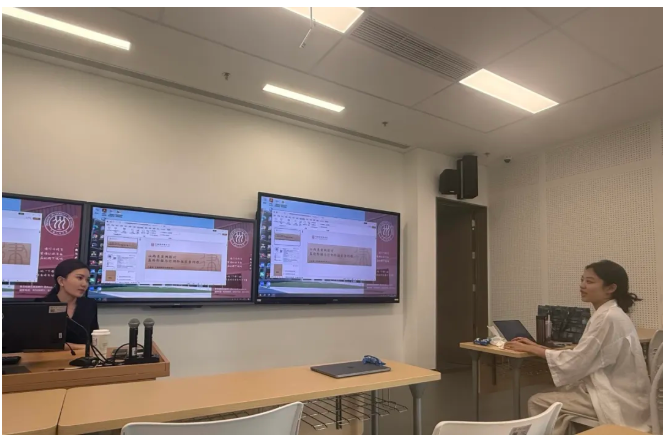
During the Q&A session, Attorney Wang Jiaming addressed each question raised by the students—including the admissibility of evidence in criminal proceedings for illegal business operations cases, issues regarding referrals from the Supervisory Commission in practice, and the legality of concurrent compulsory measures in the coordination between the Supervisory Commission and the Procuratorate—with clear perspectives and thorough analysis. Attendees, both faculty and students, noted that the lecture was grounded entirely in real case law and firsthand experience, offering vivid content that directly addressed practical pain points.
This lecture closely integrated practical experience with cutting-edge academic issues, providing valuable practical case studies for legal research. Attorney Wang Jiaming expressed his hope that the students and academic colleagues in attendance would continue to focus on prominent issues in the coordination between the Supervisory Commission and the Procuratorate, as well as between administrative and criminal proceedings. He encouraged them to engage in deeper reflection and research grounded in both theoretical study and judicial practice, working together to improve criminal procedural systems, safeguard the legitimate rights and interests of parties involved, and advance judicial fairness.