

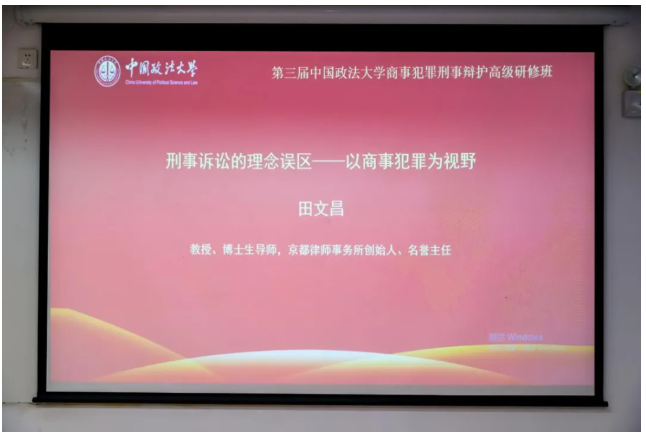
On May 25, 2026, Attorney Tian Wenchang—founder, honorary director, and doctoral advisor of King&Capital Law Firm—was invited to attend the Third Advanced Training Course on Criminal Defense for Commercial Crimes, co-hosted by the School of Criminal Justice at China University of Political Science and Law and the Research Center for Innovation and Development in Criminal Defense at China University of Political Science and Law, and delivered a lecture titled “Conceptual Misconceptions in Criminal Procedure: A Perspective on Commercial Crimes.” He engaged in an in-depth analysis of conceptual misconceptions in criminal procedure with legal professionals from across the country, jointly exploring cutting-edge theories and practical challenges.

At the beginning of his lecture, Tian Wenchang reviewed China’s 40-year journey in building the rule of law, noting that while the concept of the rule of law has been established, widespread acceptance of this philosophy has not yet been achieved. He emphasized that many challenges in judicial practice stem from conceptual misunderstandings.
Subsequently, drawing on issues observed in criminal practice, Tian Wenchang systematically outlined the top ten misconceptions in the field of criminal procedure:
1. Denying the Presumption of Innocence in the Name of Seeking Truth from Facts
Tian Wenchang argued that “denying the presumption of innocence in the name of seeking truth from facts” uses the abstract concept of “seeking truth from facts” to undermine the principle of presumption of innocence as a methodological foundation. This leads to a lack of concrete standards for conviction, resulting in subjective and arbitrary conviction criteria influenced by the balance of power in discourse.
2. Using the principle of “neither wrongful conviction nor wrongful acquittal” to negate “in dubio pro reo”
Tian Wenchang argued that no society can fully achieve the balance of “neither wrongful conviction nor wrongful acquittal”; trade-offs are inevitable. Only by unequivocally affirming the principle that “it is better to let a guilty person go free than to convict an innocent one” and by unequivocally upholding “in dubio pro reo” can the problem of wrongful convictions be fundamentally resolved.
III. Balancing Legal Truth and Objective Truth
Tian Wenchang argues that throughout history, humanity has continuously pursued objective truth, yet objective truth is unattainable. This is why legal truth has been adopted as a unifying standard. However, since legal truth is not necessarily the same as objective truth, the principles of “in dubio pro reo” and the presumption of innocence are still necessary to protect the rights of the accused. Yet, if legal truth and objective truth are given equal weight, double standards will inevitably emerge, thereby allowing the process to be swayed by those in power.
Tian Wenchang pointed out that the essence of law is order, which is realized through judicial fairness. The purpose of court proceedings is to uphold judicial fairness, and achieving judicial fairness requires ascertaining the truth. How, then, is the truth ascertained? It is through legal truth. How is legal truth realized? It is through procedural justice, and lawyers are responsible for ensuring procedural justice.
IV. Emphasizing the Balance Between Combating Crime and Protecting Human Rights
Tian Wenchang argued that giving equal weight to combating crime and protecting human rights represents significant progress, yet this approach still contains a logical contradiction. The Criminal Procedure Law safeguards the human rights of criminal suspects or defendants. An approach prioritizing crime suppression follows the principle of “presumption of guilt in cases of doubt,” while one prioritizing human rights protection follows the principle of “presumption of innocence in cases of doubt.” If both are given equal weight, double standards will emerge, leaving room for the abuse of power and “rule by man.”
V. Suspects or Defendants Lack the Right to Review Case Files
Tian Wenchang noted that while many believe defendants lack the right to review case files, the Criminal Procedure Law stipulates that defendants have the right to cross-examine evidence. Since both the prosecution and defense attorneys require several months to prepare for cross-examination, defendants naturally also need time to fully prepare.
Furthermore, Tian Wenchang argued that there should be no exchange of evidence in criminal proceedings; only the prosecution has the obligation to disclose evidence to the defense, while the defense has no such obligation.
VI. The Legality of Defense Evidence
Tian Wenchang cited a case he handled early in his career as an example. At that time, the evidence proving the defendant’s innocence had been stolen from the office of the director of public security by a friend of the defendant. While this evidence was, of course, obtained illegally, the defendant was ultimately acquitted.
This prompted Tian Wenchang to reflect on the “legality of defense evidence.” He further reasoned that if, in a major homicide case, the defendant’s lawyer obtained evidence through improper means proving that another person was the actual perpetrator and submitted it to the court, would the judge still sentence the defendant to death simply because the source of the evidence was illegal? The conclusion, of course, is no. Tian Wenchang argued: Even if a lawyer violates the law and deserves punishment, the consequences of the lawyer’s unlawful conduct should not be borne by the defendant. Therefore, defense evidence need not be held to an overly strict standard of legality.
VII. Lawyers May Exercise the Right to Defense Independently, but Not Against the Client’s Will
Tian Wenchang argues that a lawyer’s right to defend stems from the client. The premise of a lawyer’s independent exercise of this right is that they must not present arguments detrimental to the client against the client’s will; they must absolutely not independently present arguments contrary to the client’s will.
VIII. A Lawyer’s Duty of Confidentiality Cannot Prevail Over Investigative Powers
Tian Wenchang noted that while the Lawyers Law and the Criminal Procedure Law strictly stipulate a lawyer’s duty of confidentiality, in practice, investigative authorities frequently engage in a series of actions such as searching law firms for files and case records, or taking statements from lawyers. The lawyer’s duty of confidentiality exists precisely to counterbalance investigative powers. Clients cannot expose their lawyers to secure a lighter sentence; the lawyer’s duty of confidentiality embodies the principle of mutual trust between lawyer and client and serves as the very foundation upon which the legal profession rests.
IX. Reversal of the Burden of Proof
Citing the “Peng Yu case” as an example, Tian Wenchang pointed out that the fundamental error in that case lay in the reversal of the burden of proof. Subsequently, Shenzhen took the lead in enacting local legislation explicitly stipulating that in such situations, the burden of proof rests with the person who received assistance. However, a case emerged in Hunan involving three elementary school students accused of knocking down an elderly woman. In that case, following Shenzhen’s principle, the elderly woman’s complaint was dismissed; instead, her son was arrested on charges of “extortion.” In response, Tian Wenchang emphasized that even when charging someone with extortion, the investigating authorities must still bear the burden of proof; the issue cannot be reduced to a simple either/or scenario. This problem is also reflected in the difficulty of excluding illegally obtained evidence. The core reason for this difficulty lies in the fact that once such evidence is excluded, investigators may face the risk of being held accountable.
Tian Wenchang argued that, in practice, adhering to the principle of favoring the defendant, any evidence should be excluded if there is a possibility that it was obtained illegally. This “possibility” does not necessarily imply certainty, nor does it necessarily mean that the relevant personnel engaged in torture to extract a confession. It is evident that the issue of the reversal of the burden of proof is widespread in both civil and criminal proceedings, and its root cause lies in numerous misconceptions regarding legal principles.
X. Confusion Regarding the Roles and Positions of Prosecution, Defense, and Judiciary
Tian Wenchang noted that the issue of “conflict between judges and defense counsel” is becoming increasingly severe. At its root, the primary responsibility for this problem lies with judges; lawyers’ opinions can only be realized through judges and, under normal circumstances, would not proactively provoke conflict. The core crux of the “conflict between judges and defense counsel” issue is that the judicial independence and neutrality of judges are not guaranteed, which essentially stems from a deviation from the concept of the rule of law.

At the conclusion of the lecture, Tian Wenchang offered the following advice to the lawyers in attendance: Lawyers should not merely focus on handling individual cases; they also have a responsibility to use specific cases to advance the rule of law and promote legislative improvements. This approach not only improves the judicial environment and elevates the professional status of lawyers but ultimately ensures the protection of clients’ rights and the realization of judicial fairness.
The lecture closely aligned with cutting-edge concepts in criminal procedure and the practical aspects of commercial crime defense, resonating deeply with the participants and earning widespread acclaim. The session concluded successfully amid enthusiastic applause.