

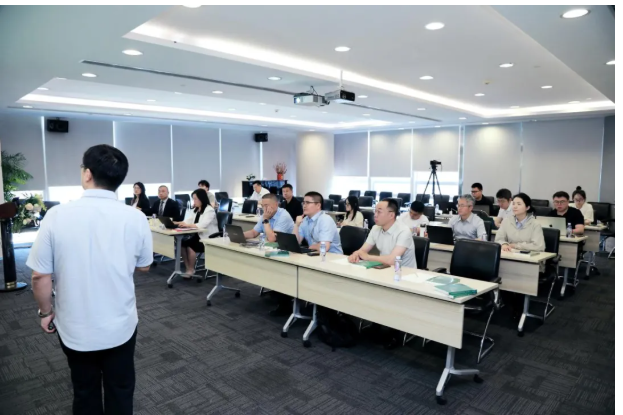
On May 28, 2026, King&Capital Law Firm successfully hosted the 19th installment of its “Criminal Case Discussions” series.
Organized by the Third Criminal Law Department of King&Capital Law Firm, the “Criminal Case Debate Forum” series focused on the cutting-edge topic of “Practical Challenges in Environmental and Resource Crimes under the Implementation of the Ecological and Environmental Code.” The event featured special guest speakers: Guo Gong, Research Fellow at Peking University Law School; Zhang Sijia, Attorney at the King&Capital Environmental, Food, Drug, and Intellectual Property Law Research Center; and Tang Jianbin, Director of the King&Capital Environmental, Food, Drug, and Intellectual Property Law Research Center. The three experts conducted in-depth discussions on three core topics: the impact of the Code’s implementation, rules for the identification of hazardous waste, and the determination of mining-related crimes. They delivered a professional feast of both theoretical depth and practical insight to hundreds of fellow lawyers participating both online and offline.

Moderator: Liu Xinyu
Event Background: New Challenges in Environmental Criminal Justice in the Era of Codification
The promulgation of the Ecological and Environmental Code marks a transition in China’s environmental governance from a system of standalone and fragmented laws to a new era of systematization and codification. With over 160,000 characters, the Code is one-third larger in content than the Civil Code. It integrates all existing regulatory frameworks—including pollution prevention and control, ecological protection, resource utilization, and spatial management—and covers three major areas: the campaign against pollution, ecosystem protection, and green and low-carbon development.
Within this grand codification framework, the field of environmental and resource crimes faces numerous cutting-edge challenges: How can precise defense strategies and adjudication be achieved for environmental and resource crimes under the Ecological and Environmental Code? How should the detection and identification of hazardous waste in cases of environmental pollution be legally determined? Does the unauthorized sale of construction sand and gravel constitute the crime of illegal mining? These issues are not only hot topics in theoretical research but also critical pain points in judicial practice. This event will focus on these core issues, conducting in-depth discussions that progress from the macro to the micro level, and from conceptual frameworks to technical details.
Professor Guo Gong: Six Major Impacts of the Ecological and Environmental Code on the Determination of Environmental and Resource Crimes

Guo Gong, Research Fellow and Doctoral Supervisor at Peking University School of Law; Director of the Center for Resource, Energy, and Environmental Law at Peking University; Deputy Secretary-General of the Environmental and Resource Law Research Association of the China Law Society; Lead Author of the “Ecological Protection” section of the “Expert Draft” of the Ecological and Environmental Code
Professor Gong Guo pointed out that China is the only country in the world to name its legal code “Ecological and Environmental Code.” This designation carries two layers of meaning: first, “ecology + environment” represents a broad integration of categories, encompassing pollution prevention and control, ecological conservation, and green and low-carbon development, and covering all areas of nature conservation; second, it highlights the holistic nature of ecosystems, moving beyond the traditional perspective of single environmental elements to coordinate the relationship between humans and nature through an ecosystem-based approach. He noted that in the future, China’s environmental legal system will evolve into a framework where the Code coexists with standalone laws, with the Code taking precedence. The resulting gaps in legal continuity and conflicts in application caused by the lag in revising subordinate laws will become a significant area of research for environmental criminal defense.
Based on this, Professor Gongdu summarized six core changes in the Code regarding the determination of environmental crimes:
(1) Formalization of Legal Interest Values
The Code establishes a modern, moderate stance on anthropocentrism, rejecting both narrow anthropocentrism and extreme ecocentrism. Taking the long-term interests of humanity as a whole as its fundamental starting point, it simultaneously designates the ecological environment itself, ecosystem functions, and natural spaces as independent legal interests worthy of protection. It creates the legal concept of “ecological and environmental rights and interests,” incorporates the harmonious coexistence of humans and nature into legislative objectives, and directly alters the legal evaluation criteria for environmental damage.
(2) Comprehensive Expansion of the Scope of Protected Objects
The Code significantly broadens the boundaries of environmental crime protection, such as by including unutilized land with important ecological functions within the ecological protection red line; establishing separate protection systems for water resources and rivers, lakes, and reservoirs; farmland protection is no longer limited to crop production functions, as the loss of ecological functions is also included in damage assessments; ecologically fragile areas such as wetlands, plateaus, and deserts have officially entered the scope of key legal protection, with significant differences in judicial discretion for equivalent acts of destruction across different ecologically sensitive regions.
(3) Upgraded Standards for Determining Damage
Traditionally, environmental harm was assessed solely based on damage to human health; the Code now places ecosystem destruction on par with public health hazards as factors for criminal liability. Even if pollutants pose no direct harm to humans, the destruction of biological communities and disruption of ecological balance may still result in criminal liability. Illegal hunting and forest-related crimes are gradually shifting from quantity-based standards to comprehensive assessments of ecological value and intergenerational compensation, moving away from a single quantitative sentencing model.
(4) Significant Expansion of the Scope of Liable Entities
The Code breaks away from the traditional limitation of holding only enterprises accountable, establishing equal liability for both natural persons and legal entities; it explicitly includes legal representatives and principal responsible persons as liable parties for environmental violations and crimes; and it fully incorporates third-party intermediary institutions—such as those involved in environmental impact assessments, environmental monitoring, motor vehicle emissions testing, and greenhouse gas verification—into the scope of joint liability and criminal regulation. Judicial interpretations have been adjusted in tandem to revise the rules for identifying entities responsible for falsifying monitoring data, aligning with reforms to the pollutant discharge permit system. These adjustments distinguish between corporate and individual offenses to avoid a one-size-fits-all approach to accountability.
(5) Broader Scope for Determining Administrative Violations
The scope of application of the phrase “in violation of state regulations” in the Criminal Law has been significantly expanded. Mandatory provisions of the Code, technical standards, and supporting rules authorized by the State Council may all serve as prerequisites for administrative violations in environmental crimes. Local environmental regulations that are stricter than national standards may be regarded as an extension of national law in the field of pollution control, further narrowing the legal gray areas for environmental violations.
(6) Ecological Restoration Becomes a Core Factor in Criminal Sentencing
Ecological restoration can be described as the “crown jewel” of modern environmental law, as judicial philosophy has shifted from a focus on punishment alone to prioritizing restoration. Proactively fulfilling ecological restoration responsibilities has been elevated from a mitigating factor associated with pleading guilty and accepting punishment to an independent discretionary mitigating factor, encompassing diverse methods such as self-restoration, commissioned remediation, purchasing forest carbon credits, and public service compensation. In minor environmental cases, timely completion of ecological restoration can lead to a decision not to prosecute during the review and prosecution stage, representing a significant breakthrough in criminal defense work.
Professor Gong Di emphasized that while the Code contains few direct criminal provisions, its comprehensive reforms in philosophy, systems, responsibilities, and standards profoundly impact the threshold for criminal liability, the determination of circumstances, and sentencing standards for environmental crimes. It also raises open-ended questions—such as whether the destruction of private property by wildlife can be justified under the doctrine of emergency avoidance—prompting deep reflection among participants.
Attorney Zhang Sijia: Six Key Review Points for Hazardous Waste Testing and Appraisal in Environmental Pollution Crimes

Attorney Zhang Sijia, Attorney at Beijing King&Capital Law Firm, Deputy Director and Secretary-General of the King&Capital Environmental, Food, Drug, and Intellectual Property Law Research Center
Attorney Zhang Sijia delivered a presentation titled “Research on Difficult Issues in Hazardous Waste Testing and Appraisal in Environmental Pollution Crimes.” She pointed out that environmental crimes are predominantly result-oriented offenses, and the causal relationship between polluting acts and harmful consequences relies heavily on professional testing and appraisal. The legality, authenticity, and relevance of appraisal opinions directly determine guilt or innocence and the severity of sentencing, and they are also the most contentious aspects of such cases.
Regarding the preliminary review of judicial appraisals, Attorney Zhang Sijia emphasized the need to focus on four core areas: First, compliance with institutional and personnel qualifications—mere registration on the environmental impact assessment credit platform does not equate to possessing qualifications for judicial appraisal of environmental damage; formal qualifications must be jointly registered by provincial judicial administrative authorities and ecological and environmental departments. Second, the legality of closed-loop sampling procedures—non-standard sampling or procedural gaps will directly invalidate testing data; third, the accurate application of standards, strictly prohibiting the mixing of testing methods from different fields or the continued use of obsolete standards; and fourth, the reliability of testing data, strictly distinguishing between detection limits and quantification limits—detection results below the quantification limit must not be used as grounds for conviction.
Drawing on a real-life case of environmental pollution in Chengdu, she analyzed the expert opinion and pointed out common fatal flaws:
1. The conclusion was merely speculative, stating that “pollution may have been caused,” without providing core data on specific doses or concentrations;
2. The expert did not sign the report;
3. The institution issued a professional opinion after having its scope of environmental impact assessment and testing operations reduced; such expert opinions should not be accepted as evidence under the law.
At the same time, she outlined four common practical pitfalls in hazardous waste identification: mistakenly classifying industrial by-products and recyclable raw materials as hazardous waste; reversing the statutory procedure of “first cross-referencing the catalog, then identifying characteristics”; arbitrarily expanding the scope of application of the catch-all provisions in the hazardous waste catalog; and confusing the sampling standards for administrative emergency sampling with those for criminal cases. She particularly emphasized that administrative emergency sampling is applicable only for administrative screening and cannot be directly used as criminal evidence; the number of solid waste samples collected in criminal cases must strictly meet the required standards. Furthermore, she stated that during case handling, natural background values of soil and water bodies, as well as interference from historical pollution in the surrounding area, must be excluded. Expert opinions that fail to eliminate such interfering factors cannot establish a complete causal relationship and cannot serve as the basis for conviction.
Attorney Zhang Sijia also clarified the two-tier classification rules for hazardous waste based on the meeting minutes: materials with clear source characteristics are directly classified according to the Hazardous Waste Catalog; for those with unknown sources, a comprehensive determination must be made by combining written opinions from administrative agencies, production processes, and the defendant’s statements.
Attorney Zhang Sijia’s presentation provided criminal defense attorneys with a clear and actionable roadmap for cross-examining hazardous waste expert opinions.
Attorney Tang Jianbin: Defining the Boundary Between Unauthorized Sale of Construction Aggregates and the Crime of Illegal Mining

Attorney Tang Jianbin, Senior Partner at Beijing King&Capital Law Firm and Director of the King&Capital Environmental, Food, Drug, and Intellectual Property Law Research Center
Attorney Tang Jianbin focused on the highly prevalent and contentious issue of distinguishing between the unauthorized sale of construction aggregates and the crime of illegal mining within environmental and resource crimes. He noted that environmental and resource crimes are highly dependent on administrative regulations; the prerequisite for establishing the crime of illegal mining is a violation of administrative regulations governing mineral resources, and criminal evaluation cannot be conducted in isolation from the underlying administrative laws.
Using two typical case precedents—the land leveling case in a Fujian industrial park and the ecological restoration case of an abandoned mining area in Inner Mongolia—he highlighted the core controversy: whether the subsequent unauthorized sale of sand and gravel extracted during lawful construction or ecological restoration projects can be directly classified as the crime of illegal mining.
Drawing on the *Mineral Resources Law* and normative documents from the Ministry of Natural Resources, he clarified the legal exception: for government-approved land leveling, industrial park development, and ecological restoration projects, the extraction of construction sand, gravel, and clay within the permitted scope for construction purposes does not require a mining license; surplus materials from such projects may be disposed of compliantly through official centralized trading platforms. Unauthorized private sales constitute only an administrative violation and do not necessarily constitute a criminal offense.
He systematically outlined the four core jurisdictional boundaries distinguishing criminal from non-criminal conduct:
First, strictly distinguish between mining activities and sales activities. The crime of illegal mining regulates unlicensed mining activities, not subsequent sales. The sales amount only affects sentencing; one cannot retroactively infer that prior excavation was illegal based on subsequent unauthorized sales.
Second, legitimate excavation incidental to construction projects does not constitute a crime. Sand and gravel generated from land leveling or slope cutting to fulfill contractual construction obligations are inherent incidental acts of the project. Without a subjective intent to profit from mining, even unauthorized sales constitute only administrative or civil breaches of contract and do not involve criminal offenses.
Third, analogical interpretation and subjective presumption are prohibited. One cannot presume that the perpetrator engaged in illegal mining under the guise of a construction project solely based on the profit derived from sales; without substantive evidence, one cannot attribute criminal intent.
Fourth, the boundaries of the construction scope and purpose must be strictly adhered to. Large-scale mining of sand and gravel for profit that exceeds the approved area or deviates from the purpose of construction may still be legally classified as the crime of illegal mining.
At the same time, drawing on the guiding principles of Supreme People’s Court precedent cases, he summarized the following adjudication rules: excavation activities conducted in advance of a legitimate construction project do not constitute illegal mining if subsequently sold without authorization; the disposal of remaining sand and gravel after mining is completed is not equivalent to new mining activities; and where there is no additional mining activity and only the unauthorized sale of mineral products, no criminal liability shall be imposed. These principles provide clear guidance for legal defense and corporate compliance.
Event Summary
This edition of “Criminal Case Debate Forum” featured a progressive exploration of core issues regarding the determination of environmental and resource crimes under the legal code framework. Starting with Professor Gong’s macro-level analysis of the Environmental and Ecological Code, followed by Attorney Zhang Sijia’s micro-level practical breakdown of hazardous waste testing and identification, and concluding with Attorney Tang Jianbin’s precise delineation of the legal boundaries of the crime of illegal mining, the three guests provided insights that combined theoretical depth with practical solutions to industry pain points.
The formal implementation of the Ecological and Environmental Code has reshaped the value orientation, scope of protection, and liability framework of environmental criminal justice, placing higher demands on the professional competence and interdisciplinary knowledge of criminal defense attorneys.
King&Capital Law Firm will continue to leverage the “Criminal Case Debate Forum” platform to regularly address cutting-edge issues in criminal law, deepen expertise in the specialized field of environmental and resource criminal law, and build a professional platform for industry exchange and experience sharing. We are committed to contributing to ecological civilization through the power of professional legal expertise and continuously empowering the high-quality development of the criminal defense industry.
Upcoming Events
The “Criminal Case Debate Forum” series is a dedicated initiative established by the Third Criminal Law Department of King&Capital Law Firm to strengthen internal communication, enhance attorneys’ practical criminal defense skills, and boost the firm’s brand influence in criminal defense. The series aims to foster exchange and cooperation among King&Capital’s main office and branch offices, between colleagues and external experts, and among internal departments. The “Criminal Case Debate Forum” will be held once a month, and the next session will continue to invite professionals to share insights and engage in discussion.