

Beijing King&Capital (Shanghai) Law Firm focused on the overall risks associated with the adjudication of new types of fraud cases, with more than a dozen lawyers collaborating to explore a new paradigm for systematic defense strategies.



Swipe left or right to view images
Image
On the afternoon of June 5, an academic lecture focusing on cutting-edge challenges in criminal defense unfolded in a lively atmosphere of discussion at the Shanghai office of King&Capital (Shanghai) Law Firm. The lecture was moderated by Attorney Jiang Yongqian, with Attorney Lu Xianghui serving as the keynote speaker. More than ten attorneys, including Zhu Dongsheng, Zhang Qingsheng, Yang Bailin, Zhu Jilei, Yuan Shaoguo, Guo Hepu, and Guo Chunyan, participated in the case discussion. Centered on the theme of “Holistic Assessment and Systematic Defense in ‘Routine X’ Fraud Cases,” the event featured nearly three hours of in-depth sharing and intellectual exchange.
I. Problem Awareness: When “Holistic Assessment” Becomes Judicial Practice
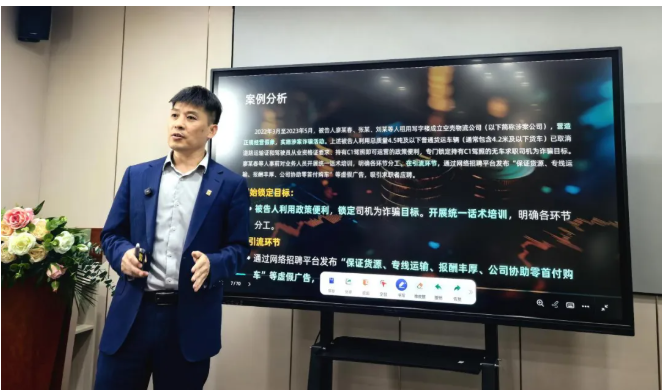
In recent years, new types of fraud cases, typified by “predatory lending” and “predatory transportation schemes,” have occurred frequently. In judicial practice, a tendency toward “holistic adjudication” has gradually emerged—bundling multiple stages such as lead generation, interviews, contract signing, performance, and contract termination into an “indivisible criminal whole,” thereby making integrated determinations regarding criminal charges, calculating the total amount involved, and inferring the intent to illegally appropriate funds.

In his presentation, Attorney Lu Xianghui pointed out that while this “three-part holistic” methodology has improved the efficiency of crime identification, it also harbors hidden risks: without a review of structural authenticity, it is highly prone to the “composite fallacy”—linearly projecting the illegal nature of a single stage onto the whole, or conversely applying the criminal label of the whole to each individual part, thereby eroding the boundaries of the principle of legality.
“This is not a simple matter of evidence induction, but a category error in the sense of systems theory.” Attorney Lu Xianghui used the “theater effect” as an analogy: when one person stands up, their view improves, but when many stand up, the collective view actually deteriorates—the simple aggregation of individual attributes does not necessarily give rise to the criminal attributes of the whole.
II. Methodological Upgrading: From “Finding Defense Points” to “Building Systems”
The core innovation of this lecture lies in the first-ever systematic integration of three cross-disciplinary scientific philosophical paradigms—reductionism, holism, and systems theory—into criminal defense methodology, thereby proposing an operational framework for “systemic defense.”
• Reductionism excels at dissecting components but struggles to address the emergent characteristics of complex systems such as “Scheme X”;
• Holism focuses on social effects but may blur the boundaries of elements of a crime due to the “fallacy of composition”;
• Systems theory, however, offers an “operational framework” that transcends binary oppositions: it acknowledges the necessity of analyzing elements of a crime while emphasizing the interactive relationships among elements, the cyclical construction of norms and facts, and the structural coupling between the legal system and society.
Attorney Lu Xianghui argues that the core of systemic defense is not a piecemeal rebuttal focused on “finding points of defense,” but rather the “construction of an alternative holistic narrative”—replacing the “guilty ecosystem” with an “innocent ecosystem” and triggering a “mutation” in the adjudication system by demonstrating a “fundamental misperception” in the prosecution’s charging framework.
III. Case Matrix: Bidirectional Validation from “Conviction” to “Acquittal”
To illustrate the practical implementation of “systemic defense,” the lecture selected multiple reference cases from the Supreme People’s Court’s database to form a comprehensive case matrix:
The Liao Mouchun “scheme-based fraud” case demonstrates how the prosecution constructs a seemingly airtight “overall scheme” narrative through a three-tiered progression of “chain of conduct—chain of evidence—chain of proof.” Conversely, the He Mouyi extortion case serves as a classic model of “systemic defense”: the defendant assaulted a third party due to his wife’s extramarital affair and demanded compensation. The case resulted in a conviction at first instance, a remand by the second instance court, an acquittal in the retrial, and a final acquittal. Attorney Lu Xianghui used this case to dismantle the prosecution’s “fallacy of composition”—“violence + demand for money ≠ extortion”—arguing that the key lies in the differing motives behind the two acts, which lack the “means-end” structural coupling required under criminal law.
In the contract fraud case involving Wu, he was falsely accused by a lender in a “predatory lending” scheme and sentenced to nine months in the first instance. Later, when a case involving organized crime came to light, the lender was found to have made a false accusation, and Wu was acquitted upon retrial. This case highlights a key technique in “systemic defense”—restoring the victim from a mere endpoint of the scheme to a subject of the elements of the crime: when the lender disburses funds despite knowing the property documents are fraudulent, the victim’s “erroneous belief” no longer exists, and the objective elements of the crime of fraud are thereby severed.
IV. Panel Discussion: At the Intersection of Theory and Practice

During the panel discussion moderated by Attorney Zhu Dongsheng, participating lawyers engaged in a lively discussion on the practical implementation of “systemic defense.” Attorney Zhu Dongsheng pointed out that current judicial practice exhibits a tendency toward “penetrative adjudication,” in which a series of formally lawful acts are collectively deemed criminal due to the final harmful outcome. Citing the online lending and education and training industries as examples, he noted that the boundary between commercial conduct and criminal offenses is becoming increasingly blurred, requiring defense counsel to respond to “holistic charges” with “holistic counterarguments.”

Attorneys Jiang Yongqian, Zhang Qingsheng, Yang Bailin, Zhu Jilei, Yuan Shaoguo, Guo Hepu, and others drew upon their case handling experiences to engage in in-depth dialogue with the keynote speaker on topics such as evidence discovery within the “victim’s cognitive framework,” cross-examination techniques regarding “process coupling,” and the application of the “separation of consideration principle” in arguments regarding the amount of the offense. The on-site discussion extended from “scheme-based operations” to multiple fields such as medical insurance fraud, commercial compliance, and criminal risks in the new energy industry, fully demonstrating the academic atmosphere of the King&Capital Shanghai Criminal Defense Team, which is characterized by “using cases to drive theory and using theory to inform practice.”
V. Seven Major Risks and Four-Tiered Defense:
The “Toolkit” of Systemic Defense
At the conclusion of the lecture, Attorney Lu Xianghui distilled the judicial risks associated with “holistic determination” into seven key warnings and provided corresponding actionable defense strategies:
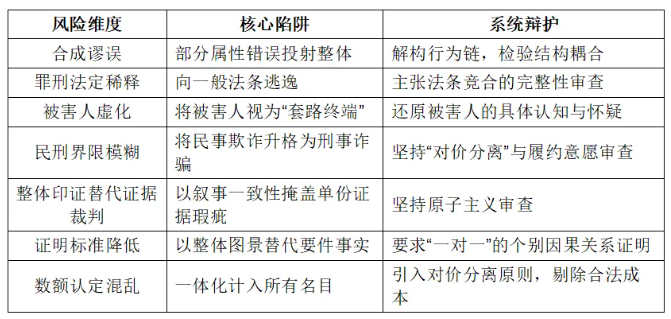
“Systematic defense does not deny the whole; rather, it requires that the whole possess structural authenticity,” Attorney Lu Xianghui concluded. “When we say ‘this is a scheme,’ we must not only see the ‘form’ of the scheme but also examine its ‘essence’—the unified criminal intent, the intent to illegally appropriate property, and the structural coupling between the means and the end.”
Conclusion: The Academic Foundation of King&Capital Shanghai’s Criminal Defense
Against the backdrop of criminal justice increasingly emphasizing penetrative scrutiny and holistic assessment, Beijing King&Capital (Shanghai) Law Firm has consistently adhered to an academic, meticulous, and paradigm-based defense mindset to address complex challenges. This lecture was not only an in-depth interpretation of the adjudication rules for “Scheme X” cases but also an internal upgrade of criminal defense methodology.
Moving forward, the King&Capital Criminal Defense Team will continue to deepen its expertise in the theory and practice of “systemic defense,” safeguarding the principle of legality in criminal law through systematic thinking and defending the legitimate rights and interests of every client with professional competence.