

On June 25, 2026, Wang Jiaming, a partner at Beijing King&Capital Law Firm, was invited by the Beijing Association of Corporate Legal Counsel to deliver a specialized lecture and training session for the association’s members on the topic “Understand the Rules, Know the Boundaries, Uphold Integrity, and Go Far: An Interpretation of the Judicial Interpretation (II) on Embezzlement and Bribery, and Risk Prevention and Control of Occupational Crimes in State-Owned and Central Enterprises.”
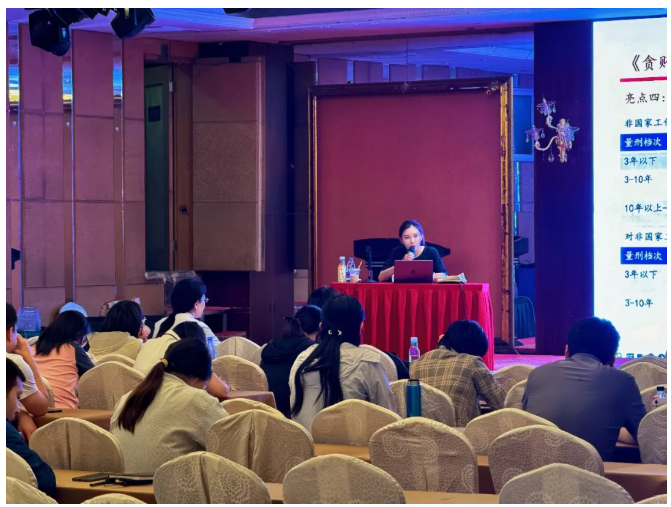
Attorney Wang Jiaming began by addressing the “new normal” and challenges of anti-corruption efforts in state-owned enterprises against the backdrop of the new era, conducted an in-depth analysis of the legislative intent behind the “Interpretation (II) on Several Issues Concerning the Application of Law in Handling Criminal Cases of Embezzlement and Bribery,” and further explored the risk points of common occupational crimes in state-owned and centrally administered enterprises under the new judicial interpretation, as well as the specific manifestations and legal risks of new forms of corruption in these enterprises, providing attendees with comprehensive and effective risk prevention and control strategies.
At the beginning of the lecture, Attorney Wang Jiaming introduced the practical context behind the issuance of the new judicial interpretation. Using case studies, he illustrated that anti-corruption efforts in state-owned enterprises in the new era are characterized by high-ranking officials involved, large sums of money at stake, diverse types of crimes, and strict law enforcement, while facing new challenges such as “shadow companies,” “stock option corruption,” “offshore corruption,” and “petty corruption at the grassroots level.” These new forms of corruption have significantly increased the difficulty of regulatory oversight, investigation, and law enforcement. The issuance of the new judicial interpretation is precisely intended to address new situations and issues arising in judicial practice and to further refine and improve the standards for applying the law.
During the session on interpreting the new judicial interpretation, Attorney Wang Jiaming conducted an in-depth analysis of the core highlights of the new regulations. Attorney Wang Jiaming pointed out that the new judicial interpretation: First, taking into account the actual circumstances of socio-economic development, clarifies the sentencing standards for the crimes of bribery accepted by an entity, bribery offered to an entity, and bribery committed by an entity; Second, focuses on new forms of hidden corruption and addresses the invisible and evolving nature of corruption, adopting a strict standard of “a promise constitutes bribery” regarding bribery through mediation; Third, it clarifies the methods used to evade supervision in the misappropriation of public funds, refines the criteria for determining “failure to return,” and strengthens controls over “failure to return”-type misappropriation crimes, such as fabricating payment reasons and intentionally failing to record accounts receivable in accordance with regulations; Fourth, it enhances the equal protection of non-public property under criminal law by unifying the standards for private and state-owned enterprises; Fifth, it refines the rules for determining the amount of bribes involving specific property and expected returns.
Drawing on his personal experience handling official misconduct cases in the financial sector, Attorney Wang Jiaming further pointed out that the new judicial interpretation still leaves room for controversy regarding the determination of bribe amounts involving expected returns: when the equity acquired by the perpetrator carries no premium, the interpretation still fails to provide normative guidance for practical departments in determining the amount of the crime. Furthermore, addressing issues such as limited scope for applying the “voluntary surrender” defense and inconsistent legal provisions in past embezzlement and bribery cases, the new judicial interpretation clearly defines the circumstances under which voluntary surrender can be recognized, thereby providing practical defense strategies for such official misconduct cases.

In the section on risk prevention and control, Attorney Wang Jiaming comprehensively analyzed common types of official misconduct committed by personnel in state-owned companies and enterprises and provided effective risk prevention and control strategies. Attorney Wang Jiaming pointed out that relying solely on post-incident punishment is no longer sufficient to effectively curb occupational crimes in state-owned and centrally administered enterprises. It is essential to establish a comprehensive prevention and control system grounded in a culture of compliance, centered on institutional mechanisms, and supported by technological means, while adhering to the core principle of “prioritizing preventive measures, supplemented by real-time monitoring, and backed by post-incident resolution.”
The training was rich in content and logically structured, closely integrating practical experience with the latest legislative developments. It provided valuable practical insights for legal professionals from member units of state-owned and centrally administered enterprises who attended the session, helping them understand and apply the new regulations. Attorney Wang Jiaming expressed his hope that fellow participants would continue to pay close attention to cutting-edge issues in the field of occupational crimes. Grounded in legislative trends and judicial practice, he encouraged them to give more thought to and conduct more research on regulatory blind spots in new forms of corruption, strengthen compliance frameworks within state-owned enterprises, enhance corporate governance capabilities, and eliminate potential sources of corruption within enterprises.