

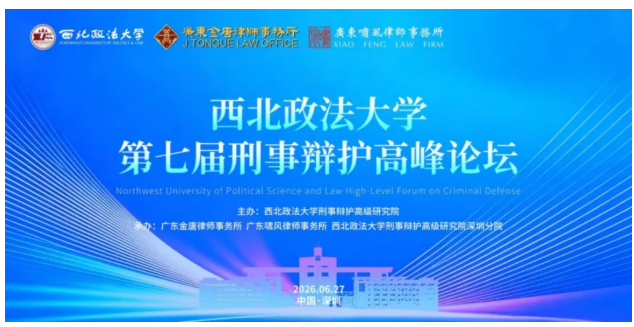
On June 27, 2026, the 7th Criminal Defense Summit Forum of Northwest University of Political Science and Law was grandly held in Shenzhen. The forum was organized by the Advanced Research Institute of Criminal Defense at Northwest University of Political Science and Law, and co-hosted by Guangdong Jintang Law Firm, Guangdong Xiaofeng Law Firm, and the Shenzhen Branch of the Advanced Research Institute of Criminal Defense at Northwest University of Political Science and Law. With “Proving the Subjective Elements of a Crime” as its central theme, the forum brought together nearly 60 leading legal experts and criminal defense practitioners from across the country, as well as more than 400 delegates, to jointly explore cutting-edge and complex issues in criminal justice.
Several attorneys from Beijing King&Capital Law Firm were invited to attend the event as representatives. Among them were Tian Wenchang, Honorary Director of King&Capital Law Firm and Honorary Dean of the Advanced Institute of Criminal Defense at Northwest University of Political Science and Law; Zhu Yonghui, Director of King&Capital Law Firm and Vice Dean of the Advanced Institute of Criminal Defense at Northwest University of Political Science and Law; Liang Yali, Senior Partner at King&Capital Law Firm, Director of the King&Capital Criminal Defense Research Center, and Vice Dean of the Advanced Institute of Criminal Defense at Northwest University of Political Science and Law; Men Jinling, Senior Partner at King&Capital Law Firm and Vice Dean of the Advanced Research Institute of Criminal Defense at Northwest University of Political Science and Law; and Wang Jiaming, Partner at King&Capital Law Firm, each played key roles in important segments such as the opening address, keynote speeches, session moderation, and thematic presentations, comprehensively showcasing King&Capital Law Firm’s profound theoretical foundation and top-tier practical expertise in the field of criminal defense.
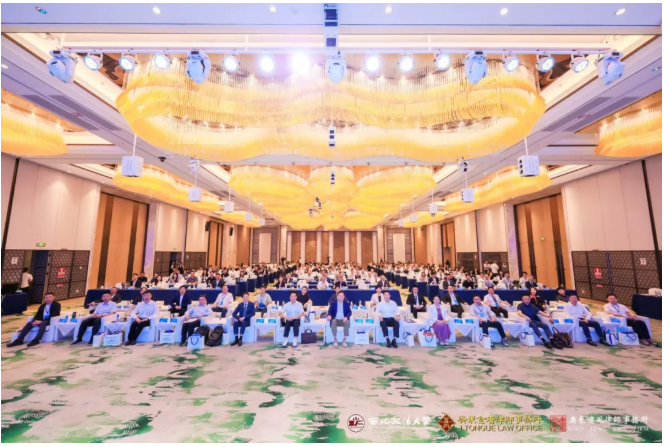
Forum Venue
As a flagship academic event in China’s criminal defense sector, this year’s forum featured three major discussion sessions, conducting systematic and in-depth deliberations on the methods of proof, rules of evidence, and judicial practices regarding the subjective elements of crimes. The Kyoto Law Firm team participated deeply throughout the forum’s agenda, consistently offering high-quality professional insights to contribute “Kyoto wisdom” toward resolving challenges in judicial practice and advancing the criminal defense industry.
Tian Wenchang Delivers a Keynote Speech at the Opening Ceremony
The opening ceremony was presided over by Chen Jingchun, Dean and Professor of the School of Criminal Law at Northwest University of Political Science and Law, and Council Member of the Chinese Society of Criminal Law.

Chen Jingchun, Dean and Professor of the School of Criminal Law at Northwest University of Political Science and Law, presides over the opening ceremony
I
Sun Haoliang, Member of the Party Committee and Vice President of Northwest University of Political Science and Law, delivers the opening address

Tian Wenchang, Honorary Director of Beijing King&Capital Law Firm and Honorary Dean of the Advanced Institute of Criminal Defense at Northwest University of Political Science and Law, delivers an opening address

Cai Hua, Director of Guangdong Xiaofeng Law Firm and Vice Dean of the Advanced Institute of Criminal Defense at Northwest University of Political Science and Law, delivers an opening address
At the opening ceremony, Sun Haoliang, Member of the Party Committee and Vice President of Northwest University of Political Science and Law; Tian Wenchang, Honorary Director of Beijing King&Capital Law Firm and Honorary Dean of the Advanced Research Institute of Criminal Defense at Northwest University of Political Science and Law; and Cai Hua, Director of Guangdong Xiaofeng Law Firm and Vice Dean of the Advanced Research Institute of Criminal Defense at Northwest University of Political Science and Law, delivered speeches in succession.
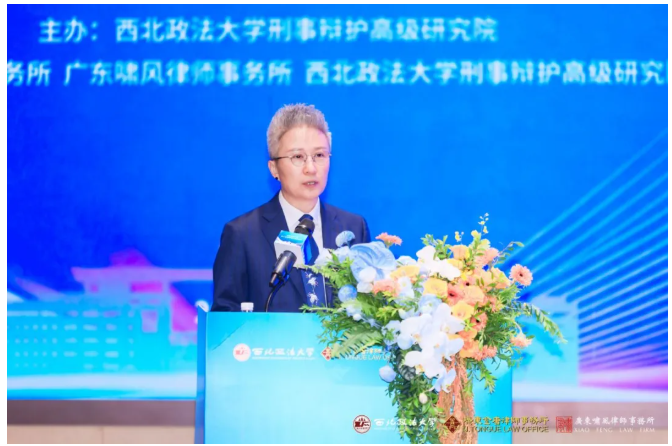
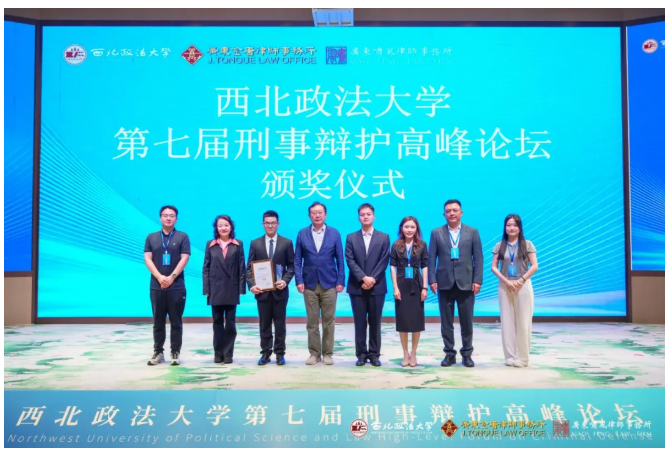
Ming Can, Director of the Management Committee at Guangdong Jintang Law Firm and Vice Dean of the Shenzhen Branch of the Northwest University of Political Science and Law’s Advanced Institute of Criminal Defense, presided over the awards ceremony
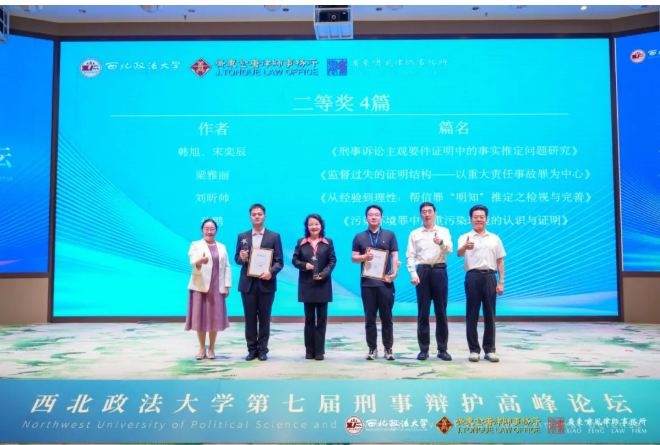
Liang Yali (third from left), Senior Partner at King&Capital Law Firm, Director of the King&Capital Criminal Defense Research Center, and Vice Dean of the Northwest University of Political Science and Law’s Advanced Institute of Criminal Defense, won second prize in the essay contest
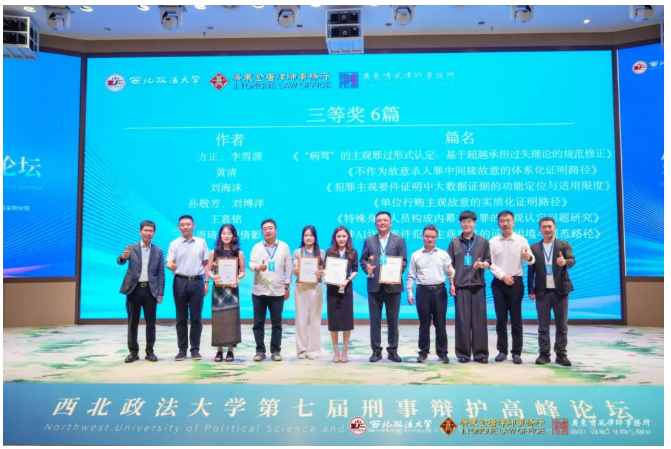
Wang Jiaming (sixth from left), Partner at Beijing King&Capital Law Firm and Postdoctoral Researcher at Renmin University of China, won third prize in the essay competition
Tian Wenchang, Honorary Director of Beijing King&Capital Law Firm and Honorary Dean of the Advanced Institute of Criminal Defense at Northwest University of Political Science and Law, poses for a group photo with some of the award-winning authors
During the opening ceremony, the award ceremony for the “7th Criminal Defense Summit Forum” essay contest was also held. Ming Can, Director of the Management Committee at Guangdong Jintang Law Firm and Vice Dean of the Shenzhen Branch of the Northwest University of Political Science and Law’s Advanced Institute of Criminal Defense, presided over the ceremony. Experts from both the legal practice and academic communities presented trophies and certificates to representatives of the authors of the 12 outstanding papers.
Liang Yali, Senior Partner at King&Capital Law Firm, Director of the Kyoto Criminal Defense Research Center, and Vice Dean of the Advanced Research Institute of Criminal Defense at Northwest University of Political Science and Law, received awards for her paper “The Structural Framework for Proving Negligence in Supervision: Focusing on the Crime of Major Responsibility Accidents.” Additionally, Wang Jiaming, a postdoctoral researcher at Renmin University of China and a partner at King&Capital Law Firm, Wang Jiaming, a postdoctoral researcher at Renmin University of China, titled “A Study on the Subjective Determination of the Crime of Insider Trading by Persons in Special Positions,” were awarded the second and third prizes, respectively, for their solid empirical research and rigorous theoretical frameworks.

Tian Wenchang, Honorary Director of Beijing King&Capital Law Firm and Honorary Dean of the Advanced Institute of Criminal Defense at Northwest University of Political Science and Law, delivered a keynote speech

Li Lanying, Professor at Xiamen University and Standing Council Member of both the Chinese Society of Criminal Law and the Chinese Society of Criminal Procedure Law, delivered a keynote speech

Ji Xiangde, Professor at the University of Chinese Academy of Social Sciences, Dean of the Institute of Publishing, and Standing Council Member of the Chinese Society of Criminal Procedure Law, delivered a keynote speech
Subsequently, Tian Wenchang, Honorary Director of Beijing King&Capital Law Firm and Honorary Dean of the Advanced Research Institute of Criminal Defense at Northwest University of Political Science and Law; Li Lanying, Professor at Xiamen University and Standing Council Member of both the Chinese Society of Criminal Law and the Chinese Society of Criminal Procedure Law; and Ji Xiangde, Professor at the University of Chinese Academy of Social Sciences, Dean of the Institute of Publishing, and Standing Council Member of the Chinese Society of Criminal Procedure Law, each delivered keynote speeches.
In his opening remarks, Tian Wenchang, drawing on the development history of China’s criminal defense industry, highly commended the forum’s choice of topic—focusing on the proof of subjective elements—as a core judicial challenge. He expressed his hope for in-depth dialogue between academia and the legal profession to jointly advance the theoretical and practical standards of criminal justice.
During the keynote address session, Tian Wenchang delivered a systematic exposition on the historical dilemmas surrounding the proof of subjective elements in criminal cases and potential pathways to resolution. He pointed out that the core challenge in proving subjective elements lies in the fact that, given the widespread refusal of perpetrators to confess, judicial practice often presumes subjective intent based on objective conduct. However, such presumption is inherently subjective; it essentially involves deriving the defendant’s subjective intent from the judge’s own subjective understanding, which naturally carries the risk of bias in determination. This dilemma is particularly pronounced in new types of crimes such as the crime of aiding and abetting money laundering, money laundering, and concealing or disguising the proceeds of crime.
Addressing the two mainstream approaches to determination currently used in judicial practice, he conducted an in-depth analysis of their respective limitations: while the presumption rule has a clear basis in judicial interpretations, is simple to apply, and places less pressure on judges in terms of discretion and accountability, it struggles to cover all case scenarios. Its rigid nature tends to lead to oversimplification in determinations, which in turn can unduly expand the scope of criminal liability; as a result, its application is now being gradually restricted in newly issued judicial interpretations; The comprehensive determination rule relies on the totality of the evidence and adheres to the principle of unifying subjective and objective elements, offering a more rigorous standard of determination. However, it lacks concrete operational guidelines, making it difficult to maintain a consistent standard in practice and posing significant challenges in implementation. The either-or choice between these two approaches fails to fundamentally resolve the evidentiary dilemma.
Tian Wenchang specifically pointed out that current judicial interpretations contain obvious regulatory pitfalls: the phrase “should have known” is semantically ambiguous, and interpretation standards vary across similar provisions—some articles include the qualification “except where there is evidence proving that the person was actually unaware,” thereby defining it as a presumption of “actual knowledge”; other provisions contain no such exceptions, effectively incorporating the normative state of “should have known but did not know” into the category of “actual knowledge,” thereby blurring the line between intent and negligence. This even raises suspicions of expansive interpretation that exceeds legislative authority, directly exacerbating the confusion surrounding judicial determination standards.
He emphasized that the key to breaking this deadlock lies in shaking off the mental shackles of exegetical jurisprudence, stepping outside the inherent framework of current norms, and pursuing a research path that integrates substantive and procedural criminal law. Only by exploring entirely new solutions beyond the two traditional approaches can we truly resolve the challenge of proving subjective elements.
In the three major discussion sessions of this forum, lawyers from Beijing King&Capital Law Firm participated in hosting and delivering keynote speeches, presenting professional research findings across various specialized dimensions.
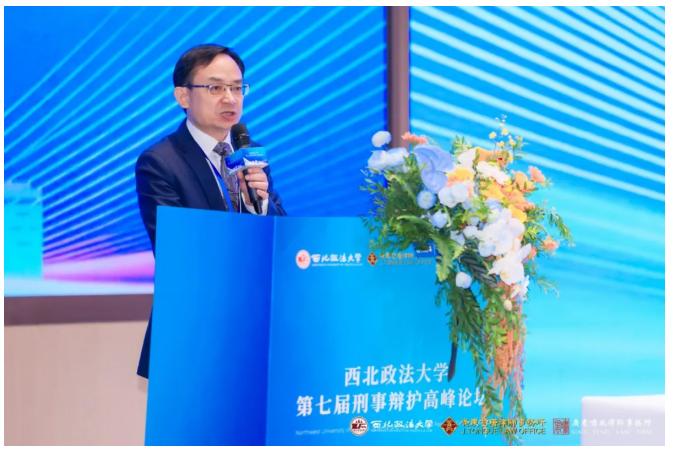
Zhu Yonghui, Director of Beijing King&Capital Law Firm and Vice Dean of the Advanced Institute of Criminal Defense at Northwest University of Political Science and Law, chaired the first session
The first session of the forum, titled “Methods of Proving the Subjective Elements of a Crime,” was chaired by Zhu Yonghui, Director of Beijing King&Capital Law Firm and Vice Dean of the Advanced Research Institute of Criminal Defense at Northwest University of Political Science and Law. Drawing on his deep professional expertise and extensive industry experience, he skillfully managed the pace of the discussion, guiding the speakers to engage in thorough exchanges on the topic of proof methods. He facilitated a meaningful dialogue bridging theoretical research and practical application, ensuring the session’s professionalism and efficiency.

Liang Yali, Senior Partner at King&Capital Law Firm, Director of the Jingdu Criminal Defense Research Center, and Vice Dean of the Advanced Institute of Criminal Defense at Northwest University of Political Science and Law, delivered a keynote speech
During the keynote presentation segment of the first session, Liang Yali—Senior Partner at King&Capital Law Firm, Director of the Kyoto Criminal Defense Research Center, and Vice Dean of the Advanced Institute of Criminal Defense at Northwest University of Political Science and Law—delivered a special presentation titled “The Structural Framework for Proving Supervisory Negligence: Focusing on the Crime of Major Responsibility Accidents,” based on her award-winning paper. Taking major mining disaster cases she personally handled as her starting point, Attorney Liang Yali directly addressed the chaotic practice in some judicial proceedings of “retrospectively inferring negligence from the outcome,” identifying the logical fallacy of “double inference”—namely, “retrospectively inferring a breach of duty from the harmful outcome and directly presuming subjective negligence from the breach of duty.” Drawing on empirical research data from 20 judicial rulings, she vividly revealed the current systemic absence of core elements of liability—such as the possibility of avoiding the outcome and the possibility of specific foreseeability—in the determination of supervisory negligence, warning of the judicial risk that such cases may drift toward strict liability based on outcomes.
Addressing this critical issue, Attorney Liang Yali, drawing on the New Theory of Negligence and the theory of objective liability, systematically constructed a four-tiered evidentiary framework comprising “scope of supervisory duty—breach of duty—possibility of avoiding the result—possibility of specific foreseeability,” and clarified the rules governing the allocation of the burden of proof between the prosecution and the defense. She emphasized that the stricter the accountability for workplace safety, the more precise the evidentiary structure for supervisory negligence must be; vague assessments such as “failure to manage or supervise” cannot substitute for the item-by-item proof of negligence elements. It is essential to uphold the principle of legality in criminal law and achieve precise adjudication.

Men Jinling, Senior Partner at King&Capital Law Firm and Vice Dean of the Advanced Research Institute of Criminal Defense at Northwest University of Political Science and Law, delivered a keynote speech
In the second session, “Rules for Proving the Subjective Elements of a Crime,” Men Jinling, Senior Partner at King&Capital Law Firm and Vice Dean of the Advanced Research Institute of Criminal Defense at Northwest University of Political Science and Law, delivered a keynote speech titled “The ‘May’ and ‘Should’ in the Determination of ‘Knowingly’ Under the Rules.” Drawing on practical case examples, she directly addressed the current situation where the proof of subjective elements has become virtually non-existent. From the perspective of evidentiary law principles, she clearly defined the fundamental differences between the two types of determination rules: the “may” presumption of knowledge essentially constitutes indirect proof and does not deviate from the requirement of strict proof; adjudicators must still assess, based on the totality of the evidence, whether the standard of beyond a reasonable doubt has been met, and this presumption is not legally binding; In contrast, the “shall” presumption of knowledge is the true presumption in the context of evidence law—a substitute rule of proof explicitly established by law. Once the underlying facts are established, the required facts must be deemed proven, and the burden of rebuttal shifts; this constitutes an exception to the rule of strict proof.
Citing evidence law theory, Men Jinling emphasized that the underlying facts for a presumption must be explicitly stipulated by law and cannot be left to the judge’s discretion. Addressing the current issues of lagging procedural law interpretation and the disconnect between theory and practice, she called for greater emphasis on research into the theory of procedural law interpretation, using rules of evidence to constrain adjudicators’ authority to determine facts, and promoting the standardization and rule-of-law-based nature of judicial determinations.

Wang Jiaming, Partner at King&Capital Law Firm and Postdoctoral Researcher at Renmin University of China, delivers a keynote speech
Wang Jiaming, a partner at King&Capital Law Firm and a postdoctoral fellow at Renmin University of China, delivered a keynote presentation in this session based on her award-winning essay, “A Study on the Subjective Determination of the Crime of Insider Trading by Persons with Special Status.” She noted that, judging from China’s current law enforcement and judicial handling of securities crimes, there is a structural dilemma regarding the rules for presuming subjective intent in such cases, resulting in numerous enforcement issues and a high degree of arbitrariness. Unlike traditional economic crimes such as money laundering, contract fraud, and smuggling, securities crimes lack clear judicial interpretations specifying the types of objective conduct from which the perpetrator’s subjective intent can be inferred. This is because the objective conduct involved in securities crimes is extremely limited—it consists solely of the objective act of stock trading. Therefore, the issue of rules for inferring subjective intent must be addressed from both legislative and judicial perspectives. Legislatively, it is necessary to clearly define the scope for rebutting the presumption while strictly regulating the evidentiary requirements for the underlying facts to be proven. From a judicial perspective, it is essential to strictly limit the scope of the presumption while substantively assessing the determination of rebuttable circumstances, ensuring that every criminal judgment withstands the test of the “beyond a reasonable doubt” standard of proof.

Ming Can, Director of the Management Committee of Guangdong Jintang Law Firm and Vice Dean of the Shenzhen Branch of the Advanced Institute of Criminal Defense at Northwest University of Political Science and Law, delivered the closing remarks.

Liu Renqi, Professor at Northwest University of Political Science and Law and Executive Dean of the Advanced Institute of Criminal Defense, delivered the closing remarks.
At the conclusion of the forum, Ming Can, Director of the Management Committee of Guangdong Jintang Law Firm and Vice Dean of the Shenzhen Branch of the Advanced Institute of Criminal Defense at Northwest University of Political Science and Law, and Liu Renqi, Professor at Northwest University of Political Science and Law and Executive Dean of the Advanced Institute of Criminal Defense, delivered closing remarks in succession, bringing the forum to a successful close.
Conclusion
At this forum, the expert team from King&Capital Law Firm delivered outstanding performances in multiple key sessions, which epitomizes the firm’s long-standing commitment to a “theory + practice” dual-drive development philosophy. As a leading law firm in China deeply rooted in the field of criminal defense, King&Capital Law Firm has consistently dedicated itself to this area, emphasizing both the professional precision of individual case handling and the importance of theoretical research and the cultivation of legal talent. Through various channels—including high-level academic forums, professional training programs, and practical research articles—the firm continuously shares its professional insights to advance the specialized and standardized development of the criminal defense industry.
Moving forward, King&Capital Law Firm will remain true to its founding mission in criminal defense. Leveraging its top-tier professional team and deep practical experience, the firm will continue to focus on complex and cutting-edge issues in the criminal justice system, contributing even more to the high-quality development of China’s criminal defense sector and the upholding of judicial justice.