

On June 27, 2025, the 16th Session of the Standing Committee of the 14th National People’s Congress voted to adopt the newly revised “Anti-Unfair Competition Law of the People’s Republic of China,” which will take effect on October 15, 2025.
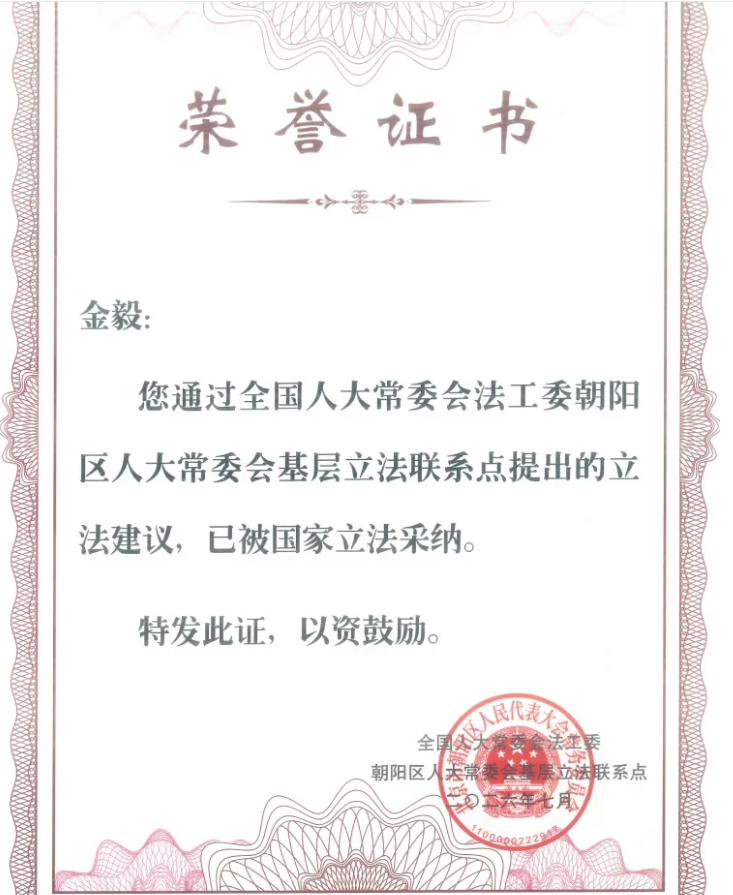
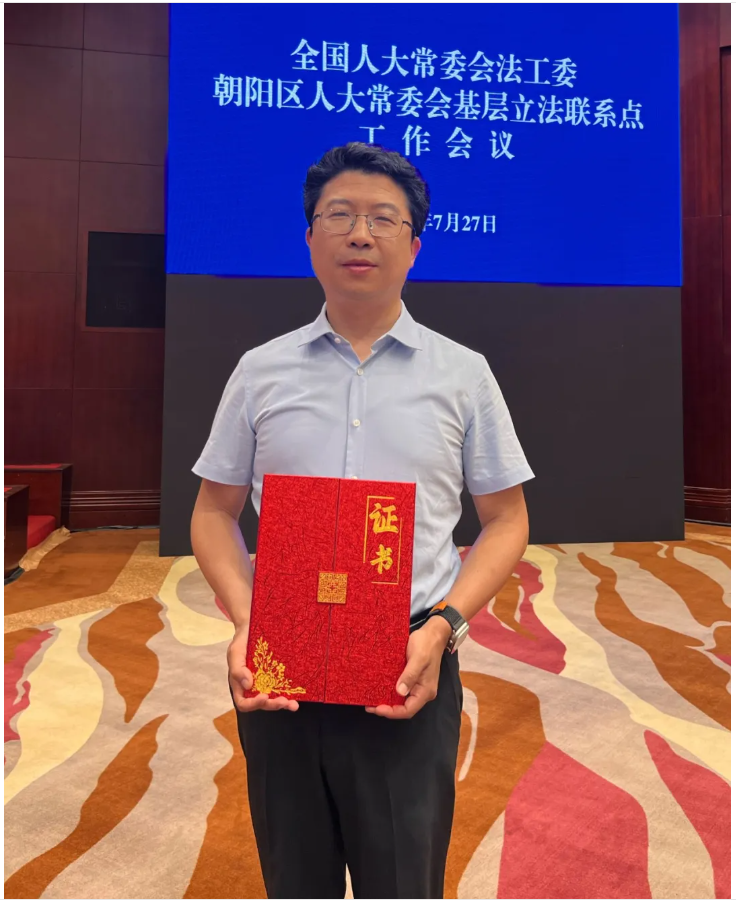
During the amendment process, two legislative proposals put forward by Attorney Jin Yi, a partner at Beijing King&Capital Law Firm, were formally adopted. Recently, the Grassroots Legislative Liaison Office of the Chaoyang District People’s Congress Standing Committee—affiliated with the Legislative Affairs Commission of the Standing Committee of the National People’s Congress—presented Attorney Jin Yi with a certificate of honor in recognition of his active contributions to the legislative process.
In January 2025, in accordance with the Chaoyang District People’s Congress Standing Committee’s work plan for soliciting opinions on the draft law, Attorney Jin Yi led the formation of a professional team. Adhering to a problem-oriented, practice-oriented, and rule-oriented approach, the team systematically conducted research and analysis. Focusing on the alignment of the *Anti-Unfair Competition Law of the People’s Republic of China (Revised Draft)* with judicial practice, the team conducted in-depth analyses of core provisions such as the special provisions on the internet, data regulation, and platform conduct standards; drawing on diverse scenarios such as platform operations, data processing, and e-commerce operations, the team categorized and compiled a list of high-frequency disputed behaviors and challenges in rights protection; by comparing the provisions with typical domestic case law and industry consensus, they repeatedly refined the logical structure of the provisions and regulatory approaches, ultimately formulating legislative recommendations that combine legal theoretical support with practical operational value, thereby providing a solid basis for decision-making in the amendment process.
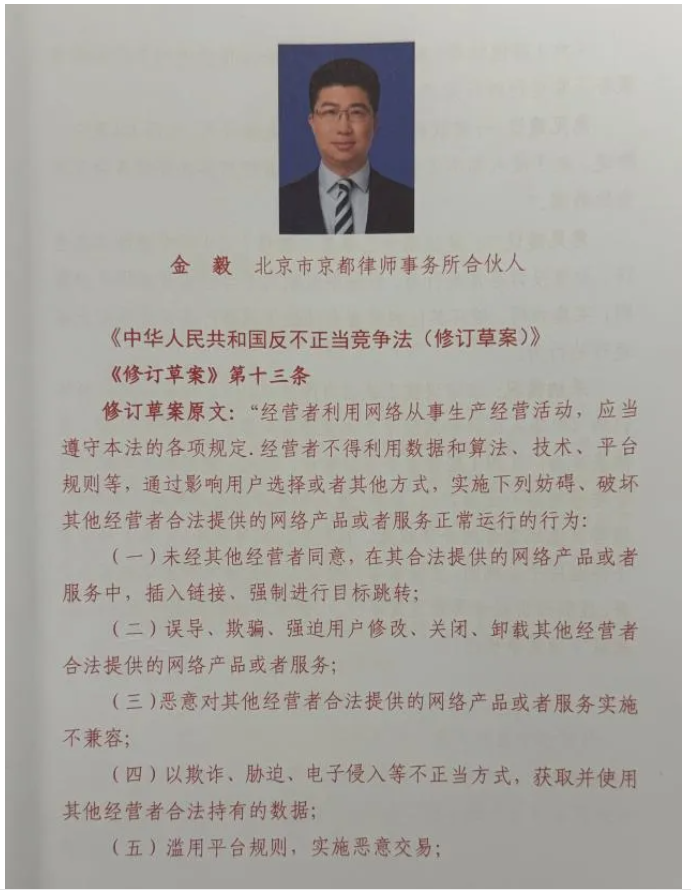
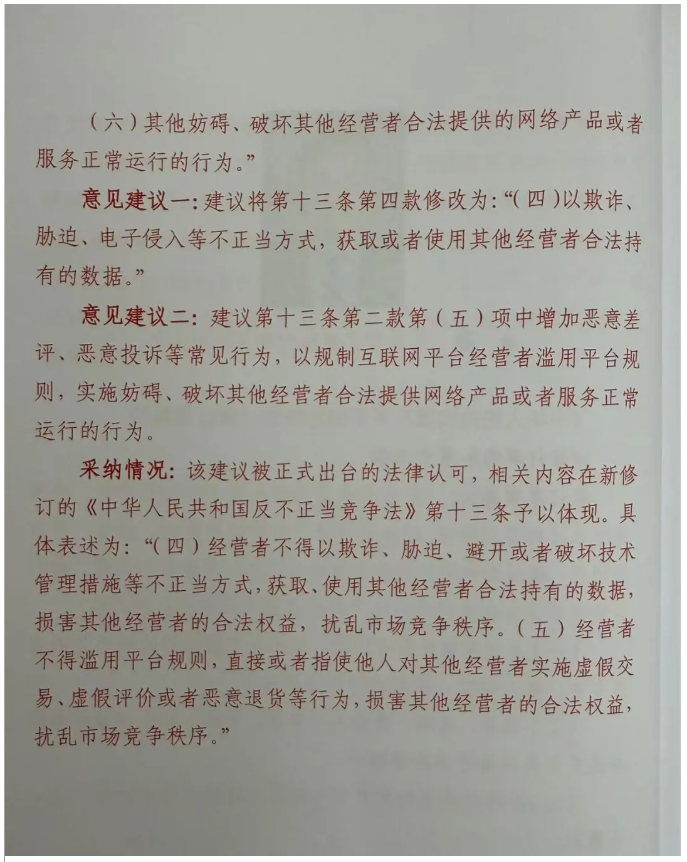
The two recommendations adopted this time closely address core issues in competition governance within the digital economy. First, regarding the problem that the dual behavioral elements of “obtaining and using” in Article 13, Paragraph 2, Item (iv) of the “Revised Draft” result in an overly narrow scope of regulation, the recommendation is to amend the behavioral elements to “obtaining or using.” This would lower the threshold for determination, effectively cover new forms of unfair competition such as data scraping, and strengthen the protection of operators’ data rights. Second, addressing the current situation in the platform economy where malicious negative reviews and complaints are frequent but legal regulation is insufficient, the proposal recommends explicitly adding such behaviors—such as malicious negative reviews and complaints—to Article 13, Paragraph 2, Subparagraph (v), to fill regulatory gaps, strengthen oversight of the abuse of platform rules, and uphold a fair and competitive market order.
Swipe left or right to view images
This legislative amendment process served as a vivid example of democratic lawmaking. Attorney Jin Yi stated that through his participation in providing legislative recommendations, he gained a deeper understanding that the rule of law is the best business environment and that fair competition is the soul of a market economy. Looking ahead, he will continue to deepen his expertise in the field of competition law, serve as a steadfast defender of a fair competitive order, and contribute his professional expertise as a lawyer to high-quality development.