
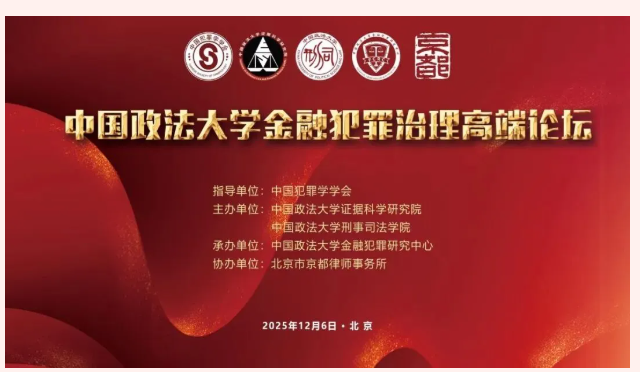
2025 December 6, China University of Political Science and Law Financial Crime Governance High-end Forum was grandly held in Beijing. The conference was guided by the Chinese Society of Criminology, hosted by the Institute of Evidence Science of China University of Political Science and Law and the School of Criminal Justice of China University of Political Science and Law, organized by the Financial Crime Research Center of China University of Political Science and Law, and co-organized by King&Capital Law Firm, from Tsinghua University, Peking University, Renmin University of China, Beijing Normal University, Jilin University, China University of Political Science and Law, the Central University of Finance and Economics, the University of International Business and Economics, State Prosecutor's College, Emergency Management University, China Judicial Big Data Research Institute, China-Shanghai Cooperation Judicial Training Base and other colleges and research institutes, the State Administration of Market Supervision, the People's Bank of China, Ant Science and Technology Group Company Limited, Beijing King&Capital Law Firm, Beijing Hengdu Law Firm, Beijing Zhonglun Wende Law Firm, Beijing PCG Law Firm and other practical departments, more than 200 teachers and students and industry representatives attended. More than 200 teachers and students and industry representatives attended this meeting. The successful organization of this China University of Political Science and Law High-end Financial Crime Governance Forum marks an important step in the synergy between theoretical research and practice in the field of financial crime governance in China. Taking Xi Jinping's thought on the rule of law as the fundamental guideline, the forum studied and carried out in depth the strategic plan of the central government on promoting the rule of law in a comprehensive manner, and tightly focused on the realistic needs of financial rule of law construction in the new era, it brought together top experts from the academia and first-line practical elites to discuss in depth the cutting-edge issues, core difficulties and countermeasures and suggestions of financial crime governance, which is essential for promoting the modernization of the national financial governance system and governance capacity, serving the national financial security strategy, improving the financial rule of law, and promoting the modernization of the financial governance system. It is of great significance to promote the modernization of the national financial governance system and governance capacity, serve the national financial security strategy and improve the financial rule of law protection system.

1
Opening Ceremony
The opening ceremony of the forum was presided over by Peng Wenhua, professor and doctoral supervisor, director of the Institute of Evidence Science of China University of Political Science and Law. Wan Chun, former deputy ministerial-level full-time member of the Procuratorate Committee of the Supreme People's Procuratorate, second-class prosecutor, and president of the Chinese Society of Criminology, Tian Wenchang, advisor of the Criminal Specialized Committee of the All-China Lawyers' Association, honorary advisor of the Chinese Society of Criminal Law Firm, founder and honorary director of King&Capital Law Firm in Beijing, and Liu Yanhong, member of the Standing Committee of the Party Committee of the China University of Political Science and Law and Vice President of China University of Political Science and Law, and standing vice president of China Criminal Enforcement Law Firm have made speeches successively. Mr. Liu Yanhong, Vice President of China University of Political Science and Law and Vice President of China Society of Criminal Enforcement Law

The host of the meeting, Prof. Peng Wenhua, warmly welcomed the guests and pointed out that this China University of Political Science and Law High-end Governance Forum on Financial Crimes had a large number of guests and fruitful results, which fully demonstrated the good situation of the deep integration of theory and practice in the field of financial crime governance in China. This forum has a distinctive significance of the times and an important milestone value, the future will be based on the financial crime research center, continue to promote the theoretical innovation and practical breakthroughs in the cross-cutting field of financial crime, at a higher level to converge the consensus, the formation of synergies, for the service of the national financial security strategy, and promote the modernization of the rule of law in finance to contribute to the wisdom and professional strength of the University of Law.

President Wan Chun pointed out in his speech that finance is the bloodline of national economy, and it is an important foundation for building a strong financial country to coordinate financial development and security and promote high-quality financial development. The important instructions of General Secretary Xi Jinping on financial work and the fight against corruption should be implemented in depth, and the punishment of financial corruption and the prevention and control of financial risks should be promoted as a whole. President Wan Chun emphasized that financial crimes are highly specialized and socially hazardous, and it is necessary to improve the legal system of financial supervision, strengthen the synergy between supervision, law enforcement and justice, and severely punish crimes that seriously jeopardize financial security in accordance with the law. In recent years, the procuratorial authorities have continued to enhance the modernization of financial crime governance by strengthening the construction of specialized teams and sectoral collaboration. Finally, he had high expectations for the Financial Crime Research Center of China University of Political Science and Law and hoped that this inaugural meeting and the high-end forum would be a new starting point to continuously produce high-quality results and play the role of a high-end think tank, and that the Chinese Society of Criminology would also give strong support.

Director Tian Wenchang pointed out in his speech that this forum, with the theme of “Financial Crime Governance”, is precise in topic selection and far-sighted in intention. Financial crime is the focus and difficulty in the field of crime governance at present. Due to the late start of the development of China's financial market, the rapid renewal of the financial industry, and the relative lack of relevant legislation and governance experience, the regulation of financial crime faces many complex challenges in long-term practice. Director Tian Wenchang systematically reviewed the systematic evolution and practical difficulties in the setting of crimes and identification of constituent elements of financial fraud in China, pointing out that financial crimes have long faced divergence of application in the setting of crimes and identification of constituent elements. He emphasized that financial crimes are mostly statutory crimes, and efforts should be made to promote the clarity of the formulation of the crime and typology research to avoid over-generalization of the application in legislation and justice, and to prevent the occurrence of wrongful cases. Director Tian Wenchang suggested that the governance of financial crimes should adhere to the concept of “prioritizing prevention and combating with caution”, and promote a more scientific, precise and rational financial crime governance system based on in-depth research on the laws of crime and risk evolution.

Liu Yanhong, vice president of the university, pointed out in his speech that under the impetus of big data, artificial intelligence and blockchain technology, the new financial industry has been developing rapidly, and financial crimes present a complex situation in which the old and new are intertwined and the light and heavy co-exist, which poses a challenge to the treatment and governance of crimes. In particular, influenced by differences in regulatory regimes among countries, cross-border capital flows and the drive for high profits, financial risks and crimes continue to be more difficult to govern, posing higher requirements for legislation, justice and law enforcement. She emphasized that in the context of implementing the spirit of the Fourth Plenary Session of the Twentieth Central Committee of the CPC and promoting the “Tenth Five-Year Plan”, it is necessary to strengthen the prevention and control of financial crimes at source and synergize the governance of civil, administrative and criminal affairs, and that this forum, relying on the strengths of the integrated research on criminal affairs of the University of Law and gathering the strengths of multi-disciplines, will inject a new impetus of the rule of law into the service and protection of the national financial security.
2
Unveiling and Appointment Ceremony

After the opening ceremony, the forum held a plaque unveiling and appointment ceremony, which was presided over by Zhou Hongbo, member of the Party Committee and vice president of the State Prosecutor's College and vice president and secretary-general of the Chinese Society of Criminology. He pointed out that in the current context, the formation of a specialized financial crime research center to carry out systematic and forward-looking financial criminology research has become an important mission given by the times. Financial crime center relying on China University of Political Science and Law of the profound accumulation of legal disciplines, to serve the national financial security as the core mission, by the criminologist Professor Yin Bo as the core leader, brings together the field of authoritative experts and scholars and practitioners, will be able to deeply integrate high-quality academic resources, linked to the financial regulatory bodies, the judiciary and the industry's top think tanks together to build a cross-field network of collaborative research.
(A) Inauguration Ceremony of Financial Crime Research Center of China University of Political Science and Law

Wan Chun, President of the Chinese Society of Criminology, and Liu Yanhong, Vice President of China University of Political Science and Law, jointly inaugurated the “Financial Crime Research Center of China University of Political Science and Law”. Relying on the advantages of law disciplines of China University of Political Science and Law, the Center, with Prof. Yin Bo as the director, gathers authoritative experts and practitioners in the field, and is committed to building a national platform integrating academic innovation, talent cultivation, decision-making consulting and social service, providing professional intellectual support and practical guidance for the governance of financial crimes.
(II) Appointment Ceremony of Financial Crime Research Center of China University of Political Science and Law
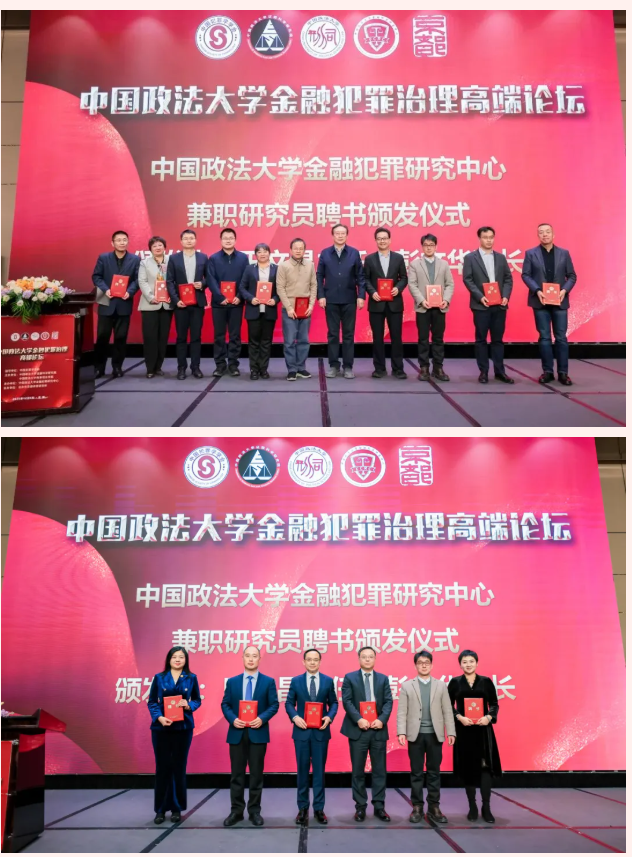
In order to enrich the strength of the Research Center and promote the deep integration of industry, academia and research, the ceremony was held at the site of the letter of appointment issuance. Mr. Tian Wenchang, founder and honorary director of Beijing King&Capital Law Firm, and Mr. Peng Wenhua, director of the Institute of Evidence Science of China University of Political Science and Law, jointly issued appointment certificates to the relevant experts. Appointed experts include: Prof. Peng Wenhua, Prof. Yang Dong, Prof. Liu Pinxin, Prof. Wang Rhenium, Prof. Shang Haowen, Prof. Zhao Binghao, Prof. Guo Zhiyuan, Prof. Li Huaisheng, Prof. Guo Zhilong, Prof. Shangwu and other well-known scholars in the field of financial rule of law and the rule of law of criminal law, as well as lawyers such as Zhu Yonghui, Yang Zhaodong, Liu Lijie, Cao Shuchang, Jin Jie, Wang Xintong, Xia Jun, Wang Zaikui and other practical experts, Mr. Zhang Yanfeng and other practical experts.
The appointed experts will rely on their profound theoretical background and rich practical experience to help the research center carry out case studies, academic innovation, talent training and other work, injecting a strong impetus for the research of financial crime governance.
3
Keynote Speech
The first unit of “keynote speech” is hosted by Guo Zhiyuan, professor and vice dean of the School of Criminal Justice of China University of Political Science and Law. Yang Dong, Dean of the School of Law of Renmin University of China, Professor and Vice President of the China Securities Law Research Society, Wu Yun, Director of the Supervision Division 2 of the Anti-Money Laundering Bureau of the People's Bank of China, and other experts delivered keynote speeches.
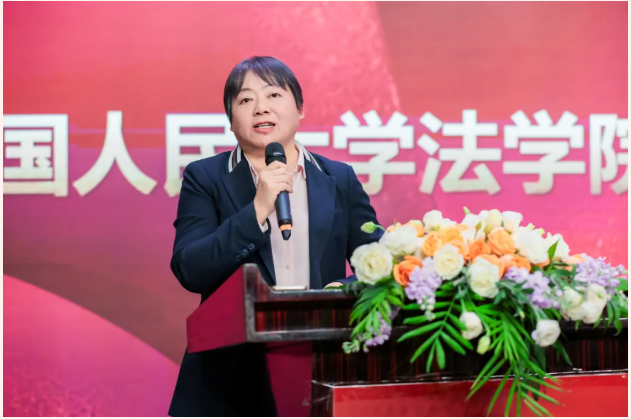
On behalf of the organizers, Vice Dean Guo Zhiyuan extended a warm welcome to the participating guests. She pointed out that the governance of financial crimes should not only retrospectively punish the committed crimes, but also prevent them from happening in the first place, so that both punishment and prevention can be carried out. It is necessary to cross criminology, criminal law, evidence law, financial law, fiscal law and other disciplines to explore the objective laws in line with the governance of financial crimes.
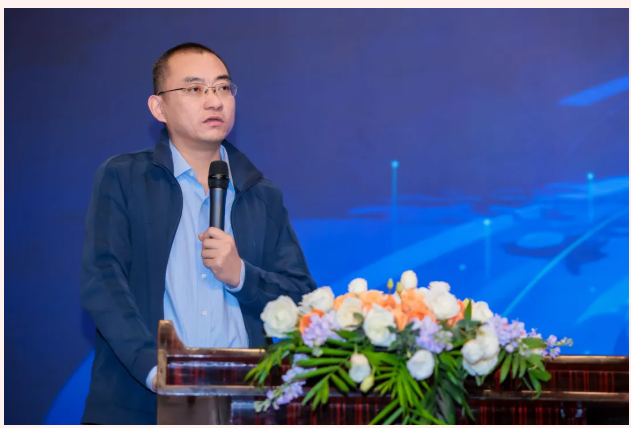
Prof. Yang Dong, Dean of the Law School of Renmin University of China, delivered a keynote speech on “Xi Jinping's Thought on the Rule of Law: Constructing China's Own Knowledge System for Financial Crime Governance”, pointing out that strict and fair justice should be used to serve the economic and social development goals of the Tenth Five-Year Plan period. In order to ensure the implementation of the economic and social development goals of the “Tenth Five-Year Plan” period, under the guidance of General Secretary Xi Jinping's thought on the rule of law, the basic principles and paths of China's autonomous knowledge system should be constructed, so as to form an autonomous framework of a new type of knowledge system that focuses on human beings and covers the “four-in-one” aspects of science and technology, organization, behavior and governance, and to strengthen the punishment of emerging science- and technology-driven financial crimes, including financial crimes, by means of high quality justice. Punishment. By increasing effective regulation, we will not only combat crime, but also promote the development of new productive forces through the power of the rule of law. At present, the digital jurisprudence paradigm is moving towards the “fifth scientific paradigm”, whose core has originality, epoch and autonomy, and the structure, unity and normativity of the digital governance paradigm correspond to the three major conditions for the formation of the jurisprudence paradigm, which makes it necessary to build a two-dimensional governance architecture system with parallel scientific and technological governance and legal governance; centering on the practice of financial science and technology, Prof. Yang pointed out that the Internet financial science and technology has become the main source of financial crime, which is the main cause of the financial crime. Professor Yang pointed out that the mutation and impact of Internet financial science and technology has brought serious challenges to the governance of financial crimes, and that Internet financial crimes are characterized by “diversified business, complex and intersecting legal relations” and “hidden behavior and great social harm”, and traditional supervision is not enough to cope with them, and it is necessary to further promote the development of financial crimes. To cope with the lack of power, it is necessary to further promote science and technology-driven regulation, i.e., regulatory science and technology, and to promote the sharing of government data through “common votes”; at the same time, he also pointed out that it is necessary to build an organizational framework in the context of the meta-universe, establish a system based on the concept of the court in order to effectively build a digital ecosystem, and to further strengthen the protection of criminal law in the digital era, and to realize the protection of the Internet financial crimes through tools and means such as large models, He also pointed out the need to build an organizational framework in the context of meta-universe, establish a system based on the court concept to effectively build a digital ecosystem, further strengthen the protection of criminal law in the digital era, and realize the precise combat against criminals through tools and means such as big models and artificial intelligence.
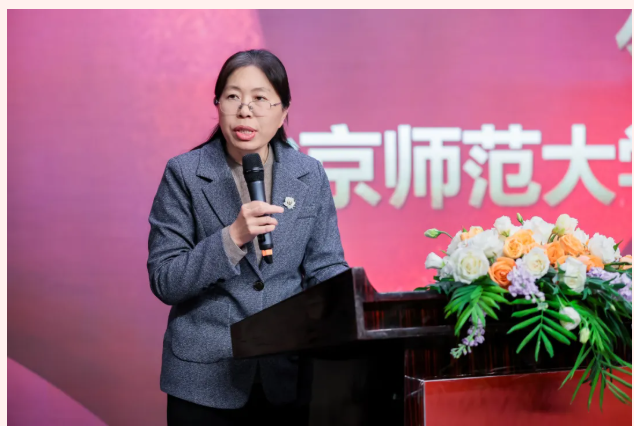
Mr. Wu Yun, Director of the Department of Anti-Money Laundering, delivered a keynote speech on “Tracking Funds: Anti-Money Laundering: From Crime Fighting to National Governance”, pointing out that the evolution of anti-money laundering work in the international arena is progressively expanding from the traditional area of crime fighting to becoming an important tool for national governance. Taking into account the background of the revision of China's Anti-Money Laundering Law and the evolution trend of international anti-money laundering work, he emphasized the key role of anti-money laundering in the governance of financial crimes and national economic security, and looking ahead, pointed out that it is necessary to further improve the laws and regulations on anti-money laundering, strengthen the risk-based supervision, and make good use of the means of capital monitoring, so as to effectively play a positive role in enhancing the effectiveness of national governance.
The expert delivered a speech with the keynote of “Clarifying the Boundaries of MLM Law Enforcement and Constructing an All-Chain Financial Governance Pattern”. He first introduced the current situation and brief information of the legal field of combating pyramid schemes, pointing out that pyramid schemes and illegal fund-raising have intersecting and superimposed risks in terms of behavioral patterns, dissemination methods and social hazards. Focusing on the problem of confusing law enforcement boundaries in practice, he emphasized that we should insist on looking at the essence through the phenomenon, accurately grasping the subjective purpose and objective behavioral characteristics of the illegal acts, and scientifically distinguishing the law enforcement boundaries. At the same time, he proposed to further standardize the rules for classifying and disposing of assets related to the public and assets related to the case, strengthen departmental coordination and linkage, promote the formation of an all-chain financial governance pattern, and continuously maintain a high-pressure deterrent posture against related illegal and criminal behaviors.
4
Research on Frontier Issues of Financial Crimes
Yang Junli, Deputy Secretary of the Party Committee of the Institute of Evidence Science of China University of Political Science and Law, presided over the keynote speech of the second unit “Research on Frontier Issues of Financial Crimes”. Luo Xiang, Director and Professor of the Institute of Criminal Law of China University of Political Science and Law, Liu Pinxin, Professor of the School of Law of Renmin University of China, Shang Haowen, Professor of the Institute of Criminal Law Science of Beijing Normal University, Wang Ruosi, Associate Professor of the School of Law of Jilin University, Editor of Contemporary Law, and Shi Fang, Deputy Director of the Institute of Criminal Law of China University of Political Science and Law and Associate Professor of China University of Political Science and Law, made the keynote speeches. Mr. Wang Kai, Deputy Editor of Chinese Jurisprudence, Mr. Li Zhengyin, Deputy Director of the Research and Development Planning Department of the State Prosecutor's College and Deputy Secretary General of the Chinese Society of Criminology, talked with the organizers.
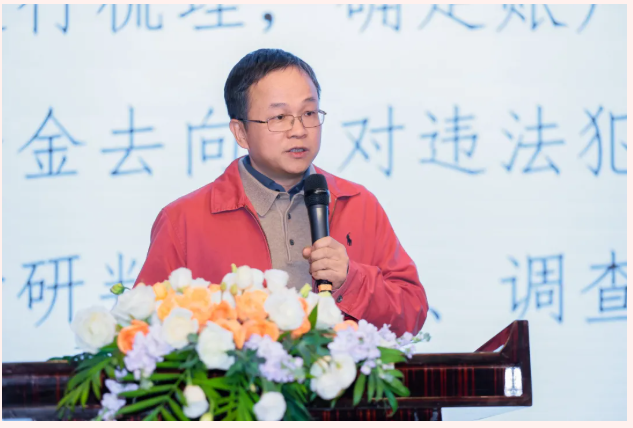
Secretary Yang Junli, on behalf of the organizers, extended a warm welcome to the guests. She pointed out that in the context of the rapid development of the financial market and the emergence of new forms of crime, it is of great significance to deepen the study of legal issues related to financial crimes in order to improve the rule of law safeguards, maintain financial security and promote the healthy development of the private economy.
(I) Speaker's Viewpoint Sharing
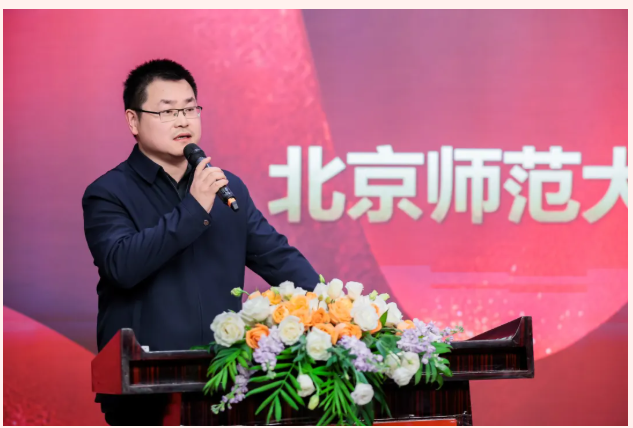
Professor Luo Xiang delivered a speech on the topic of “Path of Restriction in Criminal Regulation of Financial Crimes”, pointing out that natural and legal crimes co-exist in financial crimes, and that in order to prevent excessive intervention of penal power in financial activities, it is necessary to cautiously promote the application of restriction in financial crimes from the judicial level. On the one hand, the antecedent law should be respected, focusing on the distinction between violation and crime, avoiding disorder in the interface between the criminal law and the antecedent law, and maintaining the internal unity of the legal order; on the other hand, the abstract legal interests in the statutory offenses must be reduced to the collection of personal interests. Statutory offense is essentially a crime that indirectly violates individual rights, and only when the rule of thumb is able to actually violate individual legal interests can the right to punishment be utilized; if it is not possible to ultimately point to the infringement of individual rights, criminal regulation cannot be initiated only on the basis of abstract administrative interests.

Prof. Liu Pinxin delivered a speech on the topic of “New Evidence Response to Financial Crimes: Academic Observations on Golden Analysis as Evidence”. He pointed out that financial crimes are closely related to national security and people's happiness, and are characterized by a high degree of cross-fertilization of jurisprudence, finance and data science. As a technical path of analyzing and applying the massive data of the funds involved in the case as evidence, “Golden Analysis for Evidence” manifests itself as a form of electronic evidence in which the judicial authorities, according to the law, systematically sort out and correlate the account relationship of the fund transactions, the amount of funds, the transaction time and the counterparty's information to reveal the facts of the illegal and criminal behaviors. The “Golden Analysis for Evidence” analyzes the real capital flow as the object, which is more verifiable than the “Identification for Evidence”, but the algorithm model itself is not certainly reliable, and must be safeguarded by strict procedural norms and traceable verification mechanism; its data involves personal sensitive information, and its use must be regulated according to law. However, the algorithmic model itself is not necessarily reliable and must be guaranteed by strict procedural norms and traceable verification mechanisms.
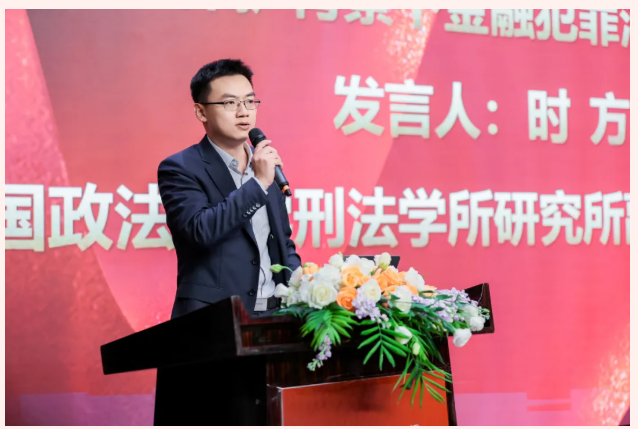
Prof. Shang Haowen delivered a speech on the topic of “Reasonable Application of Criminal Presumption in the Determination of Securities Crimes”, explaining in detail the application scenarios, boundaries and reasonableness judgment standards of criminal presumption in the determination of securities crimes from a cross-disciplinary perspective. Prof. Shang Haowen analyzed the objective phenomenon of criminal presumption in practice in terms of subject identification, objective behavior and subjective intent. Then, he introduced in-depth the possible risks associated with the basic principles of criminal procedure and the burden of proof, as well as the excessive application of criminal presumption may affect the vitality of the financial market and produce a chilling effect. Finally, from the theoretical point of view, it is proposed that “secondary presumption” should be used cautiously in criminal justice practice, allowing the parties to make counter-evidence, and ensuring the standard of evidence of the basic facts, so as to achieve a reasonable balance between adhering to the bottom line of the rule of law in criminal cases and penetrating the complex financial market.