

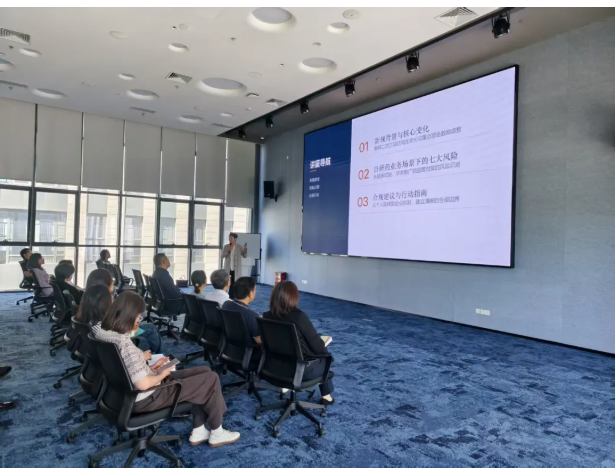
Recently, Wang Xintong, a senior partner at King&Capital Law Firm in Beijing, was invited to conduct a specialized training session on “Criminal Compliance and Risk Prevention” for a foreign-listed innovative pharmaceutical company. Drawing on the latest updates to the “Interpretation (II) on Several Issues Concerning the Application of Law in Handling Criminal Cases of Embezzlement and Bribery,” she provided a systematic explanation of criminal risks and prevention strategies for pharmaceutical companies in key areas such as clinical trials, academic promotion, business cooperation, procurement management, and regulatory communication.
In recent years, the pharmaceutical industry has remained under a governance environment characterized by stringent regulation and intense scrutiny. With the “Judicial Interpretation (II) on Embezzlement and Bribery” set to take effect on May 1, 2026, issues such as the transfer of benefits, hidden kickbacks, arrangements for anticipated benefits, and the conflation of corporate bribery with individual conduct in the pharmaceutical sector are being subjected to increasingly detailed scrutiny under criminal judicial review. For enterprises, compliance is no longer merely an internal management issue concerning “comprehensive systems,” but is increasingly becoming a foundational capability essential for business sustainability, team protection, and corporate resilience through economic cycles.
I. From “Industry Practice” to “Criminal Regulation”:
What Signals Do the New Regulations Send?
This training session first focused on the impact of the “Judicial Interpretation on Embezzlement and Bribery (II)” on the pharmaceutical industry. The lecture highlighted three key changes: First, the further alignment of criminal liability and sentencing standards between public-office and non-public-office occupational crimes. This means that when providing benefits to individuals such as doctors at private hospitals or procurement personnel at private enterprises, one can no longer rely on the status of “non-state employees” as a buffer against risk; Second, scrutiny of implicit vehicles for benefits—such as equity, profit-sharing rights, expected returns, and opportunity benefits—has been significantly strengthened, rendering the traditional notion that “anything other than cash does not constitute a bribe” obsolete; Third, the pharmaceutical sector has been explicitly designated as a key regulatory focus area, meaning that the threshold for prosecuting bribery offenses and judicial evaluations will be more stringent.
This shift has direct and practical implications for innovative pharmaceutical companies. Whether it involves clinical collaborations during the advancement of R&D pipelines, or academic promotion, expert advisory arrangements, external licensing and joint development, and communication regarding regulatory review before and after commercialization, there may be fundamental differences in criminal evaluation depending on payment channels, benefit structures, approval documentation, cumulative amounts, and associated parties.
II. Key High-Risk Scenarios of Greatest Concern to Pharmaceutical Companies
Based on the content of this training, pharmaceutical companies currently need to pay particular attention to the following high-frequency risk categories:
First, the issue of distinguishing between clinical trial funding and investigator compensation. Clinical funding and investigator fees inherently have a legitimate business basis; however, if payment standards and schedules are improperly linked to patient enrollment rates, data output, or subsequent prescribing behavior, they may shift from “genuine consideration” to “improper benefit transfers.”
Second, risks associated with lecture fees, consulting fees, and advisory fees in academic promotion. Academic exchanges in the pharmaceutical industry do not inherently pose a problem; however, if there are payments that significantly exceed standard rates, a lack of substantive conference content, incomplete attendance records or documentation of outcomes, or a correlation between expenses and prescribing or recommendation behavior, these activities are likely to become a focus of regulatory and judicial scrutiny.
Third, risks related to equity and revenue arrangements in external licensing and joint R&D. When innovative pharmaceutical companies design business development (BD) partnerships, joint development agreements, or milestone payment structures, linking equity, revenue rights, or project profit-sharing to the counterpart’s regulatory facilitation, patient enrollment coordination, ethics committee resources, or official influence—even if not actually realized—may fall under the review framework for “expected-benefit” improper benefit transfers.
Fourth, communication risks related to review, approval, and regulatory oversight. Normal communication through official channels is permitted by regulations and essential for business operations; however, any arrangement that influences the pace of review or regulatory judgments through third-party intermediaries, personal connections, covert sponsorship, or informal contacts will significantly amplify criminal and reputational risks.
Fifth, risks related to procurement, service outsourcing, and internal expense management. In supplier selection, CRO collaborations, conference services, clinical outsourcing, marketing activities, and expense reimbursement, practices such as kickbacks, consulting fees, holiday gift-giving, fraudulent invoicing, and the use of personal accounts as intermediaries may not only trigger commercial bribery risks but may also extend to issues such as embezzlement, misappropriation of funds, and corporate criminal liability.
III. For Pharmaceutical Companies, Risk Prevention and Control
The Key Is Not Merely “Having Policies,” but Ensuring “Policies Are Truly Implemented”
During the training, Attorney Wang Xintong particularly emphasized that what pharmaceutical companies need to be most vigilant about at present is not that “policies are not written well enough,” but rather that “policies and processes exist, yet in individual cases, it cannot be proven that the policies have actually played a real role.” From the perspective of criminal judicial practice, even the most comprehensive reimbursement, hospitality, and payment systems may still be deemed “paper compliance” if they lack pre-approval, anomaly detection, thorough verification, clear delineation of responsibilities, ledger management, whistleblower investigations, and audit reviews.
For pharmaceutical companies, truly effective risk prevention and control should be implemented through at least the following measures: First, establish a closed-loop process for clinical funds, academic expenses, business cooperation payments, and procurement payments, encompassing “contract—approval—invoicing—corporate payment—reconciliation.” Second, establish internal standards and cumulative early-warning mechanisms for speaking fees, consulting fees, and KOL collaborations. Third, implement higher-level approval and documentation requirements for regulatory communications, hospitality arrangements, and interactions with external intermediaries. fourth, making procurement recusal, dual-review, anonymous reporting, special audits, and monitoring of abnormal transactions routine mechanisms.
In other words, the goal of compliance is not to halt business operations, but to help the business move forward within a framework that is verifiable, traceable, and explainable. For innovative pharmaceutical companies, this protects not only the company but also management and frontline employees.
IV. Starting with a Single Training Session:
Observing the Real Changes in Pharmaceutical Companies’ Compliance Needs
During this training session, the client team engaged in in-depth discussions on issues such as “which expenses are most likely to cross the line under the new regulations,” “which cooperative arrangements are likely to be deemed as hidden transfers of benefits,” and “how to balance business advancement with criminal risks.” It is evident that following the implementation of the new judicial interpretation, pharmaceutical companies’ focus on criminal risks is shifting from merely “being aware of the risks” to “seeking to establish an actionable internal control system.” This also signifies that compliance efforts within the pharmaceutical sector are entering a more pragmatic phase: the emphasis is no longer solely on external regulation, but also on whether internal mechanisms can truly withstand scrutiny in specific cases.
Beijing King&Capital Law Firm has long focused on practical developments in the fields of pharmaceuticals, life sciences, corporate compliance, and criminal risk prevention. Moving forward, we will continue to provide support—including risk identification, system reviews, specialized training, and dispute resolution—tailored to key industries, scenarios, and positions, combining business acumen with a criminal law perspective. We are committed to helping enterprises establish a more robust balance between innovative development and compliance governance.