

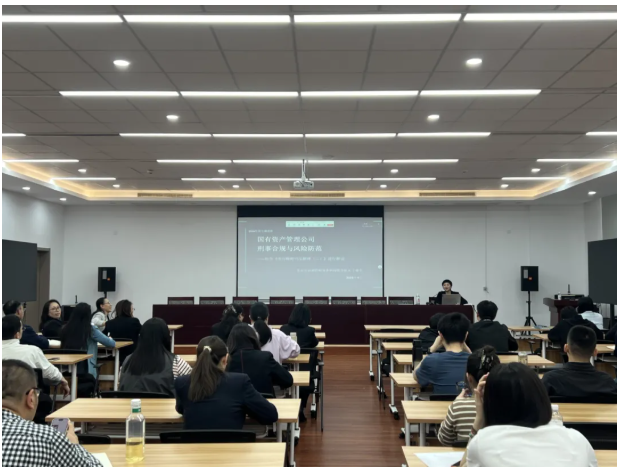
In April 2026, Wang Xintong, a senior partner at King&Capital Law Firm, was invited to deliver a special lecture on “Criminal Compliance and Risk Prevention” for Beijing Jianji Asset Management Co., Ltd. Using the latest amendments to the “Judicial Interpretation on Embezzlement and Bribery (II)” as a starting point, the training tailored to the operational characteristics of state-owned asset management companies. It systematically addressed the criminal risks most commonly encountered by enterprises and key personnel in daily operations, focusing on frontline scenarios such as leasing and investment promotion, engineering renovations, asset disposal, financial receipts and payments, and safety management.
Unlike typical compliance training, this course did not remain at the level of abstract legal provisions. Instead, it addressed risks in the context of actual business operations, defined boundaries through specific scenarios, and illustrated consequences using real-world cases. This approach precisely reflects the evolving needs of state-owned enterprises regarding criminal risk prevention: companies are increasingly concerned not merely with “whether they are aware of a particular criminal charge,” but rather with “which routine actions could be subject to criminal liability” and “which institutional measures need to be effectively implemented.”
I. Under the New Regulations,
The Risk Focus in the State-Owned Asset Management Industry Is Shifting
Following the implementation of the “Judicial Interpretation on Embezzlement and Bribery (II),” issues such as internal corporate corruption, off-the-books funds, slush funds, corporate bribery, corporate bribe-giving, embezzlement of corporate assets, and misappropriation of funds have been placed under a clearer and stricter criminal evaluation framework. For state-owned asset management companies, this shift warrants particular attention. This is because such enterprises do not manage a single product or project, but rather a comprehensive portfolio of operational resources—including real estate, land, equipment, industrial parks, leasing assets, disposal opportunities, project settlements, and joint development ventures—that can be allocated, approved, and traded.
Precisely for this reason, criminal risks rarely arise in extreme scenarios where “top leaders take large sums of money in a single transaction,” but are more often hidden in the minutiae of the business chain: Who can secure better leasing resources? Who can obtain longer rent-free periods? Who receives preferential treatment in construction certifications and settlements? Who can lock in low prices early during asset transfers? Who can collect company funds through personal accounts? And who can divert opportunities rightfully belonging to the company to entities controlled by themselves or their relatives and friends? Once these issues become tied to personal interests, they rapidly transform from internal management problems into criminal risks.
II. Based on the training content, the most frequent risks faced by state-owned asset management companies are concentrated in ten key scenarios
Based on the content of this training, the state-owned asset management sector in which Beijing Jianji Asset Management Co., Ltd. operates currently faces at least ten key risks that warrant particular attention: “favor fees” and “gratitude fees” in leasing, tenant recruitment, and lease renewals or rent reductions; Failure to record or delayed recording of receivables such as rent, deposits, security deposits, and maintenance funds; Kickbacks and “hunting” schemes in construction renovations, maintenance, procurement, and settlement; Using investment promotion resources, client resources, and park resources to establish personal companies or divert business opportunities; Decisions to sell assets at below-market prices and procedural lapses in asset valuation, pricing, and disposal; Disguising bribes as consulting fees, service fees, equity returns, relocation allowances, or bonuses; Withholding and embezzling project kickbacks, slush funds, and off-the-books funds; Falsifying construction materials, forging signatures, and fabricating approval chains; Failure to follow the “Three Major and One Important” decision-making process for major matters; and Approving projects with known defects in safety, environmental protection, and construction management.
While these scenarios may appear disparate, they share a common underlying pattern, ultimately revolving around four key elements: money, power, procedures, and people. Money encompasses rent, deposits, transfer payments, construction payments, and compensation; power includes the authority to attract investment, approve projects, set prices, conduct inspections, authorize payments, and dispose of assets; procedures involve valuation, public notice, procurement, collective decision-making, the “Three Major and One Important” decision-making process, risk control reviews, and documentation; People include key personnel, heads of subsidiaries and branches, frontline managers in industrial parks and projects, and their related parties. Whenever these four elements become unbalanced at any point, criminal risks inevitably arise.
III. Truly effective compliance is not merely “having systems in place,”
but rather “systems that can demonstrate they have actually functioned.”
A key point emphasized in this training is that, in criminal judicial practice, the mere existence of a system is only the starting point; whether the system is actually implemented is the key. For state-owned asset management companies, even the most comprehensive systems for receivables collection, asset disposal, project settlement, and related-party conflict avoidance will be deemed “paper compliance” if they lack supporting measures such as prior approval, dual verification, anomaly alerts, due diligence, record retention, whistleblower investigations, and special audits.
Based on this assessment, the training focused on the operational characteristics of the state-owned asset management industry and highlighted several practical risk prevention and control measures: establishing a closed-loop collection mechanism to ensure the entire chain—from contracts, invoicing, receipt of funds, book entry, to write-off—is verifiable; establishing rigid procedures for asset disposal to ensure that the “three essentials”—valuation, approval, and underlying documentation—are never omitted; establishing early warning mechanisms for project changes and settlements to trigger timely reviews for abnormal certifications, price discrepancies, and payments; Establishing a system for reporting and recusal regarding key positions to maintain dynamic oversight of business operations by employees and their relatives; enforcing a mechanism to eliminate “slush funds” and off-the-books funds, leaving no room for project departments, industrial parks, or branch offices to operate “side accounts”; simultaneously, through tiered training, a dual-person checks-and-balances system for key positions, and internal whistleblowing and audit mechanisms, shifting the line of defense against criminal risks from the legal department to the front lines of business operations.
IV. From a Single Training Session to an Entire Industry:
Risk prevention and control have become an integral part of state-owned enterprises’ operational capabilities
This training session at Beijing Construction Machinery Asset Management Co., Ltd. also reflects an increasingly clear trend in the state-owned asset management industry: enterprises’ approach to criminal risk prevention is shifting from “remedial measures after the fact” to “proactive prevention,” from “focus by the legal department” to “joint participation by business departments,” and from “concern about leadership incidents” to “protecting key personnel and the overall operational integrity of the organization.”
For state-owned asset management companies, risk prevention and control is not an additional burden that conflicts with business development. On the contrary, the more a company has concentrated resources, a long operational chain, numerous projects, and frequent external interactions, the more it needs to embed criminal compliance into its operational processes. Only by ensuring that key business operations run on a track that is verifiable, traceable, and auditable can a company, while revitalizing existing assets, advancing upgrades and renovations, and improving operational efficiency, effectively prevent risks from escalating to the stage of criminal investigation and accountability.
Beijing King&Capital Law Firm will continue to focus on key industries such as state-owned enterprises, platform companies, asset management, construction, pharmaceuticals, and finance, providing practical criminal compliance training, system reviews, risk identification, and dispute resolution services. We are committed to helping enterprises strike a more robust balance between high-quality development and high-standard compliance.