


On October 17, 2026, the “First Forum on Criminal Defense by Large Law Firms,” co-hosted by the Institute of Evidence Science at China University of Political Science and Law, the National “2011 Plan” Collaborative Innovation Center for Judicial Civilization, the Research Center for Financial Crime at China University of Political Science and Law, the Research Center for Innovation and Development in Criminal Defense at China University of Political Science and Law, King&Capital Law Firm, and Dacheng Law Firm, was held at the Library Complex on the Haidian Campus of China University of Political Science and Law. With the theme “Handling Cases at the Intersection of Civil and Criminal Law and Collaborative Defense,” the forum was attended by Chen Guoqing, Deputy Director of the Advisory Committee of the Supreme People’s Procuratorate, Member of the National Committee of the Chinese People’s Political Consultative Conference (CPPCC), and Second-Class Senior Prosecutor; Professor Liu Yanhong, Vice President of China University of Political Science and Law and Director of the Research Center for Innovation and Development in Criminal Defense; Wu Jianghong, Standing Council Member and Vice President of the All-China Lawyers Association; and Yuan Fang, President and Editor-in-Chief of China Rule of Law Magazine, who all attended the opening ceremony and delivered remarks. The forum featured keynote speeches and roundtable discussions, with in-depth deliberations on three specific topics. The keynote session, themed “Basic Rules for Handling Cases Involving the Intersection of Civil and Criminal Law,” was moderated by Guo Lixin, Director of the Institute of Procuratorial Theory at the Supreme People’s Procuratorate. Speakers included Jiang Bixin, Vice Chair of the Constitution and Law Committee of the 13th National People’s Congress (participating online), and Professor Peng Wenhua, Dean of the Institute of Evidence Science at China University of Political Science and Law. Professor Yin Bo, Director of the Institute of Judicial Studies at China University of Political Science and Law, delivered the concluding remarks at the closing ceremony. Senior partners Liu Lijie, Men Jinling, and Wang Xintong, along with full-time attorney Qian Hao from Beijing King&Capital Law Firm, were invited to participate in the forum and deliver speeches.
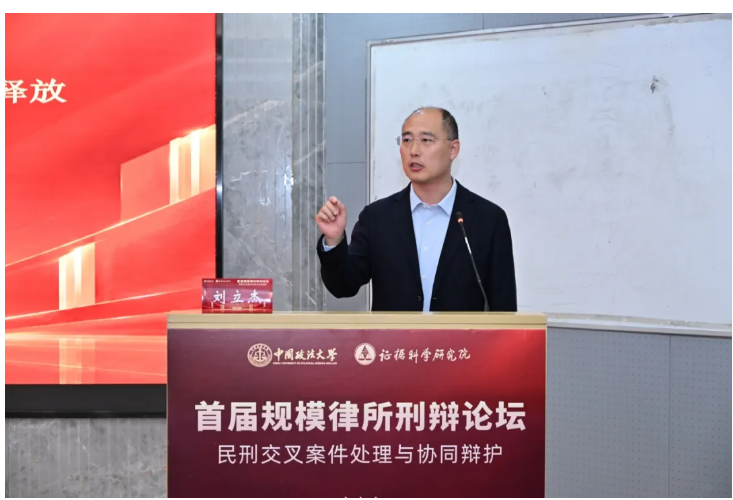
The roundtable forum session, themed “Unlocking the Potential of Collaborative Defense by Large Law Firms in Cases Involving the Intersection of Civil and Criminal Law,” featured a presentation by Attorney Liu Lijie—Senior Partner and Managing Partner of the Second Criminal Practice Department at Beijing King&Capital Law Firm—titled “Collaborative Dilemmas Amid the Intertwining of Corporate Financial Crimes and Bankruptcy Proceedings: Pathways to Achieving Cross-Firm Civil-Criminal Collaborative Defense as Illustrated by a Case Involving a Certain Petrochemical Group.” Drawing on his experience handling a bill fraud case involving a certain petrochemical group—in which the court ruled that the fraud amount exceeded 17 billion yuan, 167 affiliated enterprises underwent substantive consolidation and reorganization, the criminal defense was handled by the King&Capital team, and the bankruptcy administrator was appointed by another law firm—Attorney Liu Lijie shared practical insights on cross-firm civil-criminal coordination amid the intertwining of corporate financial crimes and bankruptcy proceedings.
Referring to Article 11 of the “Provisions of the Supreme People’s Court on Several Issues Concerning the Trial of Civil Disputes Involving Criminal Offenses,” which took effect on September 22, 2026, Attorney Liu Lijie addressed three practical issues: “sequence, funds, and coordination.” First, the debate over sequence: criminal and bankruptcy proceedings may proceed in parallel, but the identification of criminal assets must precede bankruptcy distribution. Illicit gains have never been considered part of the debtor’s assets, and assets belonging to criminal victims must be identified and segregated before the completion of bankruptcy distribution and the execution of the reorganization plan; Second, regarding the issue of funds: once proceeds of crime have become intermingled with funds from legitimate business operations, the key to recovery lies in whether the illicit funds can be “identified.” The primary battleground is judicial auditing; at the same time, one must be vigilant against situations where bona fide mortgages on assets purchased with illicit funds take priority over restitution, as well as the issue of victims receiving double compensation; Third, the coordination debate: the same law firm cannot simultaneously provide criminal defense for an enterprise involved in criminal proceedings and serve as its bankruptcy administrator. Different legal teams should, while maintaining clear boundaries to avoid conflicts of interest, establish information channels through asset identification and reconciliation, consensus on the nature of claims, and communication regarding procedural milestones, and engage in necessary coordination based on shared interests.

The first seminar session, themed “Key Techniques for Effective Defense in Civil-Criminal Intersection Cases,” featured a keynote speech by Attorney Men Jinling, a senior partner at Beijing King&Capital Law Firm, titled “The Basic Logic of Defense in Civil-Criminal Intersection Cases.” Starting from the provisions of the *Provisions of the Supreme People’s Court on Several Issues Concerning the Trial of Civil Disputes Involving Criminal Offenses*, Attorney Men Jinling pointed out that the determination of “the same facts” is the fundamental proposition of criminal procedural law research—namely, the “assessment of factual identity”—which determines the ultimate outcome of resolving civil-criminal overlap issues. She argued that the normative concept of “basic facts” lacks sufficient scope; in terms of both connotation and boundaries, the concept of “essential facts” carries greater normative weight. Using the crime of contract fraud as an example, she pointed out that the validity of the guarantee contract in civil proceedings is the key to determining whether the principal contract constitutes the crime of fraud (or contract fraud). The core elements of the crime of fraud are “fabricating facts and concealing the truth—leading the victim to make a mistaken expression of intent—the victim disposing of property based on that mistaken expression of intent—and property loss resulting from such disposition.” On the one hand, the validity of a full guarantee objectively cuts off the final link in the chain of elements required for the crime of fraud, ensuring that the defendant will not suffer any property loss; on the other hand, it may indirectly prove that the defendant never had the subjective intent to unlawfully appropriate the victim’s property from the outset.
Drawing on two cases she has handled, Attorney Men Jinling pointed out that in judicial practice, the “criminal first, civil later” approach results in the following: it is generally very difficult to secure an acquittal once a criminal case has entered the litigation process; by the time the case reaches the civil litigation stage, civil judges generally lack the courage to independently rule that the guarantee contract is valid. This is because, according to the new “Provisions,” once a civil judgment declares the guarantee contract valid, it would undermine the res judicata effect of the criminal judgment, thereby creating grounds for a retrial of the criminal case in accordance with the law. Consequently, in civil proceedings following criminal trials for such cases, creditors’ claims are generally not upheld. She noted that the issue of civil-criminal overlap is a complex proposition where theory and practice intertwine, requiring joint research by scholars, judicial authorities, and attorneys—a topic that remains ever-evolving.

Attorney Wang Xintong, Senior Partner at Beijing King&Capital Law Firm and Deputy Director of the Foreign-Related Affairs Committee of the Beijing Lawyers Association, spoke during Session Two of the symposium, titled “Effective Defense Strategies for Substantive Determinations in Civil-Criminal Intersection Cases.” Her presentation was titled “Mortgage Priority, Criminal Restitution, and Conflict of Interests: Substantive Determinations and Defense Strategies in Banking-Related Civil-Criminal Intersection Cases.” Drawing on the specific application scenario of confirmed warehouse financing, Ms. Wang Xintong shared a civil-criminal crossover case she personally handled. Using this specific case as an example, she systematically analyzed how to determine whether the facts are the same, whether proceedings should be suspended, how to maximize recovery of victims’ losses in such cases, whether it would lead to double compensation, and the calculation of interest during the suspension of proceedings in civil cases involving criminal charges. She noted that the new regulations provide attorneys with more insights for handling civil-criminal overlap cases, while also presenting greater challenges.

During Session 3 of the symposium, titled “Defense and Response to Procedural Rules in Civil-Criminal Intersection Cases,” Attorney Qian Hao of Beijing King&Capital Law Firm delivered a presentation entitled “Defense Strategies Regarding the Mutual Recognition of Evidence in Civil-Criminal Intersection Cases.” Attorney Qian Hao argued that the new regulations’ rules on the mutual recognition of evidence enhance the certainty in determining the admissibility of illegally obtained evidence in civil-criminal intersection cases, while simultaneously creating uncertainty regarding the applicability of facts and evidence from criminal cases in civil litigation; To address the mutual recognition rules, it is necessary to “prioritize the defense” while also “looking ahead,” extending the scope of the defense to potential future civil litigation. This requires focusing on three key areas of defense: the exclusion of illegally obtained evidence, case materials involving evidence types not specified by law, and evidence materials related to sentencing without a conviction.
This forum focused closely on the *Provisions of the Supreme People’s Court on Several Issues Concerning the Trial of Civil Disputes Involving Criminal Offenses*, providing rich theoretical guidance and practical experience for the handling of civil-criminal crossover cases and coordinated defense strategies. The forum concluded successfully.